
This article’s audio content is presented by the Air & Space Forces Association, commemorating and assisting our Airmen, Guardians, and their relatives. Discover further details at afa.org
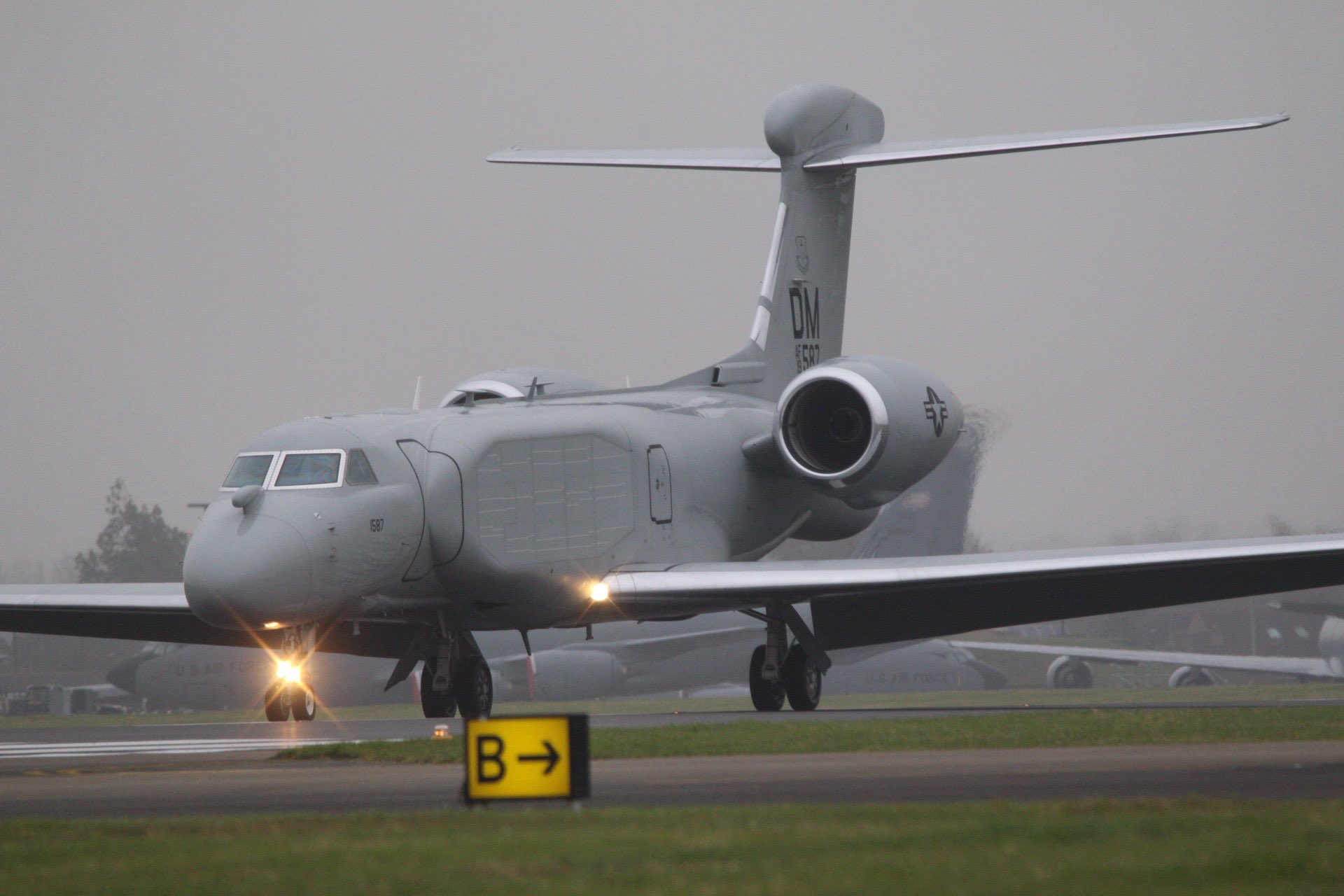
Two of the U.S. Air Force’s EA-37B Compass Calls were observed at RAF Mildenhall in the United Kingdom, eliciting conjectures that these novel electronic assault aircraft are destined for missions opposing Iran.
This week, digital flight monitoring systems recorded two EA-37Bs—extensively altered Gulfstream G550 planes equipped with sophisticated electronic combat gear—taking off from Davis-Monthan Air Force Base in Arizona on March 30, subsequently touching down at Mildenhall. They operated under the designations AXIS 41 and AXIS 43.
Images of an EA-37 at Mildenhall appeared on social platforms on March 31. The aircraft depicted displayed insignia on its rear stabilizer suggesting its allocation to Davis-Monthan and revealed substantial body alterations designed to house electronic combat apparatus, characteristic of an EA-37.
The Air Force currently possesses five EA-37s, from a projected contingent of ten. These aircraft are slated to execute various electronic combat assignments, such as disrupting hostile communications, radar, navigation, and diverse signals. They will also neutralize adversary air defenses by impeding the data-sharing capabilities of weapon platforms and command-and-control infrastructures.
According to Air Combat Command, the EA-37 is capable of traveling almost 770 miles an hour at altitudes reaching 45,000 feet, boasting an operational reach of 4,400 nautical miles.
The EA-37 is supplanting the Air Force’s antiquated and diminishing collection of EC-130H Compass Calls. These older aircraft originated from C-130 airframes dating back to the Vietnam War period and have grown progressively challenging to sustain. Over the past ten years, the Air Force’s EC-130 fleet has shrunk from fifteen to just four units, despite the Compass Call’s crucial contributions in campaigns such as the conflict against the Islamic State and the pullout from Afghanistan.
For the past month, EC-130s have been conducting electronic combat sorties targeting Iran, as part of Operation Epic Fury.
Citing reasons of operational security, U.S. Central Command refrained from commenting on the deployments of the EA-37B.
The 355th Wing, stationed at Davis-Monthan, affirmed to Air & Space Forces Magazine its possession of three EA-37B aircraft but chose not to elaborate on their prospective assignments. Since May 2025, Airmen have been executing practice flights at the base with the novel Compass Call, an aircraft that has yet to undertake any active operational missions. The remaining two EA-37s belonging to the Air Force are designated for testing purposes.
Heather Penney, a former F-16 aviator and the director of studies and research at the Mitchell Institute for Aerospace Studies, remarked that the Air Force possesses a history of deploying emerging aircraft into active service during urgent requirements. She pointed to the 1991 deployment of two prototype E-8 Joint Surveillance Target Attack Radar System planes for participation in Desert Storm, and the utilization of an initial iteration of the MQ-1 Predator in 1995, as instances where capabilities were put into action ahead of schedule and demonstrated commendable performance.
Penney stated that those initial deployments “proved not merely beneficial from an operational standpoint, but also fundamentally reshaped and transformed our approach to warfare.”
Should the Air Force commit the EA-37 to active service, Penney suggested, it would mark a significant occasion and illustrate its effective utility within an operational setting.
“A greater quantity of these” aircraft is necessary, Penney affirmed. “Commanding the electromagnetic spectrum holds such vital importance for contemporary and forthcoming conflicts, yet I believe its value has been underestimated due to a lack of investment in these types of proficiencies. A common belief exists that upon crossing a threat map’s red boundary, one instantly vanishes, but that’s simply not how such situations unfold.”
Furthermore, Penney asserted, transporting two training EA-37s to the U.K. would lack rationale unless their purpose was operational deployment.
“The instructional units will possess equivalent capabilities to those actively deployed,” Penney explained. “Deploying such assets would be entirely logical if an immediate requirement arose. … Merely conducting training exercises, particularly in times of conflict, would not secure the necessary temporary duty funding for a trip to Mildenhall for leisure. That journey’s intent would be quite different.”
Chris Gordon, the Pentagon Editor, provided contributions to this account.
This article’s audio content is presented by the Air & Space Forces Association, which commemorates and assists our Airmen, Guardians, and their relatives. Discover further details at afa.org