
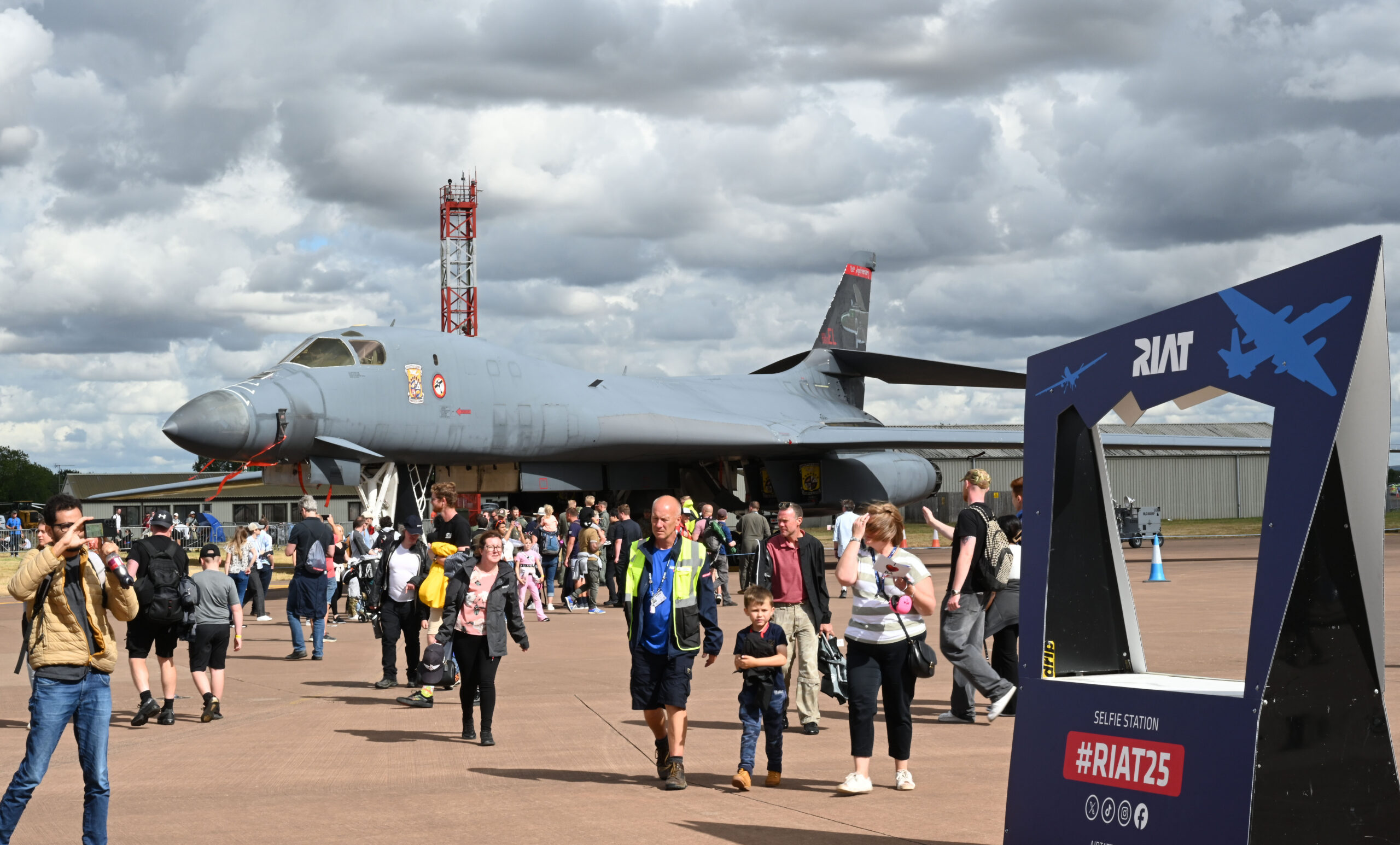
The Royal International Air Tattoo (RIAT), renowned as one of the world’s largest annual military air shows, will permanently relocate from its long-standing venue at RAF Fairford to a different military installation within the United Kingdom. Organizers announced the decision on November 4, marking a significant change for the prestigious aviation event.
The move concludes RIAT’s four-decade presence at RAF Fairford, a critical strategic base frequently utilized by the U.S. Air Force. This relocation follows the cancellation of the 2026 edition of the air show, which was originally scheduled for July. That cancellation occurred months in advance, directly attributed to the deployment of U.S. bombers to Fairford for operational purposes related to tensions with Iran. Further compounding security concerns, a suspected Iranian plot against the base prompted the swift evacuation of these U.S. bombers just a month prior to the relocation announcement.
RIAT’s new permanent home will be MOD Boscombe Down, a military airfield situated approximately 45 miles south of Fairford in the county of Wiltshire, southwestern England. The inaugural RIAT event at this new location is scheduled to take place from July 16-18, 2027.
In a statement released on November 4, Royal Air Force Charitable Trust Enterprises (RAFCTE), the organization responsible for managing the air show, affirmed that the transition to Boscombe Down “provides a strong platform for the continued growth, development, and long-term success of the world’s largest military air show.” The statement further elaborated, “MOD Boscombe Down provides an outstanding platform for RIAT’s future ambitions, offering the space, capability, and flexibility required to support the event’s continued evolution.” This indicates a strategic decision aimed at securing the event’s future scalability and operational resilience.
MOD Boscombe Down holds a distinct role within the UK defense infrastructure as the nation’s primary facility for military aircraft testing and evaluation. A key distinction from RAF Fairford is the absence of a permanent operational U.S. Air Force presence at Boscombe Down, allowing for a clearer operational landscape for the air show free from the immediate demands of frontline U.S. strategic deployments.
Over the past decade, RIAT has undergone a notable transformation, evolving beyond its traditional public air show format to become an increasingly vital platform for the global defense industry and governmental engagements. It has frequently served as a venue for high-level bilateral and multilateral meetings, as well as significant defense-related announcements. This expanded role has seen RIAT increasingly rival the stature of other major international aerospace events, such as the biennial Farnborough Airshow in the U.K. and the Paris Air Show in France, as a forum for defense diplomacy and business.
RAF Fairford has historically played a crucial role for the United States, serving as a forward operating location for bombers and other specialized aircraft deployed in Europe. Its strategic positioning has made it an indispensable asset for projecting U.S. air power across various theaters of operation. This long-standing relationship underscores the complex balancing act between hosting major public events and maintaining critical military readiness.
During the peak of ‘Operation Epic Fury’ this spring, for instance, RAF Fairford accommodated a substantial contingent of approximately two dozen B-1B Lancers and B-52H Stratofortresses. This forward-deployed concentration of heavy bombers facilitated a high volume of U.S. airstrikes against targets in Iran. The British government had explicitly granted permission for the U.S. to utilize the base for what it officially categorized as defensive strikes against Iran, emphasizing the collaborative nature of the defense efforts.
However, security concerns escalated significantly when the remaining 12 B-1Bs at Fairford abruptly departed the base on October 4. This rapid withdrawal occurred in the wake of intelligence shared by U.S. and U.K. officials, indicating a credible and likely Iranian-backed plot aimed at targeting the base. This incident highlighted the inherent risks associated with hosting a major public event, such as RIAT, at a site simultaneously serving as a critical operational hub for high-stakes military deployments.
U.K. government officials, including senior ministers and the head of the Royal Air Force (RAF), publicly expressed their support for the new arrangement. Their statements, released concurrently with the announcement, underscored the strategic importance of ensuring RIAT’s future.
Luke Pollard, the Minister for Defense Readiness and Industry, commented on the relocation, stating, “I’m delighted it has a new home at MOD Boscombe Down, a site with a proud history in aviation and innovation.” His remarks reflect an appreciation for the historical significance of the new venue.
Air Chief Marshal Sir Harv Smyth, Chief of the Air Staff, further affirmed the RAF’s commitment, stating in a separate announcement that the Royal Air Force would support “future editions of RIAT for many years to come.” He added, “This move secures the future of the airshow for decades into the future and enables the Royal Air Force Charitable Trust’s important work to continue inspiring future generations.” This emphasizes the long-term vision behind the relocation and its alignment with the RAF’s broader objectives of inspiring youth in aviation.
The RIAT traditionally benefits from a substantial U.S. military presence, a key attraction for attendees and industry professionals alike. The show’s organizers, who will maintain their operational base at Fairford, extended their gratitude to the U.S. Air Force for its extensive support during the event’s tenure at RAF Fairford.
A spokesperson for U.S. Air Forces in Europe-Air Forces Africa (USAFE-AFA), the command responsible for U.S. Air Force operations in the U.K. and across Europe and Africa, acknowledged the decision. The spokesperson stated that the command is “aware of and respects” the choice to move the air show from Fairford. They further affirmed, “We continue to work closely with our U.K. allies and look forward to remaining a key partner at RIAT,” indicating a continued commitment to participation despite the change in venue.
Why This Matters
The permanent relocation of the Royal International Air Tattoo (RIAT) from RAF Fairford to MOD Boscombe Down represents a significant strategic adjustment with multifaceted implications for global defense, aviation, and Anglo-American relations. At its core, this move prioritizes security and operational continuity for both the air show and critical military operations.
Firstly, for the RIAT itself, the shift aims to guarantee the event’s long-term viability and growth. By moving to MOD Boscombe Down, a site dedicated to military aircraft testing and evaluation without a permanent operational U.S. Air Force combat presence, the air show can avoid potential conflicts arising from high-stakes geopolitical developments. The cancellation of the 2026 show due to U.S. bomber deployments and a suspected threat highlighted the inherent tension between hosting a massive public event and maintaining a base for sensitive military operations. This move effectively de-risks the air show, providing a stable and predictable environment for future editions, which is crucial for planning, international participation, and commercial sponsorships.
Secondly, the relocation has implications for the strategic use of RAF Fairford. Freeing Fairford from the demands of hosting a large-scale public event allows it to operate with fewer constraints as a critical forward operating base for U.S. strategic assets, particularly bombers. In an increasingly complex global security landscape, the unhindered use of such facilities for rapid deployment and operational readiness becomes paramount for both the United States and its allies, including the United Kingdom. This decision subtly reinforces the UK’s commitment as a steadfast partner in global security operations, providing essential logistical support without the added complexity of managing a concurrent public spectacle.
Thirdly, the move underscores RIAT’s evolving role. No longer just a public spectacle, it has become a crucial forum for defense diplomacy, industrial showcasing, and high-level governmental discussions. Securing a dedicated and suitable venue like Boscombe Down, with its ample space and testing capabilities, ensures that RIAT can continue to fulfill and expand this vital role. It strengthens the UK’s position as a hub for defense innovation and international cooperation, providing a consistent platform for showcasing cutting-edge aerospace technology and fostering strategic alliances.
Economically, the shift will bring changes to the local economies surrounding both Fairford and Boscombe Down. While the Fairford area will lose the significant annual influx of visitors and associated revenue, Boscombe Down and the wider Wiltshire region stand to gain substantially from the tourism, hospitality, and logistical demands generated by one of the world’s premier aviation events. This redistribution of economic benefit will require local adjustments and new opportunities.
Finally, for the public and the aviation community, the relocation ensures the continuation of a beloved and inspiring event. RIAT plays a crucial role in promoting an interest in aviation, science, and engineering among future generations. By securing a long-term home, the Royal Air Force Charitable Trust can continue its mission to inspire, educate, and support the aerospace sector, ensuring that the spectacle and educational value of the air show persist for decades to come, albeit at a new, strategically chosen location.