
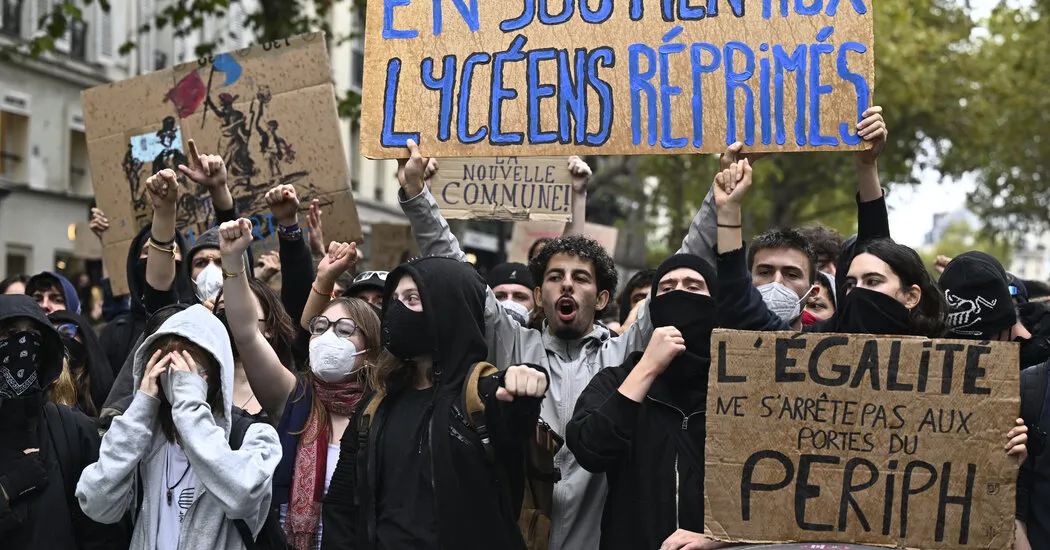
Across Europe, a growing demographic imbalance is fueling a contentious debate over public spending, pitting the financial needs of an aging population against the demands of younger generations for improved social services and future opportunities. This tension is particularly visible in France, where widespread student protests highlight concerns over underfunded public services, including education. Sébastien Ducros, a 36-year-old French data analyst and vocal supporter of these student demonstrations, points to the substantial allocation of national funds to retirees as a primary cause for the neglect of other critical sectors, such as dilapidated schools.
“A huge portion of the money is going toward retirees, while many other things are being neglected,” Mr. Ducros stated, articulating a viewpoint increasingly shared among younger Europeans. He further suggested a controversial solution, saying, “I honestly think — even if it feels strange to say — that people like my parents are in a position where they should and could” surrender some of their pension payments, especially as they approach retirement themselves. This perspective underscores a profound generational rift regarding financial responsibility and entitlement within the welfare state.
However, this proposal faces strong opposition from the very demographic it targets. Laurent Grinwald, 72, who recently retired after decades as a postal worker, firmly rejects any notion of reducing his pension, particularly if such cuts are intended to fund other state-backed services. His resistance is amplified by the current economic climate, where “rents and the cost of living have shot up.” Mr. Grinwald voiced the common sentiment among retirees who feel they have earned their benefits: “We’ve been working all this time,” he said, “and now, suddenly, the stance is, ‘Well, no, we’re going to start taking a bit more?’” This direct conflict between Mr. Ducros and Mr. Grinwald encapsulates the broader societal challenge confronting many European nations.
This fundamental disagreement extends far beyond individual anecdotes, embodying a critical question for the entire European continent. It lies at the heart of mass antigovernment demonstrations, such as those planned for Saturday in France, and mirrors recent waves of protests driven by frustrated young people in countries including Belgium, Germany, Greece, Italy, and Portugal. As Europeans experience increased longevity, a pressing question emerges: should the immediate and long-term needs of younger generations be overshadowed by the escalating costs of their parents’ and grandparents’ pensions, which consistently represent the largest expenditures in Europe’s national budgets? The growing pressure on public finances, driven by demographic shifts, has ignited what Jorge Galindo, director of EsadeEcPol, an independent think tank in Spain, describes as a clear “generational clash.” Spain, notably, operates one of Europe’s most generous pension systems, making the debate particularly acute there.
In many European countries, the substantial and growing expenditure dedicated to an expanding population of older people is increasingly perceived as coming at the expense of crucial services and subsidies for young workers. These younger individuals contribute significantly to the tax base that ultimately funds the very pension systems under scrutiny. This core budgetary challenge is further compounded by a confluence of other economic pressures. Spiraling defense costs, partly spurred by American pressure for NATO members to increase military spending and directly influenced by ongoing Russian aggression, have placed additional strain on government treasuries, making it exceedingly difficult for nations to balance their books. Furthermore, a period of high interest rates has significantly driven up the costs associated with servicing accumulated state debt, siphoning away even more funds that could otherwise be allocated to other public services or investments.
These combined financial burdens, alongside a sharp rise in rents and house prices across the continent, have exacerbated a profound sense of generational injustice among young people. Many feel that the economic opportunities and quality of life enjoyed by previous generations are becoming increasingly out of reach. A recent European Union survey starkly illustrated this sentiment: only 38 percent of individuals aged 15 to 30 believe that policymakers adequately consider the long-term consequences of their decisions. Even more concerning, only a third of young people surveyed expressed belief that today’s youth have the same chance at success as those 30 years ago. This data paints a picture of growing pessimism and disaffection among a vital segment of the population.
The enormous financial burden imposed by pension systems is a well-recognized issue among European governments. Pensions consume approximately 40 percent of all spending on social protections within the European Union, making them an unavoidable focal point for fiscal policy. Over the past decade, numerous countries have attempted to recalibrate their pension formulas, primarily seeking to cut costs while carefully navigating the potential for significant political backlash. To many older Europeans, pensions are not merely a financial benefit but are considered the sacrosanct foundation of the European welfare system, deeply ingrained in the social contract. This perception makes reform exceptionally challenging.
Often, governments have opted for gradual adjustments rather than direct cuts to individual pension payments. The most common strategy has been to incrementally raise the age at which citizens qualify for these payments — for example, from 65 to 67, or even older. Denmark, for instance, has ambitious plans to raise its retirement age to 70 by 2040, reflecting a long-term commitment to addressing the demographic shift. These measures, while less immediate in their impact on current retirees, aim to spread the cost over a longer working life and reduce the overall period of pension disbursement.
Even this cautious approach, however, has proven to carry significant political costs. A prime example is France, where President Emmanuel Macron’s attempt in 2023 to raise the country’s retirement age from 62 to 64 ignited furious protests across the nation. The scale and intensity of public opposition ultimately led his government to freeze the controversial measure. While this decision defused immediate social unrest, it left France with a different, persistent problem: how to finance its generous social protection system in the long term, especially given its significant national debt.
With one of the highest debt levels in Europe, France now faces severe fiscal constraints, particularly in its ability to allocate more funds to education, a key demand of the protesting youth. This inability directly fuels the anger and unrest currently observed. Other European countries have explored alternative strategies to mitigate this generational competition for resources. Britain, for example, has announced plans to save billions by slowing the rate at which its state pension payments increase over time, a subtle but impactful adjustment designed to temper future expenditures without outright cuts. Spain, conversely, has taken a different path, choosing to enlarge its pool of taxpaying workers to bolster its pension system. The country initially raised its pension age to 67 in most cases in 2011 to address long-term sustainability.
More recently, Spain’s current left-wing government enlarged the pension bill further by ensuring that pension payments would grow in line with inflation. This policy, designed to protect recipients from rising prices, has undeniably placed an enormous strain on the national budget. To offset these mounting costs and rejuvenate its workforce, Spain has bucked a broader European trend of tighter immigration controls. Since 2018, the country has opened its doors to a significant influx of immigrant labor, with more than 1.7 million foreigners entering the Spanish workforce. This strategy aims to increase tax revenue and thus boost contributions to the pension fund, offering a short to medium-term solution to the demographic challenge.
While this increased influx of workers has indeed boosted tax revenue, providing a much-needed injection of funds for pension contributions, experts caution that this is not a permanent solution. Eventually, these new workers will also age and retire, adding to the very pension burden they were brought in to alleviate. The long-term demographic challenges persist. The Organization for Economic Cooperation and Development (OECD) projects that Spain will spend an alarming 17.3 percent of its gross domestic product (GDP) on pensions by 2050. This figure represents an increase of roughly four percentage points from current levels, translating into the equivalent of an additional $67 billion every year in today’s terms dedicated solely to pensions. To put this in perspective, Spain currently spends approximately $79 billion on its entire education system, highlighting the immense fiscal trade-offs involved.
Despite the evident competition for resources and the underlying generational tensions, it is noteworthy that many of the young people participating in protests across Europe are reluctant to directly blame their elders. Alice Cossa, 22, an Italian student who recently protested in Venice, exemplified this sentiment, stating, “Honestly, we’ve never talked about it.” This suggests a degree of empathy or a reluctance to personalize the systemic issues, instead focusing on broader governmental or economic failures.
The proposed solutions to Europe’s fiscal dilemma often diverge along political lines. Left-wing demonstrators frequently argue that pensions and other social benefits can be adequately funded through increased taxation on wealthy individuals and large corporations, advocating for a redistribution of existing wealth. Conversely, their right-wing counterparts often suggest cutting immigration, positing that immigrants disproportionately consume welfare benefits, thereby straining public resources. However, a middle ground, or at least a more nuanced perspective, is also emerging. Some individuals contend that at least certain pension payments, particularly those received by affluent older people, should be subject to reassessment. This view challenges the universality of current pension structures, suggesting that those with substantial private means might contribute to alleviating the burden on public funds.
Alejandro Rojano, 28, a bank employee living in a basement apartment in Madrid with a roommate, articulated this frustration. He lamented that “We young people have less and less and less,” noting that his nonagenarian grandparents received “way” more than his monthly salary, which is less than 2,000 euros (approximately $2,200). Rojano expressed a common grievance: the perception that no political party would dare to cut the benefits of retirees, a powerful and dependable voting bloc. He concluded, regarding the disparity in pension payouts, “It makes no sense, you know?” This highlights the political paralysis often encountered when attempting pension reform.
Jorge Galindo, the director of the EsadeEcPol think tank, suggests that given the entrenched political interests in protecting retirees’ benefits, young people might need to organize themselves into an essentially single-issue voting bloc to gain leverage. In Europe’s typically coalition-based parliamentary systems, a small party focused solely on youth issues could potentially become a pivotal player, forcing its concerns to be taken seriously with even a handful of parliamentary seats. However, this strategy faces a significant hurdle: young people represent a shrinking demographic across Europe, while the number of older people, who are generally more likely to exercise political power through union memberships and active participation in political parties, is rapidly expanding. This demographic trend further complicates the political landscape for youth-driven reform efforts.
Further complicating the reform debate is the reluctance among many young and middle-aged Europeans to advocate for cuts to a benefit they themselves anticipate enjoying in the future. This self-interest creates a paradox, as those who might benefit from immediate reforms are also invested in the long-term preservation of the system. Daniel Ramo, 46, a teacher in Madrid, exemplified this during a recent teachers’ strike protesting dismal salaries and packed classrooms. He admitted looking forward to receiving his generous Spanish pension after making €2,100 a month after taxes. Moreover, he highlighted a direct intergenerational transfer of wealth: the benefits of his parents’ pensions often “trickle down” to help him through tough financial times. “I’m on strike knowing I’ll have to borrow money from my father,” Mr. Ramo stated, revealing that his father’s pension made him the top earner in the family.
From the perspective of retirees, these “hard-earned benefits” are not just personal entitlements but also play a crucial role in supporting families and, by extension, the fabric of European society. Encarna Matilla, 72, walking in Madrid’s sunny Retiro Park, proudly shared that “We personally make more than our children do.” She elaborated that her 88-year-old husband, who worked from the age of 14 to 70, receives a pension payment of €2,700—60 percent higher than Spain’s median salary. This substantial income allows them to help support their great-grandchildren, illustrating how pensions often serve as an essential “safety net” extending across generations, particularly in times of economic hardship for younger family members. This complex interplay of individual entitlement, societal support, and fiscal strain underscores the profound challenge of balancing competing needs in an aging Europe.
Ségolène Le Stradic contributed reporting from Paris, Josephine de La Bruyère from Rome and Carlos Barragán from Madrid.
Why This Matters
The generational clash over public resources, particularly pensions, represents one of the most critical and complex challenges facing Europe today. Its implications extend far beyond national budgets, touching upon social cohesion, economic stability, and the very future of the European welfare state model. As populations age and birth rates decline across the continent, the economic burden of supporting a growing retiree demographic falls increasingly on a shrinking workforce. This demographic shift strains public finances, diverting funds from essential investments in education, infrastructure, and innovation that are crucial for future economic growth and competitiveness. Failure to address this imbalance risks exacerbating intergenerational inequality, fueling social unrest, and undermining public trust in political institutions. The difficulty governments face in implementing meaningful pension reforms, often due to significant political backlash from powerful older voting blocs, highlights a deep-seated institutional inertia and the challenge of making long-term decisions in a democratic system. This issue is not unique to Europe; it serves as a stark warning and a case study for other developed nations grappling with similar demographic shifts and the sustainability of their social security systems. How Europe navigates this challenge will determine the stability and prosperity of its societies for decades to come, influencing everything from economic output to social solidarity and the perceived fairness of its social contract.