
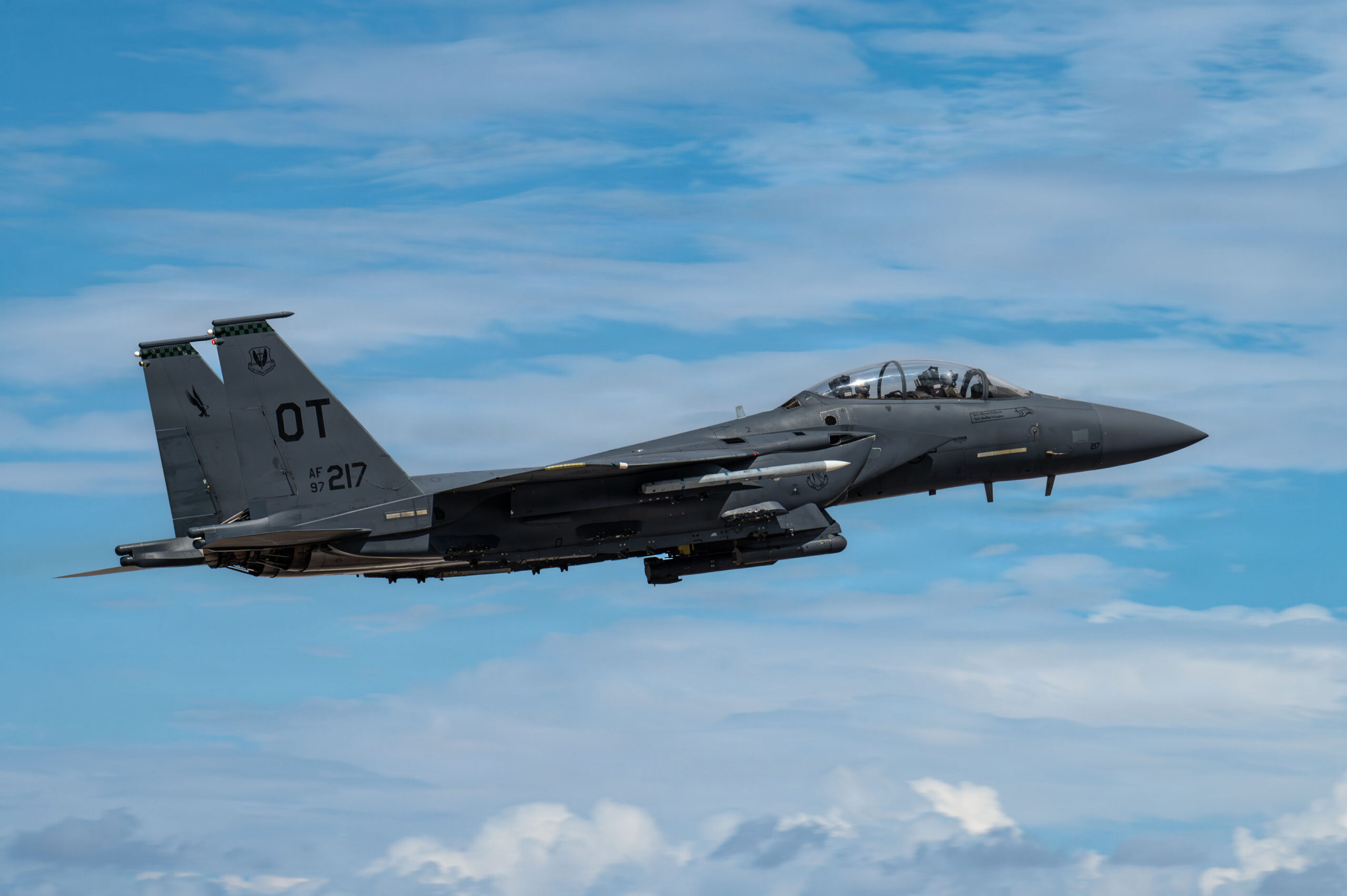
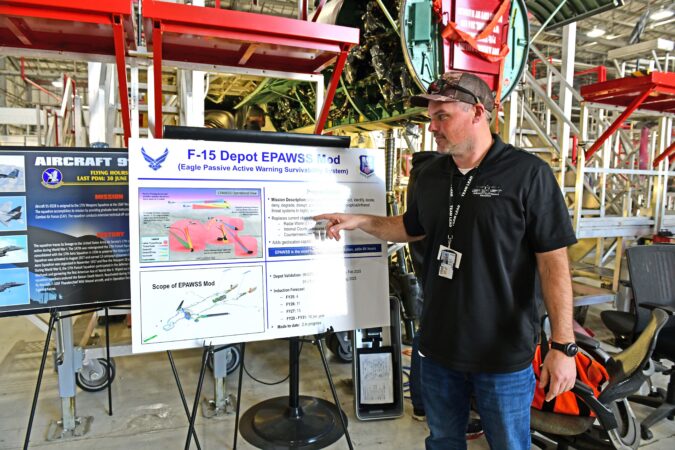
The United States Air Force (USAF) is significantly accelerating the upgrade of its F-15E Strike Eagle fighter fleet with advanced electronic warfare capabilities. The Air Force Life Cycle Management Center (AFLCMC) has inaugurated a new “speedline” at the Warner Robins Air Logistics Complex in Georgia, designed to expedite the installation of the Eagle Passive Active Warning Survivability System (EPAWSS) on these fourth-generation aircraft.
This dedicated installation line marks a strategic shift from the previous plan, which would have integrated EPAWSS only during the F-15E’s routine depot maintenance cycle, occurring every five to seven years. The establishment of an independent line is projected to substantially hasten the fielding of these next-generation Electronic Warfare (EW) capabilities across the F-15E fleet, according to a May 26 press release from the AFLCMC.
The first F-15E is scheduled to enter this new “speedline” in June. The Air Force had already fielded its initial two EPAWSS-equipped F-15Es in January 2025 at RAF Lakenheath, England, assigning them to the 48th Fighter Wing’s 494th and 492nd Fighter Squadrons for training purposes. The service’s current plans call for the integration of EPAWSS into a total of 99 F-15E aircraft, extending the operational relevance of a platform that has been in service for over three decades.
This initiative is part of a broader, concerted effort by the USAF to enhance the electronic warfare capabilities of its older, yet still critical, fourth-generation fighters, including the F-15E and F-16. These aircraft are expected to remain a vital component of the fleet for years to come, facing increasingly sophisticated electronic attack and defense measures from potential adversaries. Air Force officials have described these EW upgrades as providing “fifth-generation capabilities” to the older jets, signifying a leap in their ability to operate in contested environments.
Lt. Col. Matthew Heil, the EPAWSS materiel leader for the F-15 program office, underscored the significance of these upgrades, stating in the release, “We are not merely extending the life of this platform; we are aggressively expanding its lethality and survivability to ensure it dominates the modern battlespace.” An AFLCMC spokesman, citing operational security concerns, declined to specify the exact number of aircraft that will receive EPAWSS through the new “speedline” or how many have already been outfitted.
While original plans included fielding EPAWSS on both the F-15E and F-15C variants, the Air Force decided in 2019 to forgo installations on the F-15C. This decision was made as the F-15C is progressively being replaced by the newer F-15EX Eagle II, which comes with the EPAWSS system already integrated during manufacturing. Budget documents indicate that the USAF intends to significantly expand its F-15EX fleet, aiming to nearly double its inventory to 267 fighters.
EPAWSS Development and Capabilities
The EPAWSS system, developed by BAE Systems, represents a substantial upgrade to the F-15E’s electronic warfare suite. While it does not render the F-15E stealthy, EPAWSS and similar advanced EW technologies are crucial for enabling fighters to evade detection by enemy radar systems and disrupt adversary operations. Lt. Col. Heil emphasized this point, noting that “The integration of advanced electronic warfare suites, such as the [EPAWSS] ensures the F-15E will not just survive, but actively disrupt and dismantle adversary kill chains in the most highly contested, electromagnetically dense environments.”
According to BAE Systems, EPAWSS provides F-15E aircrews with an integrated suite of capabilities, including enhanced radar warning, precise geolocation of threats, improved situational awareness, and robust self-protection measures. This state-of-the-art digital system replaces the analog Tactical Electronic Warfare System (TEWS), a Cold War-era tool that consisted of the AN/ALR-56C Radar Warning Receiver, AN/ALQ-135 Internal Countermeasures Set, and the AN/ALE-45 Countermeasures Dispenser Set, as detailed in a fiscal year 2020 Director of Operational Test and Evaluation report. Development efforts for EPAWSS date back to the mid-2010s, reflecting a long-term commitment to modernizing the F-15 fleet’s electronic warfare capabilities.
Broader Electronic Warfare Modernization Efforts
Beyond the F-15 fleet, the Air Force is also actively pursuing similar electronic warfare upgrades for its F-16 Fighting Falcon aircraft. Northrop Grumman announced in October that it anticipates beginning production on the ALQ-257 Integrated Viper Electronic Warfare Suite (IVEWS) as early as 2026. This system is slated for installation on 72 Block F-16s. The IVEWS is designed with an ultra-wideband architecture to broaden threat protection, specifically addressing “agile and millimeter wave systems,” according to the company’s website.
A Northrop Grumman spokesperson confirmed via email on May 26 that core components, or “building blocks,” of IVEWS have been in production since 2020, with shipsets of these components already provided to the Air Force for two F-16s. The company anticipates receiving a full production contract award from the Air Force this year, aligning with the goal of achieving full-rate production as outlined in the fiscal year 2027 budget request.
While these EW systems for fighter aircraft provide critical tactical capabilities for close-in engagements, the Air Force is also investing in broader, theater-level electronic warfare assets. The service aims to nearly double its EA-37 Electronic Attack fleet over the next five years, an investment valued at more than $3 billion. The EA-37, a modified Gulfstream G550 business jet, functions as a crucial theater-level EW platform for the USAF. It provides long-range electronic methods to disrupt enemy command and control, suppress air defenses, and jam enemy radar, navigation, and communications systems.
The Air Force currently possesses 12 EA-37 jets, either in inventory or on order. Air Force Secretary Troy E. Meink informed Congress earlier this year that an additional 10 aircraft would “expand our electronic attack capability,” highlighting the service’s commitment to dominating the electromagnetic spectrum across all operational domains.
Why This Matters
The U.S. Air Force’s expedited modernization of its electronic warfare capabilities on legacy fighter aircraft, particularly the F-15E, represents a critical strategic adaptation in the face of evolving global threats. This initiative is significant for several key reasons:
- Maintaining Air Superiority in a Contested Environment:The deployment of advanced EW systems like EPAWSS is essential for ensuring that fourth-generation fighters, which comprise a significant portion of the U.S. air fleet, can effectively operate and survive against peer and near-peer adversaries. These potential opponents, such as Russia and China, have invested heavily in sophisticated integrated air defense systems (IADS) and advanced electronic warfare technologies designed to deny access to airspace. Upgrading existing platforms with “fifth-generation equivalent” EW capabilities allows these jets to detect, identify, and disrupt enemy radar and communication networks, thereby improving their survivability and combat effectiveness in highly contested environments.
- Extending the Lifespan and Relevance of Key Platforms:The F-15E Strike Eagle, a cornerstone of U.S. air power for over three decades, gains a significant operational life extension through these upgrades. Rather than solely relying on the development and procurement of costly new fifth- and sixth-generation aircraft, the Air Force is strategically investing in making its existing, proven platforms relevant for decades to come. This approach ensures a larger, more capable fleet is available for a wider range of missions, from precision strike to air-to-air combat, against modern threats.
- Economic and Industrial Impact:The accelerated installation via a “speedline” signifies a substantial investment in defense infrastructure and technology. This drives innovation within the defense industry (e.g., BAE Systems, Northrop Grumman) and supports skilled jobs in manufacturing and maintenance. The decision to rapidly integrate these systems also reflects a prioritization of readiness and a recognition of the urgent need to counter advanced threats.
- Shifting Nature of Warfare:This modernization effort underscores the increasing importance of the electromagnetic spectrum (EMS) as a critical domain of warfare, alongside land, sea, air, space, and cyber. Modern conflicts are no longer solely about kinetic weapons; the ability to control and exploit the EMS for intelligence, surveillance, reconnaissance, navigation, and communication is paramount. Investments in fighter-level EW (like EPAWSS and IVEWS) and broader theater-level EW (like the EA-37) demonstrate a comprehensive strategy to achieve and maintain dominance in this crucial domain.
- Deterrence and Global Power Projection:A more capable and survivable air fleet enhances the U.S.’s ability to project power globally and deter potential aggressors. By ensuring its aircraft can operate effectively in hostile airspace, the U.S. reinforces its credibility as a military power and its capacity to protect its interests and those of its allies worldwide. The deployment of EPAWSS-equipped F-15Es to locations like RAF Lakenheath, England, signals a commitment to bolstering NATO’s eastern flank and European security.