
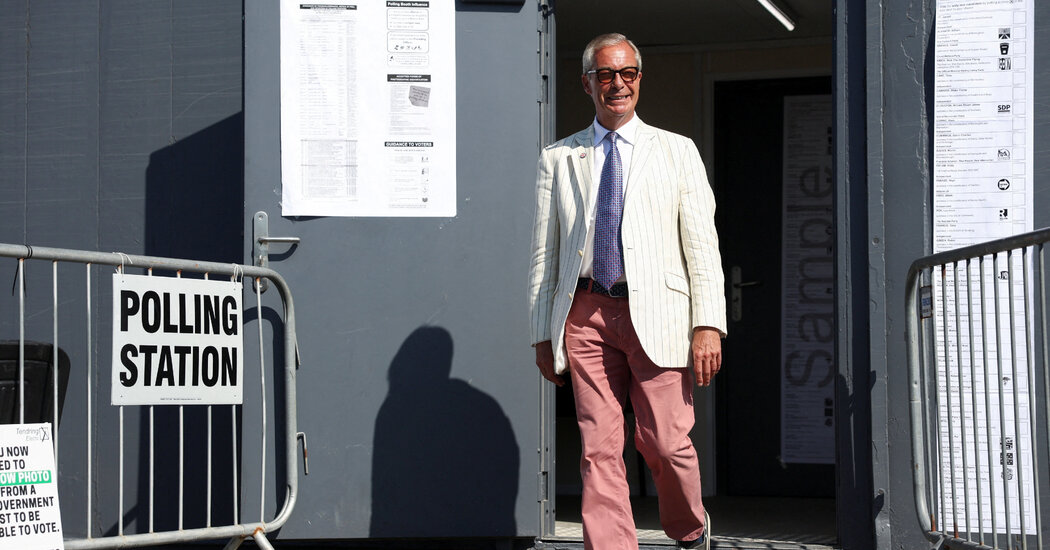
Nigel Farage, the prominent leader of Reform UK, Britain’s populist right-wing party, secured a decisive victory in a special election held on Thursday in the constituency of Clacton, a coastal area in Essex, England. This election was initiated by Mr. Farage himself last month when he resigned from his parliamentary seat amid an ongoing investigation into potential financial impropriety.
As widely anticipated, Mr. Farage comfortably defeated a diverse field of candidates, many of whom represented fringe or novelty political platforms, including the widely recognized satirical figure Count Binface, who campaigns in a trash-can-themed costume. None of the United Kingdom’s other major political parties — namely the Conservative Party, the Labour Party, or the Liberal Democrats — chose to participate in the contest. They collectively dismissed the by-election as a calculated political maneuver orchestrated by the Reform UK leader, designed primarily to divert public attention from the parliamentary investigations he faces.
The results, announced in the early hours of Friday, confirmed Mr. Farage’s substantial lead. He garnered 22,239 votes, representing 63 percent of the total ballots cast. Count Binface, portrayed by Jon Harvey, a 46-year-old writer and comedian, secured an unexpectedly high 9,455 votes, or 27 percent. This performance marked a significant improvement for Mr. Binface, whose previous best electoral result was 1 percent in a London mayoral election. Voter turnout for the special election was slightly higher than initial expectations, with 35,401 individuals participating, accounting for 44 percent of eligible voters in the Clacton constituency.
In a notable departure from established British political custom, Mr. Farage was not present at the official declaration of the election results. Instead, several hours earlier, he pre-emptively announced his victory at a Reform UK gathering dubbed “Farage Fest.” Addressing his supporters, he articulated his reasons for absence, stating, “I am damned if I am going to stand on a stage, having won a resounding victory, a ringing endorsement of all that I’ve tried to fight for and you’ve tried to fight for, and be demeaned and humiliated by nobodies.”
Mr. Farage is currently under scrutiny by the parliamentary standards commissioner regarding his failure to declare a significant financial gift. This gift, amounting to £5 million (approximately $6.7 million), was reportedly received in the weeks leading up to the general election held earlier this year. The donation originated from Christopher Harborne, a British crypto-billionaire based in Thailand. Mr. Farage has offered various explanations for the nature and purpose of this large sum, at different times claiming it was a reward for his role in the Brexit campaign and at others stating it was intended to cover his personal security costs.
Mr. Farage’s decision to resign his parliamentary seat last month, which he had held since the general election earlier this year, was followed almost immediately by his announcement to re-contest the ensuing by-election. He framed this move as an appeal to his constituents in Clacton, seeking a fresh mandate to demonstrate that his voters were unconcerned by the allegations of undeclared finances. In his resignation speech in July, Mr. Farage declared, “The people of Clacton should be the judges of my actions. This will be a people-versus-the-establishment by-election,” thereby casting the local contest as a broader referendum on his political integrity and populist agenda.
Beyond the Harborne gift, Mr. Farage alluded in his resignation speech to “yet another standards investigation underway.” Days prior to this, The Sunday Times of London had reported allegations that one of Mr. Farage’s close aides, George Cottrell, had provided him with undisclosed benefits. These reported benefits included security services, employees for social media management, and accommodation. Mr. Farage has since countered these claims by asserting that he was not required to report these benefits as they were allegedly received before his election to Parliament.
The parliamentary code of conduct, which governs the ethical standards for Members of Parliament, stipulates that lawmakers must register any benefits received within the 12 months preceding their election, unless such benefits can be definitively categorized as “purely personal gifts.” The code further advises that “Both the possible motive of the giver and the use to which the gift is to be put should be considered. If there is any doubt, the benefit should be registered.” This guideline emphasizes transparency and the avoidance of any perception of undue influence or undisclosed advantage.
Nigel Farage, a self-proclaimed ally of former U.S. President Donald Trump, has built his political career on a platform characterized by strong anti-immigration rhetoric, frequently warning of an “invasion” of migrants, and a consistent railing against what he terms “the establishment.” Reform UK, under his leadership, has seen fluctuating electoral fortunes. In May, the party achieved a notable success by securing almost 1,500 seats on municipal councils across the UK. However, its overall share of the vote in these local elections was approximately 26 percent, a decrease from over 30 percent in the preceding year. Recent national opinion polls have indicated a continued decline in support for Reform UK, with figures falling to under 25 percent and the Labour Party gaining a lead. This downturn in polling support appears to coincide with the increasing number of accusations and investigations regarding the improper disclosure of financial support.
Despite these broader trends and controversies, Reform UK officials consistently expressed high confidence that Mr. Farage would successfully reclaim his seat in Clacton. The constituency is known for its strong pro-Brexit sentiment, a cause that has been Mr. Farage’s signature political campaign. In the general election held earlier this year, Mr. Farage won the Clacton seat with 46.2 percent of the vote, significantly outperforming the Conservative Party candidate, who secured 27.9 percent.
Why This Matters
Nigel Farage’s victory in the Clacton special election, while expected given the lack of major party opposition, carries significant implications for British politics, Farage’s personal brand, and the broader issue of parliamentary integrity.
For British Politics and the Conservative Party:This win, even in a by-election devoid of mainstream competition, serves to re-legitimize Farage’s presence in Parliament and reinforces the perception of his strong local mandate in a key Brexit-supporting area. Reform UK’s very existence, and Farage’s amplified voice within Westminster, exerts considerable pressure on the ruling Conservative Party. As a right-wing populist force, Reform UK often draws votes from traditional Conservative supporters, particularly those disaffected by the current government’s policies or perceived failures. Farage’s return to the House of Commons could exacerbate this vote split, potentially hindering the Conservatives’ ability to win seats in the upcoming general election. It also pushes the Conservative Party further to the right on issues like immigration and cultural policy, as they attempt to win back voters who might otherwise defect to Reform UK.
For Nigel Farage’s Political Strategy and Brand:Farage successfully framed this by-election as a “people-versus-the-establishment” contest, utilizing the parliamentary investigations as a means to rally support against perceived institutional overreach. His unconventional handling of the victory announcement, choosing to address supporters at “Farage Fest” rather than the official declaration, further cemented his image as an anti-establishment outsider, an appeal that resonates deeply with his base. The clear mandate from Clacton, regardless of the nature of his opponents, allows Farage to claim public vindication against the allegations and strengthens his narrative that “the people” stand with him against an elite trying to silence him. This re-entry into Parliament provides him with a national platform at a critical time, ahead of a likely general election, allowing him to directly challenge the government and opposition from within the legislative body.
For Parliamentary Integrity and Public Trust:The investigations by the parliamentary standards commissioner into undeclared gifts and benefits raise serious questions about transparency, accountability, and ethical conduct for Members of Parliament. While Farage has dismissed the allegations as politically motivated, the parliamentary code of conduct is designed to ensure that lawmakers’ decisions are not influenced by undeclared financial interests. His re-election, while under investigation, creates a complex situation where a public mandate is juxtaposed against ongoing scrutiny regarding compliance with parliamentary rules. This scenario could fuel public cynicism regarding political accountability and the effectiveness of oversight bodies. How these investigations proceed, and the ultimate findings, will be crucial in demonstrating the robustness of parliamentary standards and upholding public trust in elected officials.
In essence, this special election is more than just a local contest; it is a microcosm of the broader political tensions within the UK, highlighting the enduring appeal of populist figures, the challenges to traditional party dominance, and the ongoing scrutiny over ethical conduct in public office, all of which will play a significant role in shaping the country’s political future.