
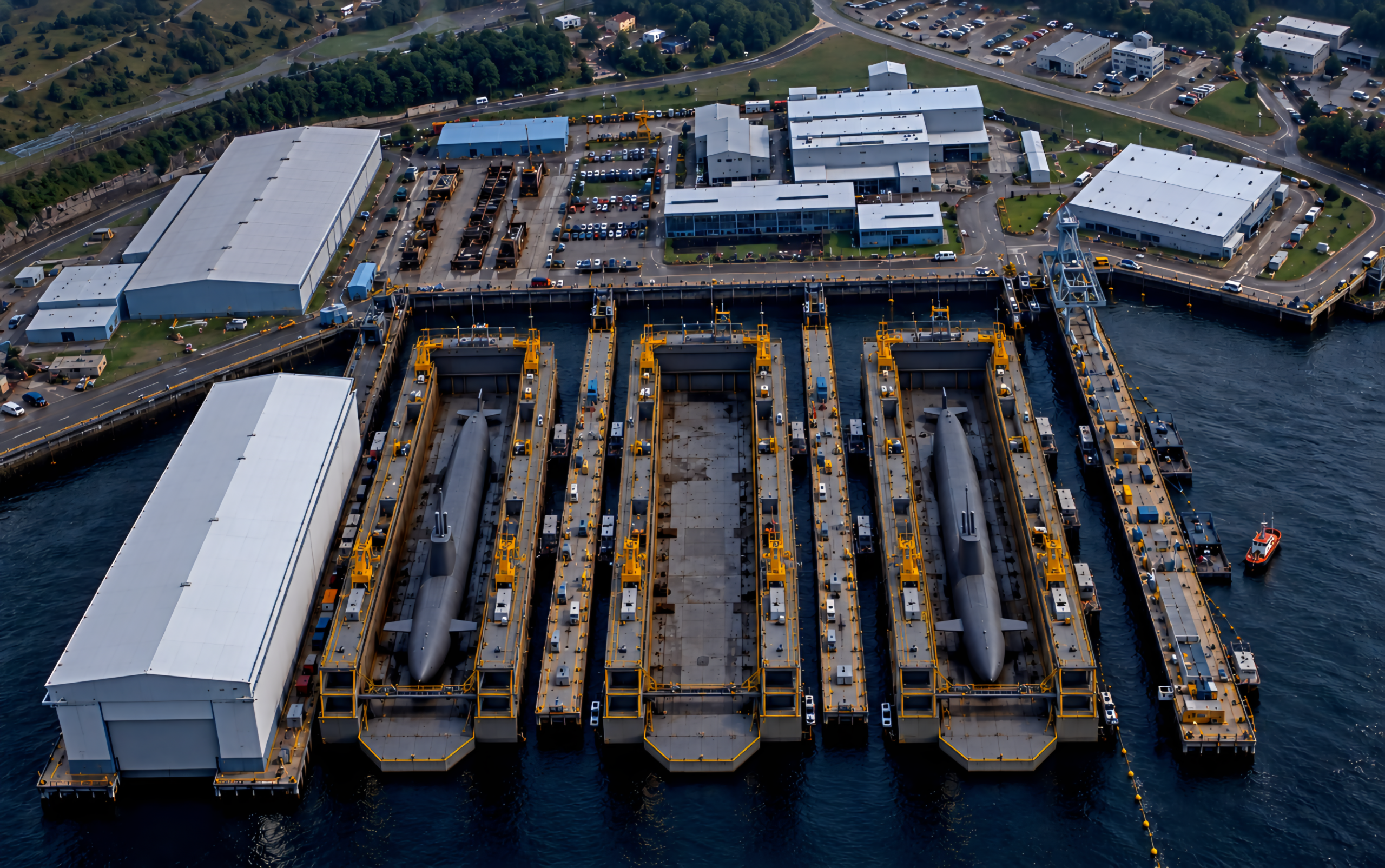
UK Government Announces Domestic Construction for Critical Naval Infrastructure and Research Vessel
The United Kingdom government has announced that three new floating docks, essential for the maintenance and repair of the Royal Navy’s submarine service at HM Naval Base Clyde (Faslane), will be built exclusively by British companies. This decision follows a UK-only tender process, justified on grounds of national security and the development of sovereign industrial capability, according to a statement from the Treasury.
This commitment falls under “Programme Euston,” a key component of the wider transformation of the Faslane base in Scotland. The new facilities are designed to provide crucial out-of-water engineering capabilities for the current and future fleet of nuclear submarines, facilitating essential inspections, upgrades, and repairs necessary for their operational readiness and safety. HM Naval Base Clyde is strategically vital, serving as the home port for the UK’s ballistic missile submarines that carry the nuclear deterrent, and since 2020, also hosting the Astute-class attack submarines. The provision of consistent out-of-water access for inspection and repair is therefore a critical operational requirement for the entire flotilla.
The Chancellor of the Exchequer, John Healey, is set to confirm this decision during his speech at the Labour Party conference. Alongside this, the Chancellor will announce a further commitment of at least £115 million for the construction of a new marine research vessel. The Treasury estimates the combined value of these two projects to be in the billions of pounds, emphasizing that both will be delivered by British companies as part of an enhanced focus on how government expenditure supports domestic industry and strengthens national capabilities.
Speaking ahead of his conference address, Mr. Healey is expected to highlight the transformative potential of such investments. He plans to draw parallels with Britain’s industrial past and present, stating:“My politics were shaped by the industrial heartlands of South Yorkshire. Today, on the site of the Orgreave pit, is Rotherham’s Advanced Manufacturing Park. Our coal mines are not coming back. But this is how Britain’s industrial past is being remade now for the modern world. This is the new age of industrialisation. A new confidence in Britain.”
The Chancellor further elaborated on the strategic importance of these investments, remarking:“Britain has a proud shipbuilding heritage, and every pound of this strategic investment in a critical sector is backing British jobs on the Clyde and businesses across the UK, supporting growth in every postcode.”He added that prioritizing British yards not only boosts national security but also contributes to“securing resilience in the industries that will drive growth today while building the capabilities the country needs for the future.”
Defence Secretary Wes Streeting echoed these sentiments, asserting that defence spending should contribute to strengthening Britain in all aspects. He stated that this commitment“means backing British by buying British wherever our industry can deliver.”Mr. Streeting underscored the centrality of HM Naval Base Clyde to the UK’s submarine service, noting that Programme Euston will modernize the base for decades to come while simultaneously supporting British shipyards, workers, and engineering. He described this approach as“defence driving the reindustrialisation of Britain and strengthening our sovereign capability.”
The decision has been welcomed by GMB, one of the largest unions representing workers in the British shipbuilding sector. GMB had previously campaigned for Programme Euston to be awarded to yards like Navantia’s facilities at Methil and Belfast, and expressed satisfaction with the UK-only tender. Robert Deavy, GMB Scotland senior organiser in engineering, emphasized the union’s view that defence procurement should actively create and safeguard skilled jobs and apprenticeships within the United Kingdom, thereby underpinning local economies.
Mr. Deavy criticised past practices, stating:“For far too long, huge UK contracts have been sent around the world to fund good jobs everywhere but here.”He observed a positive shift in government policy, adding:“The world has changed though and it is good to see a UK Government ready to invest in our sovereign industrial capability. It is beyond time.”Referring to Programme Euston as a“potentially transformative contract,”he expressed optimism that its domestic allocation would generate hope not only in Methil but also across other shipbuilding yards nationwide. Mr. Deavy urged the Scottish Government to collaborate with UK ministers to deliver the necessary investment in apprenticeships and training required to secure this contract effectively.
The new marine research vessel is projected to become operational in the early 2030s, replacing an existing ship that is nearing the end of its service life. According to the Treasury, the data and evidence collected by this vessel will be instrumental in safeguarding British waters, supporting sustainable fishing practices, and providing coastal communities with confidence that fish stocks are being responsibly managed for future generations. This initiative reinforces the UK’s commitment to marine science and environmental stewardship.
Programme Euston has been a feature of departmental planning for a considerable period, integrated into a multi-decade Clyde Transformation Programme. This broader initiative includes the Clyde Infrastructure Programme and new projects addressing berthing, ammunitioning, logistics, and engineering. The overarching goal is to ensure that HM Naval Base Clyde can safely, efficiently, and sustainably operate current and future naval capabilities. This comprehensive approach aims to modernise the entire base infrastructure to meet the demands of advanced naval operations.
This announcement coincides with a visit by the Prime Minister and the Chancellor to Merseyside. On Saturday, both leaders participated in a sea trial aboard the Royal Daffodil, which marks the first new Mersey Ferry built in over sixty years. The £26 million vessel was constructed at Cammell Laird in Birkenhead, a shipyard that would likely be among those interested in bidding for surface vessel construction work, such as that represented by the new marine research vessel.
Why This Matters
The UK government’s commitment to building critical naval infrastructure and a new marine research vessel entirely within Britain signals a significant shift in national industrial and defence procurement strategy. This decision carries multifaceted implications across national security, economic development, industrial policy, and environmental stewardship.
National Security and Sovereign Capability:The core rationale for the UK-only tender on Programme Euston is rooted in national security. HM Naval Base Clyde is the operational hub for the UK’s nuclear deterrent and its advanced attack submarines. Ensuring these vessels have reliable, domestically controlled facilities for maintenance and repair reduces dependency on foreign suppliers for critical defence capabilities. This enhances “sovereign industrial capability,” meaning the UK maintains the necessary domestic expertise and infrastructure to support its most vital defence assets, a lesson perhaps reinforced by recent global supply chain disruptions and geopolitical tensions. The ability to conduct complex out-of-water engineering on nuclear submarines without external reliance is paramount for maintaining operational readiness and strategic independence in a volatile geopolitical landscape.
Economic Revitalization and “Reindustrialisation”:These projects represent a substantial investment in the British shipbuilding, engineering, and advanced manufacturing sectors. The commitment to using British companies aims to create and safeguard thousands of high-skilled jobs and apprenticeships, particularly in regions with a historical connection to shipbuilding, such as the Clyde, Methil, Belfast, and Merseyside. The Chancellor’s rhetoric of a “new age of industrialisation” and “reindustrialisation” suggests a broader government ambition to rebuild and strengthen domestic manufacturing capacity after decades of decline. This aligns with political objectives to boost local economies and “level up” opportunities across the country, positioning defence spending as a catalyst for national economic growth and resilience.
Strategic Industrial Policy:The announcement underscores a more interventionist approach to industrial policy, where the government actively directs significant contracts towards domestic industry for strategic reasons beyond just cost-effectiveness. By prioritising national security and sovereign capability, the government is signalling a willingness to leverage public procurement as a tool for industrial development and resilience. This could set a precedent for future large-scale defence and infrastructure projects, potentially reshaping the landscape of British manufacturing and engineering for decades to come and influencing how the UK positions itself in global supply chains.
Environmental and Scientific Advancement:Beyond defence, the investment in a new marine research vessel highlights the UK’s ongoing commitment to marine science and environmental protection. This vessel will play a crucial role in collecting vital data to monitor and manage British waters, support sustainable fishing practices, and inform policies related to marine ecosystems. In an era of climate change and increasing pressure on marine resources, the vessel’s work will be essential for understanding environmental shifts, protecting biodiversity, and ensuring the long-term viability of the UK’s fishing industry and coastal communities. This investment positions the UK to remain at the forefront of marine scientific research and contribute to global efforts in ocean conservation.
Political Signalling:The timing of this announcement, made by the Chancellor at the Labour Party conference and coinciding with a joint visit by the Prime Minister, carries significant political weight. It allows the government to demonstrate its commitment to national security, economic growth, and the creation of skilled jobs. It also serves as a clear message to voters about the government’s priorities and its vision for a “new confidence in Britain,” leveraging major public investments to drive both strategic national objectives and regional economic development, particularly in an pre-election political climate.