
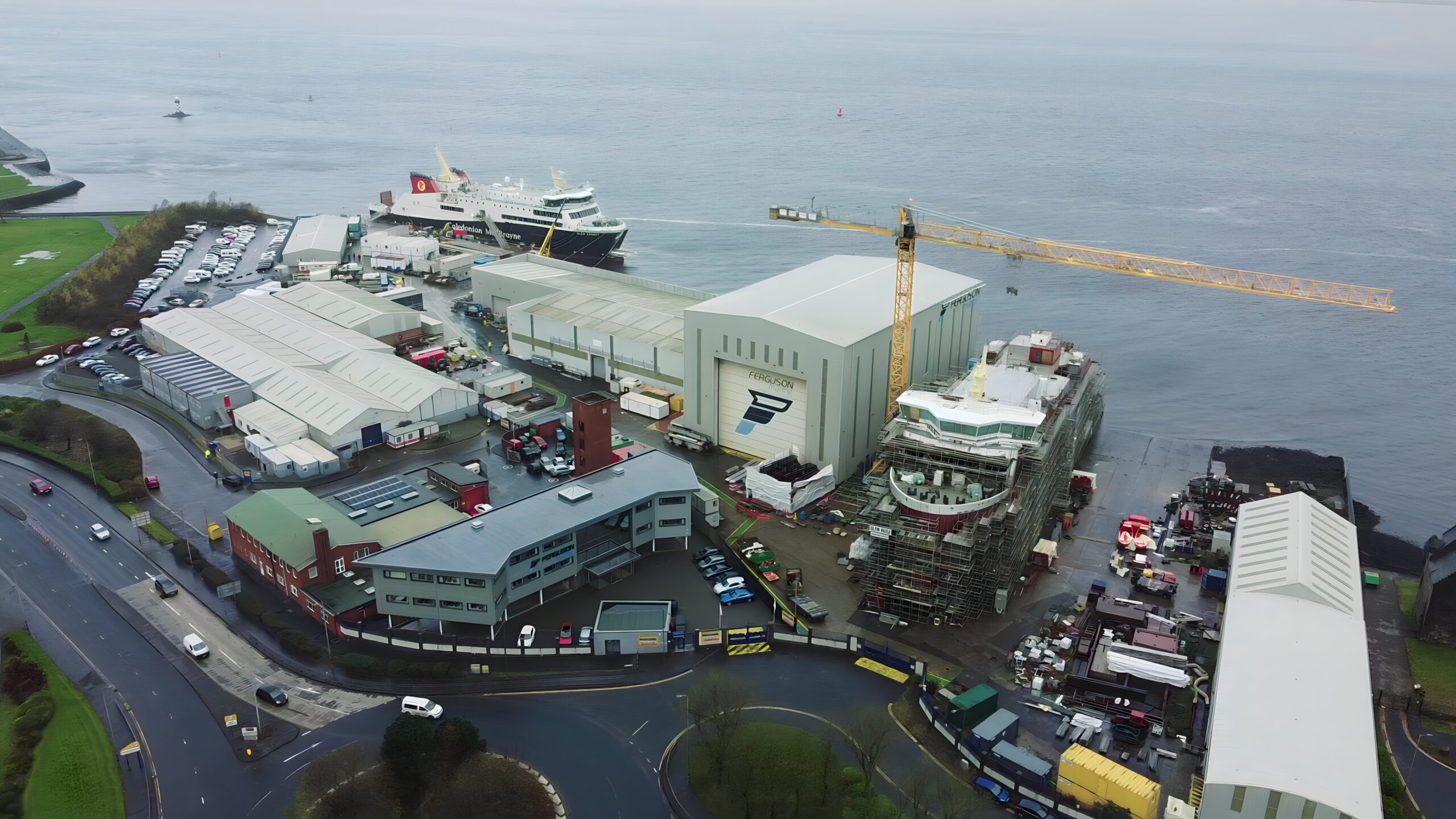
Ferguson Marine has outlined what it posits is a more structured approach to completing MV Glen Rosa, while contending that capital injection, governance overhaul, and subsequent ship construction projects could help revitalize commercial maritime construction capabilities on the Clyde.
Addressing Holyrood’s Net Zero, Energy and Transport Committee, the executives of the Port Glasgow shipyard highlighted engineering advancements on Glen Rosa, insights gained from MV Glen Sannox, and a broader initiative to modernize the enterprise after years of postponements and budget exceedances.
Duncan Anderson, the shipyard’s newly instated chairman, commenced his statement by asserting that Ferguson Marine still possesses considerable long-term promise, notwithstanding the problematic past of the two ferries.
“With a robust upgrade initiative and enhanced construction methodologies, it could be a foremost entity in the sector,”he stated.
Anderson conceded that previous shortcomings had been grave, informing parliamentary members that“the past oversight of vessel fabrication has comprised errors”and that governance and operational order had been suboptimal. However, he affirmed that the current leadership was committed to transforming how the yard functions and providing the workforce with a more defined framework.
“With the instatement of a fresh executive leadership, I have observed notable alterations in the yard and significant enhancement,”he conveyed to the committee.
He further highlighted current advancements on Glen Rosa, remarking:“We are energizing the switchboards presently, and we are nearing complete engine activation in line with the updated timeline.”He added:“We anticipate completion in the fourth quarter of this year as we progress with our upgrade initiative.”
Chief executive Graeme Thomson reported that the yard had implemented more robust project oversight measures since he assumed leadership, encompassing more meticulous strategizing, structured hazard mitigation, and a specialized project management unit.
“We have now established a much more resilient strategic methodology,”he said, adding that it had uncovered problems hitherto unapparent in their entirety.
Thomson informed MSPs that“we have created a programme management office, which was absent before,”and noted that Ferguson Marine had also internalized planning expertise, integrated the Primavera planning tool, and instituted fresh budgetary and timeline oversight mechanisms.
He characterized these alterations as a reversion to core operational rigor after years in which that had eroded.“The primary alteration that we will enact… is to commence with sound methodology from day 1,”he declared.
That assertion was buttressed during questioning from SNP MSP Kevin Stewart, when Thomson frankly conceded that project management had been a vulnerability formerly. Asked if that was fair, he responded:“Yes.”
The session also addressed engineering challenges impacting Glen Sannox, including fuselage fractures attributable to cavitation from the propellers. Thomson stated the yard now comprehended both the origin and the technical solution.
“The crack that was detected was a 20mm crack that appeared due to oscillation across the vessel body, which resulted from cavitation when the ship reversed,”he explained.
He mentioned that metallic reinforcement had already been installed to alleviate oscillation, while re-engineering efforts on the propellers had now been evaluated.
“Between the steel that we have implemented and the revised propulsion units, we will have a fix ensuring recurrence is prevented,”he affirmed.
Thomson also informed parliamentary members that insights gained from Glen Sannox were already being implemented in Glen Rosa, including the same preventative measures prior to the delivery of updated propellers.
In addition to the ferry fabrication itself, Ferguson Marine stressed the cruciality of site capitalization. Financial director David Dishon stated a £14.2 million funding allocation supported by the Scottish Government would help upgrade infrastructure and boost output efficiency.
“One of the components is a partially mechanized 13m panel line,”he detailed.“It will enable us to achieve greater output… there will be a 50 per cent efficiency surge in that regard.”
That investment is designed to bolster fabrication of subsequent ships and enhance market standing as Ferguson Marine endeavors to transcend the Glen Sannox and Glen Rosa protracted issue. Thomson said the yard believed there was a sustainable future demand if the ongoing revitalization is successfully executed.
“As the National Shipbuilding Office stated in 2022, between the UK Government and the devolved Governments, there is a demand for 150 ships in the next 30 years,”he noted.
He added:“We should be appealing and formidable in the UK within the five years and able to obtain contracts through competitive bidding.”