
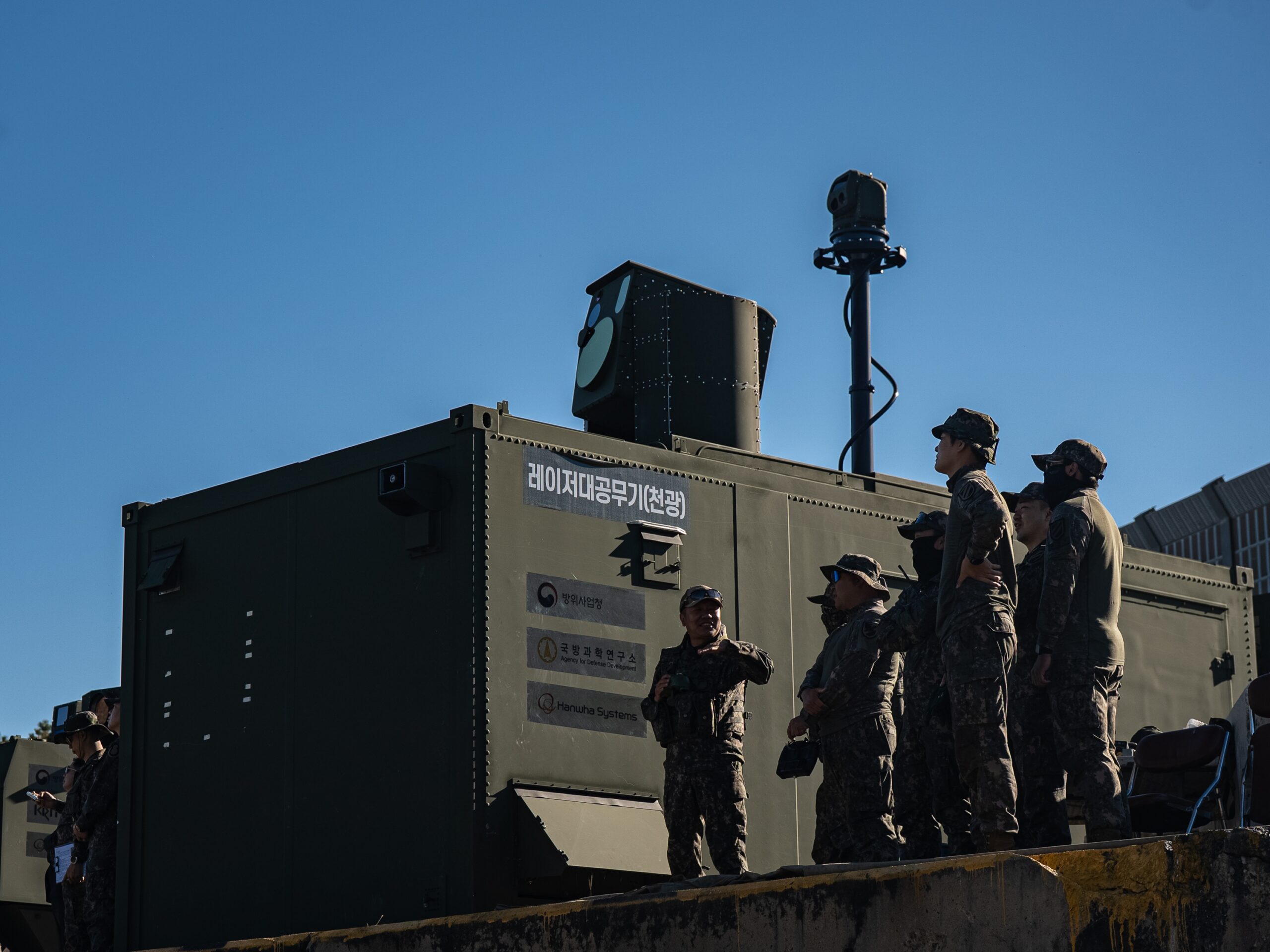
South Korea Demonstrates Advanced Laser Air Defence System, Citing Low Operational Cost
A new laser air defence weapon developed in South Korea successfully intercepted and destroyed all three target drones during a recent Republic of Korea Army exercise, according to its manufacturer, Hanwha Systems. The company claims the system, named Cheongwang, operates at a remarkably low cost, estimated at around one dollar fifty per shot.
The demonstration, featuring the Laser Air Defence Weapon Block-I – a 30kW class vehicle-mounted high energy laser cannon – took place on October 14 as part of the Army TIGER+ Future Warfare Integrated Combat Exercise. Organized by Republic of Korea Army Headquarters, the event was observed by approximately five hundred attendees, including the Chief of Staff of the Republic of Korea Army, alongside various military officials, academics, and industry figures, highlighting the strategic importance placed on this emerging technology.
Joohun Shin, head of the Laser Systems Business Centre at Hanwha Systems, emphasized the transformative potential of such systems. “Laser weapons are core assets that will fundamentally change the game of air defense,” Shin stated. He added that the company intends to “accelerate our entry into the global market to establish both Cheongwang and the high-mobility, high-power 50kW Laser Armored Vehicle as key next-generation export items for K-Defense,” signalling South Korea’s ambition to become a leading exporter in this advanced defence sector.
Cheongwang, which translates to “light of the sky,” was developed collaboratively by Hanwha Systems and the Agency for Defense Development (ADD). Hanwha Systems asserts that it is the first laser weapon of its kind to be fielded operationally anywhere, marking a significant milestone in the deployment of directed energy weapons. The system’s low operational cost, cited at approximately $1.50 per engagement, stands in stark contrast to conventional missile interceptors. Furthermore, the company highlights its logistical advantage: the system can continue firing as long as it has access to power, eliminating the need for ammunition magazines or a complex resupply chain for projectiles.
The economic disparity between traditional air defence and laser systems is a critical factor driving their development. Attack drones, such as those resembling the Shahed type, can cost tens of thousands of dollars to produce. The missiles typically used to intercept them, however, often cost hundreds of thousands, if not millions, of dollars per shot. This significant cost asymmetry means that an adversary capable of generating cheap airframes in quantity can potentially overwhelm or economically exhaust a defender, even if every defensive shot is successful. A laser system fundamentally inverts this equation, offering a cost-effective countermeasure, provided it can generate sufficient power, maintain a precise beam on target for the required duration to cause damage, and operate effectively through varying weather conditions such as fog, rain, or smoke.
The recent demonstration was not an isolated event. Hanwha Systems conducted a similar exercise on September 16 at the 2026 Defense Drone Technology Exhibition, where Cheongwang reportedly neutralized four drones and two uncrewed aircraft in succession before a domestic and international audience. At the same exhibition, the company also showcased a more powerful and mobile system, the 50kW Laser Armored Vehicle, which is being developed in-house with a view toward export markets. This vehicle was also presented at MSPO in Kielce, Poland, in September, one of Eastern Europe’s largest defence exhibitions, underscoring Hanwha’s global marketing efforts.
The development of advanced laser weapons is a global endeavour, with several nations investing heavily in the technology. Britain, for instance, has been actively pursuing its own laser directed energy weapon, DragonFire. Developed by a consortium including MBDA, Leonardo, QinetiQ, and Dstl, DragonFire successfully engaged aerial targets in trials conducted in the Hebrides in 2024. The system is currently being accelerated for potential installation on a Royal Navy Type 45 destroyer, demonstrating the push for naval integration of such technologies. The UK’s Strategic Defence Review has allocated additional funding to directed energy weapons, and the British Army has also been trialling laser systems mounted on Wolfhound vehicles, indicating a broad-based interest across military branches.
Other countries are also making significant strides. The United States has several directed energy programs, including the Army’s Indirect Fire Protection Capability-High Energy Laser (IFPC-HEL) and the Navy’s High Energy Laser with Integrated Optical-dazzler and Surveillance (HELIOS). Israel has demonstrated its “Iron Beam” laser air defense system, and Germany is also developing similar capabilities. These efforts collectively underscore a global recognition of directed energy weapons as a critical component of future air defence strategies, particularly against the growing threat of drones and other low-cost aerial threats.
Why This Matters
The successful demonstration of South Korea’s Cheongwang laser air defence system represents a significant step in the global race to develop and deploy directed energy weapons. This technology holds the potential to fundamentally reshape air defence strategies, primarily due to its claimed ultra-low operational cost of approximately $1.50 per shot. This economic advantage is crucial in an era where cheap, mass-produced drones pose an increasingly effective and economically debilitating threat to conventional air defence systems that rely on expensive missiles. By inverting the cost asymmetry, laser weapons could allow defenders to effectively counter swarms of drones without rapidly depleting their budgets or munition stockpiles.
Furthermore, the “unlimited magazine” capacity of laser systems – allowing continuous firing as long as power is available – offers a critical logistical advantage, reducing the reliance on complex supply chains for projectiles. While technical challenges such as power generation, beam stability, and atmospheric interference remain, the operational fielding and ongoing development by Hanwha Systems, alongside similar efforts in the UK, USA, and Israel, indicate a growing confidence in overcoming these hurdles. This advancement is not merely a technological curiosity; it signals a potential paradigm shift in military capabilities, influencing future defence procurements, strategic doctrines, and the geopolitical landscape of military technology exports, particularly for nations like South Korea aiming to expand their “K-Defense” global footprint.