
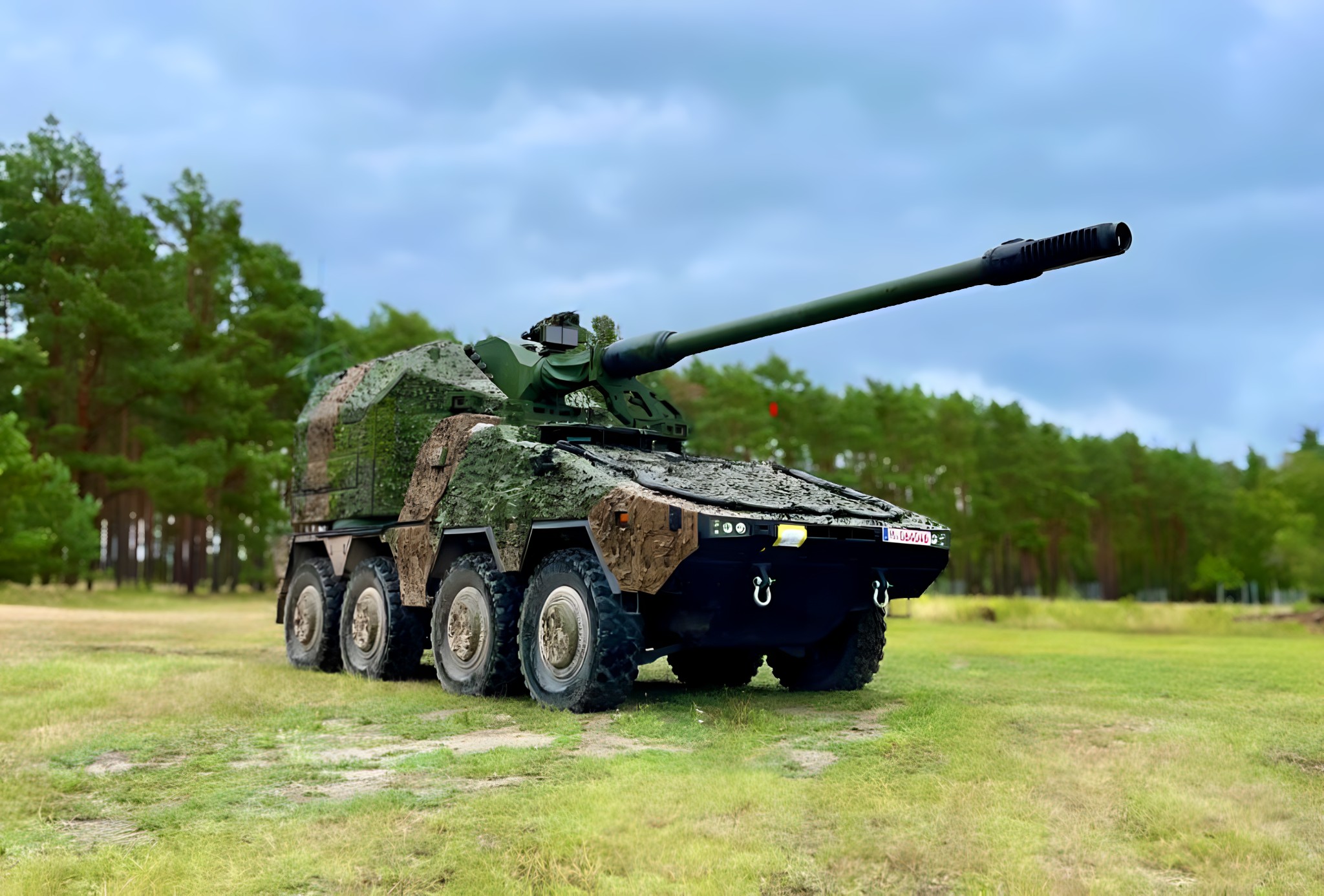
London, United Kingdom– The United Kingdom is set to significantly modernise its long-range artillery capabilities with the acquisition of the Remote Controlled Howitzer 155 (RCH155) system, a move confirmed by Minister of State for Defence Luke Pollard. The programme, which is projected to exceed £3 billion in whole-life costs, will deliver a “Minimum Deployable Capability” within the current decade, marking a crucial step in recapitalising the British Army’s firepower following the transfer of much of its existing fleet to Ukraine.
Details of the ambitious programme were provided by Minister Pollard in response to written questions from Mark Francois MP, the Conservative member for Rayleigh and Wickford, tabled on May 26. Pollard’s confirmation outlines a clear pathway for the integration of this advanced artillery system, which represents a substantial investment in the UK’s defence posture.
The “Minimum Deployable Capability” (MDC) is defined as a Royal Artillery Battery fully equipped with RCH155 platforms. This goes beyond mere procurement, encompassing the completion of necessary specialist training for personnel and the establishment of an appropriate peacetime safety case. This safety case is critical to enable effective training on UK ranges, ensuring the sub-unit is thoroughly prepared for potential operational deployment anywhere in the world. The target of achieving this MDC “within this decade” underscores the urgency and strategic importance placed on this modernisation effort.
Financially, the RCH155 programme represents a significant commitment. The acquisition cost alone is estimated to exceed £1 billion. This substantial figure is broken down into several key contracts: a £53 million Long Lead Item (LLI) contract awarded in March 2025, a £52 million Early Capability Demonstrator (ECD) contract announced in December 2025, and the primary series production contract, which was publicly confirmed on May 13, 2026. These staged contracts demonstrate a structured approach to procurement, allowing for early integration and testing before full-scale production commences.
Beyond the initial acquisition, the overall financial outlay is considerably higher. The whole-life cost of procuring and supporting a fleet of 72 RCH155 systems is projected to exceed £3 billion over an anticipated 25-year service life. This comprehensive figure includes not only the cost of the platforms themselves but also ongoing maintenance, spare parts, upgrades, training, and operational support, highlighting the long-term investment required for modern military hardware.
At the heart of this programme is the RCH155, a state-of-the-art wheeled self-propelled howitzer developed by German defence giant Rheinmetall. The system is mounted on the highly adaptable Boxer armoured vehicle platform, which is already in service with the British Army in various configurations. This commonality with existing platforms offers potential benefits in terms of logistics, training, and maintenance, streamlining integration into the UK’s force structure.
The RCH155 is capable of firing standard 155mm NATO artillery rounds, reaching ranges of up to 40 kilometres. A standout feature of the system is its high degree of automation: it can execute autonomous loading, laying, and firing sequences without requiring crew exposure. This capability significantly enhances crew safety, particularly in contested environments, and allows for a higher rate of fire and rapid redeployment, a critical advantage in modern mobile warfare scenarios.
The system has already seen operational use, notably in Ukraine, where its capabilities have been demonstrated in a high-intensity conflict zone. Its selection by the UK aligns with a broader trend across Europe towards wheeled, highly mobile artillery platforms. This shift is driven by a desire to reduce the logistical burden typically associated with tracked predecessors, improve operational flexibility, and enhance survivability through ‘shoot and scoot’ tactics, where artillery can fire and rapidly relocate before counter-battery fire can be effective.
For the British Army, the acquisition of 72 RCH155 systems represents a vital recapitalisation of its long-range fires capability. These new systems will directly replace the AS90 self-propelled howitzer, a tracked system that had been a mainstay of the UK’s artillery for decades. A significant portion of the AS90 fleet was transferred to Ukraine to aid in its defence against Russian aggression, creating a critical gap in the UK’s own artillery holdings that the RCH155 is now poised to fill.
This strategic procurement underscores the UK’s commitment to modernising its armed forces in response to evolving geopolitical threats and the lessons learned from contemporary conflicts. It reflects a clear understanding that advanced, mobile, and protected artillery is indispensable for maintaining a credible defence and contributing effectively to NATO and other international security operations.
Why This Matters
The UK’s decision to acquire the Remote Controlled Howitzer 155 (RCH155) is a multifaceted development with significant implications for military capability, strategic alliances, industrial partnerships, and the future of modern warfare:
Enhancing Military Capability and Deterrence:This procurement fundamentally strengthens the British Army’s long-range precision strike capability. The RCH155’s ability to fire 155mm rounds up to 40km with high accuracy provides a crucial advantage in modern battlefields, enabling forces to engage targets at a safe standoff distance. This increased firepower and precision enhance the UK’s defensive posture, its ability to project power, and its capacity to deter potential adversaries. It ensures that the UK can contribute robustly to collective defence operations, particularly within NATO.
Lessons from Ukraine and Modern Warfare:The war in Ukraine has underscored the critical importance of artillery in high-intensity conflict, demonstrating the need for both quantity and quality. The RCH155’s operational experience in Ukraine provides invaluable validation of its effectiveness and resilience. Its wheeled platform and autonomous firing capabilities address key lessons from that conflict: the need for mobility to avoid counter-battery fire, the importance of protecting crews, and the logistical advantages of wheeled over tracked systems. This acquisition signals the UK’s commitment to integrating real-world combat lessons into its defence planning.
Strategic European Alignment and Interoperability:The RCH155’s selection aligns the UK with a broader European trend towards wheeled, highly mobile artillery. This commonality with systems adopted by other European nations (including Germany, which developed the Boxer platform) enhances interoperability, simplifies joint exercises, and could facilitate logistics and maintenance during coalition operations. It reinforces European defence cooperation and the UK’s role within the continent’s security architecture.
Significant Financial Investment and Industrial Impact:The multi-billion-pound investment in the RCH155 programme represents a substantial commitment of taxpayer money towards national defence. It also highlights a significant defence industrial partnership with Germany’s Rheinmetall, reinforcing economic and technological ties between the two nations. While the Boxer platform has some UK industrial involvement, the series production contract for the RCH155 itself will be a major boost for Rheinmetall’s operations and associated supply chains, potentially creating or sustaining high-skilled jobs in the defence sector.
Evolution of Warfare Technology:The RCH155 embodies advanced military technology, particularly its remote-controlled and autonomous loading, laying, and firing sequences. This feature is indicative of a broader trend towards automation in modern warfare, aiming to reduce human exposure to direct combat risks while increasing operational efficiency. This investment positions the UK at the forefront of adopting cutting-edge artillery technology, influencing future doctrinal development and training within the British Army and potentially inspiring further innovation in defence systems.