
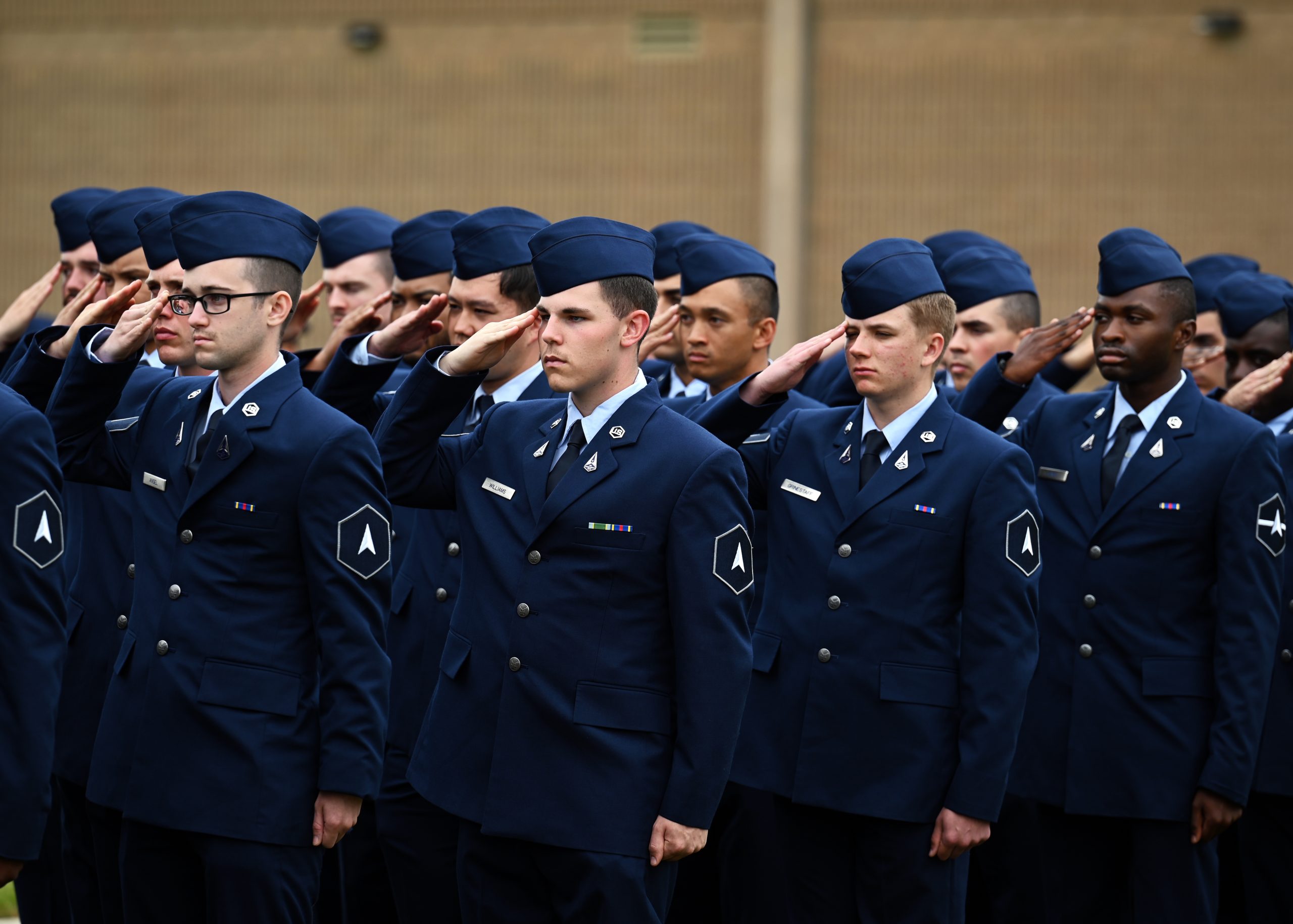
In order to satisfy increasing requirements for orbital assets vital for national defense, the Space Force’s principal non-commissioned officer indicates a need for its personnel count to increase by 100%.
John Bentivegna, the Chief Master Sergeant of the Space Force, informed legislators on February 11 that the branch’s existing contingent of 10,000 uniformed Guardians proves inadequate for fulfilling the Space Force’s developing operational mandates and for countering escalating perils posed by rivals such as China and Russia.
“To proficiently execute our national directive, it is imperative that we enhance our foundational facilities and expand our personnel twofold,” he stated during a session of the Senate Armed Services personnel subcommittee. “Such a vital augmentation is not merely essential, but also wholly attainable.”
The Space Force has already exceeded its enrollment targets for fiscal year 2026, according to Bentivegna, reaching 125 percent of its objective in merely five months. This figure encompasses 912 new entrants who, as of February 11, had either commenced fundamental military instruction or were registered in the deferred entry scheme, as reported by a branch representative to Air & Space Forces Magazine.
The Space Force’s enlistment objective constitutes a minor proportion compared to those of other military branches: only 730 new members in 2026, a decrease from 800 fresh recruits in fiscal year 2025, an amount the service achieved last year. Conversely, the Air Force’s target for 2026 approaches 33,000. However, given that the Air Force employs over 30 times the number of Airmen compared to the Space Force’s Guardians, the disparity is minor when considered proportionally.
Numerous elements contribute to establishing fundamental enlistment objectives, with the service’s operational requirements being paramount. Additional considerations, such as recruitment and instructional capabilities, along with individuals’ inclination to serve, also play a role. The Space Force has either achieved or surpassed its enrollment targets annually since its inception in late 2019.
“We shall persist in leveraging this impetus as America’s Space Force proceeds with its future expansion,” General B. Chance Saltzman, the Chief of Space Operations, communicated via a social media update.
Should legislative bodies sanction an increase in staff, Bentivegna asserted, a sufficient number of eligible candidates are available to occupy those positions.
In 2025, the Space Force inaugurated its distinct recruitment squadron, a move intended to foster more rapid expansion. The Air Force Accessions Center persists in overseeing enlistment efforts for both the Air Force and Space Force; prior to this, however, no specialized Space Force entity existed for this purpose.
“Enrollment interest for the Space Force has been extraordinary,” Bentivegna remarked. “Currently, we have more individuals desirous of commissioning or enlisting in the Space Force than we are able to accommodate, which is why I believe a twofold increase in personnel is entirely within reach.”
Bentivegna’s advocacy for an expanded Space Force mirrors pronouncements from other branch commanders in recent times. During a January presentation at an assembly sponsored by Space News and Johns Hopkins University, General Shawn N. Bratton, the Vice Chief of Space Operations, conveyed his anticipation that over the coming five to ten years, the Space Force’s uniformed and civilian contingents will at minimum expand by 100%. Presently, the service employs 5,000 non-military personnel; however, it experienced a significant depletion of skilled individuals last year due to workforce reductions mandated by the Trump administration.
Space Force financial allocations, alongside its operational mandates, have seen considerable growth since its inaugural autonomous budget in fiscal year 2021. The initial budget stood at $15.4 billion, yet expenditures have swelled to almost $40 billion by fiscal year 2026, encompassing the foundational budget proposal and supplementary appropriations within the reconciliation legislation termed the Big Beautiful Bill Act, which received congressional assent last summer.
Should President Donald Trump’s aspiration for a $1.5 trillion defense expenditure in fiscal year 2027 materialize, that fiscal allotment would expand further. Although Bratton and the branch contend there is justification for a twofold or threefold increase in the Space Force’s budget, he posited that a portion of those funds ought to be allocated towards developing the foundational systems necessary to support novel and current operations.
“My present concern leans more towards the human resources and infrastructural aspects of that calculation rather than merely the amount specified in the appropriations legislation,” Bratton remarked on January 22. “We are undertaking a substantial volume of tasks. Do I possess the requisite program departments on the procurement front to devise and deploy these aptitudes? Are the necessary evaluation and instructional frameworks in place to thoroughly refine these aptitudes? Do I command … not solely an adequate count of Guardians, but also the requisite operational facilities?”