
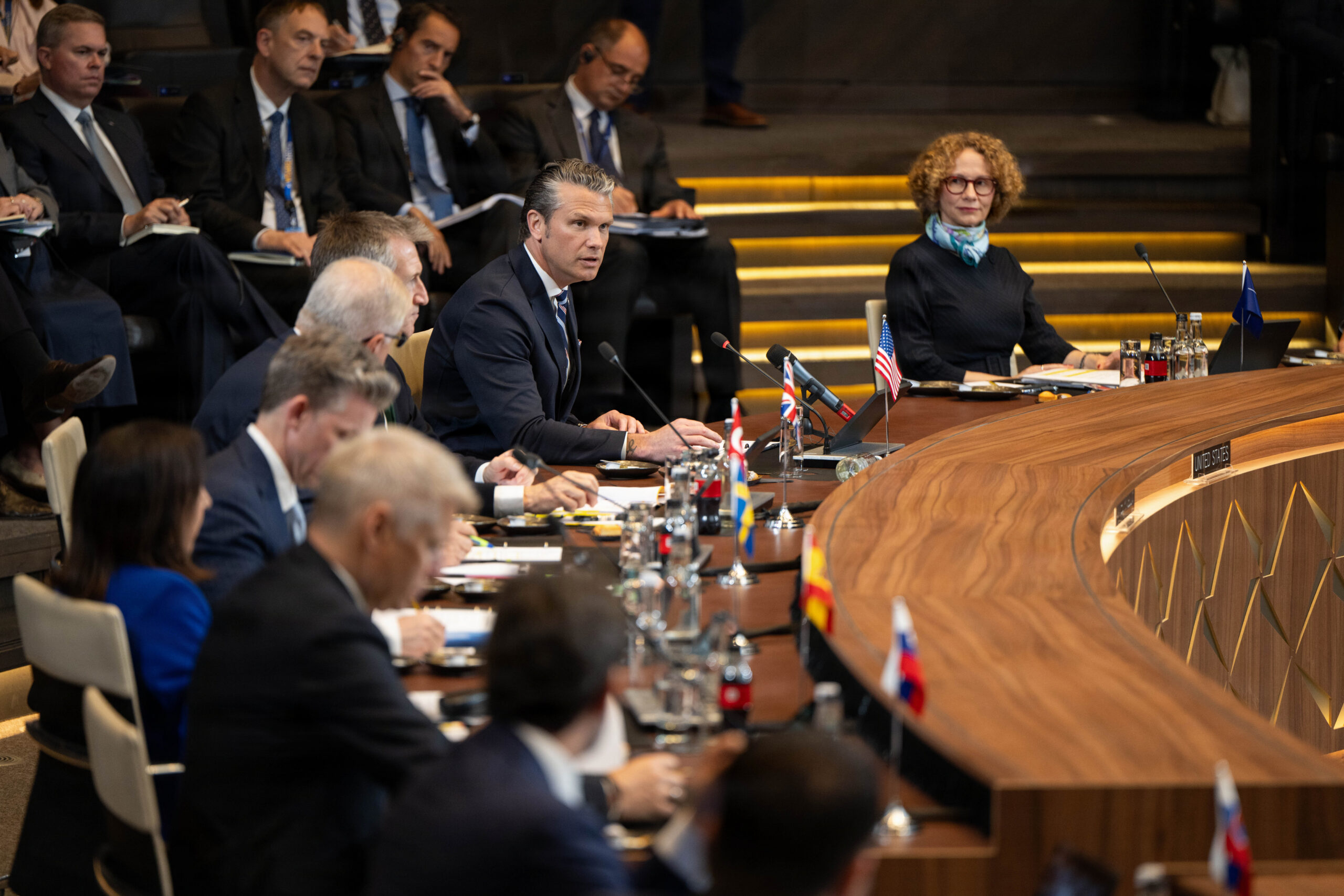
BRUSSELS—U.S. Secretary of Defense Pete Hegseth announced on June 18 that the United States is initiating a comprehensive review of its military presence across Europe. Speaking to NATO defense ministers in Brussels, Secretary Hegseth also issued a warning that the U.S. would reduce its financial contributions to the alliance’s operational budget if member states fail to meet their commitments to increase military spending.
The assessment, anticipated to span up to six months, will specifically examine “America’s core posture and basing in Europe,” Hegseth informed the allied defense ministers. A U.S. official, speaking to Air & Space Forces Magazine, confirmed that the review will be spearheaded by Air Force Gen. Alexus Grynkewich, who commands U.S. European Command and also serves as Supreme Allied Commander Europe (SACEUR), NATO’s most senior military officer. The official emphasized that the assessment does not have a predetermined outcome.
“Make no mistake about it, this will be a real review,” Secretary Hegseth stated. He elaborated that the review is designed to ensure NATO progresses swiftly and irreversibly toward European nations assuming primary responsibility for their own defense. Additionally, it aims to guarantee that U.S. forces in Europe are positioned effectively to address America’s global defense requirements, and that U.S. access, basing, and overflight rights are clearly established and assured. Hegseth contended that any other nation would undertake a similar evaluation.
These developments occur amidst ongoing discussions between the Pentagon and U.S. lawmakers, including prominent Republicans who are vocal supporters of NATO. These lawmakers have expressed discontent about not being consulted on previous U.S. troop reductions. In response, congressional members have incorporated provisions into the draft 2027 National Defense Authorization Act (NDAA) aimed at preventing further troop reductions, particularly at a time when the perceived threat from Russia remains significant. Some of these proposed provisions mandate a risk assessment by General Grynkewich and Air Force Gen. Dan Caine, Chairman of the Joint Chiefs of Staff, concerning the potential impact of any proposed U.S. troop reductions.
Reiterating a persistent U.S. concern, Hegseth asserted that many European countries have historically benefited from U.S. military spending without contributing their fair share, describing it as “free-riding.” He further admonished European nations for not providing sufficient support for U.S. military operations in Iran, an issue that has also drawn criticism from President Donald Trump.
In specific instances, the United Kingdom permitted U.S. bombers involved in operations targeting Iran to operate from one of its bases, whereas Spain declined the use of its facilities for such purposes. It was noted that European nations were not consulted prior to certain U.S. and Israeli attacks on Iran. Secretary Hegseth stressed that any restrictions on U.S. aircraft basing and overflight permissions to support operations in regions like Iran were unacceptable, suggesting that such actions could potentially lead to increased American casualties.
The Trump administration has labeled its strategy toward European security as “NATO 3.0,” a policy designed to shift primary responsibility for the non-nuclear defense of the alliance’s 32 member countries to Europe. Under this policy, the U.S. would retain its main responsibility for nuclear deterrence. Last year, nearly all alliance members reaffirmed their commitment to spend at least 2 percent of their gross domestic product (GDP) on defense, a target many key allies, including Poland and Germany, are now actively working toward meeting or exceeding.
Secretary Hegseth’s remarks precede a high-stakes annual NATO summit, which President Trump is expected to attend. “NATO will be a two-way street. It’s only common sense,” Hegseth declared. “America cannot care for or pay more for Europe’s defense than our allies.”
In recent years, the Pentagon has already implemented adjustments to its European posture, including the removal of a brigade from Romania last year and the recent halting of an armed brigade’s planned deployment to Poland. The U.S. has also reduced the assets it would commit to NATO under its Force Model in the event of a conflict. These reductions, announced in recent weeks, include fewer aerial refueling planes, fighters, and strategic bombers—capabilities that Europe either largely lacks or is in the process of acquiring through future purchases.
NATO Secretary General Rutte acknowledged the changes on June 18, stating, “It is immediate. The U.S. is lowering its contribution, still considerable, but somewhat lower than it was in the past. What you see there is that the Europeans are now backfilling it. Some of this is already done, some of this is in progress. We are working on that.”
Some allies have expressed concerns that a more gradual transition phase might have been more productive. German Defense Minister Boris Pistorius commented, “It is difficult and dangerous for the security of NATO’s European front when capabilities are withdrawn very quickly and before it is clear when these can be replaced.”
Pistorius added, “We know that they do more in the Indo-Pacific and we know that we have to do more for our conventional deterrence and defense. But it takes some time, and it needs to acknowledge that we have in Europe, and even in the United States, a challenge when it comes to the capacity of production of the defense industry.”
Despite these concerns, Secretary General Rutte conveyed confidence that the U.S. would “max out” its contributions in the event of a major conflict necessitating the invocation of NATO’s Article 5 mutual defense clause. A senior NATO official further affirmed that the U.S. force reductions have “no effect” on America’s nuclear deterrence commitment to the alliance, stating, “It’s not in question.” U.S. officials have indicated that the rationale behind this strategic shift is to reallocate military resources toward the Indo-Pacific region.
Secretary Hegseth reiterated his warning that the U.S. could reduce its funding to NATO’s operating budget, which is distinct from individual member nations’ domestic defense spending. The U.S. currently contributes approximately 15 percent to NATO’s annual budget, which stands around $5.75 billion. “Going forward, our annual NATO dues will be contingent on other countries meeting their defense spending targets,” Hegseth stated. “Where other allies do not spend with urgency, our dues contributions will go down.”
The Trump administration’s actions have drawn criticism from some U.S. lawmakers, including Republican leadership on the House and Senate armed services committees, who reported surprise at not being consulted. Both Republican and Democratic lawmakers appear united in efforts to cap potential U.S. troop cuts, with a provision in the draft NDAA aiming to mandate a floor of 76,000 troops in Europe.
“There’s nothing wrong with reviewing our posture,” Senator Roger Wicker (R-Miss.), Chairman of the Senate Armed Services Committee (SASC), told reporters on June 18. “There was some speculation that some specific announcement might be made. To the extent that no drawdowns were announced, it was a relief to some people.” Hegseth affirmed that the U.S. would consult Congress and NATO allies throughout the review process.
During Hegseth’s address, allied defense ministers were observed by reporters listening with what were described as flat, resigned expressions in the cavernous conference room at the alliance’s glass-enclosed headquarters on the outskirts of Brussels.
Secretary General Rutte acknowledged U.S. efforts to encourage greater European defense spending. He also praised America’s recent agreement with Iran, which the U.S. asserts will facilitate the reopening of commercial traffic in the Strait of Hormuz. While NATO was established to defend Europe against a Soviet attack and sent troops to Afghanistan at Washington’s insistence, alliance supporters have historically shown reluctance to grant the U.S. unrestricted use of their facilities for military operations far outside Europe without prior consultation. Hegseth’s firm stance on access and overflight for operations in the Middle East highlights a point of tension within the alliance.
Why This Matters
The United States’ announcement of a comprehensive review of its military posture in Europe, coupled with the threat to reduce funding for NATO’s operating budget, signifies a potentially major shift in the transatlantic alliance. This move reflects a sustained U.S. policy under the Trump administration, dubbed “NATO 3.0,” aimed at compelling European allies to take greater responsibility for their own conventional defense, thereby allowing the U.S. to reallocate resources to other strategic priorities, particularly the Indo-Pacific region.
For Europe, this development underscores the urgency of increasing defense spending and bolstering military capabilities independently. While some allies, like Germany and Poland, are already enhancing their contributions, the rapid pace of U.S. adjustments to the NATO Force Model has raised concerns among some, such as Germany’s Defense Minister, about potential security gaps if withdrawals occur faster than replacements can be sourced or produced. The review’s outcome will directly impact the allocation of military assets, potentially leading to a more self-reliant European defense architecture but also presenting immediate challenges in maintaining deterrence against perceived threats, notably from Russia.
Domestically in the U.S., the policy faces bipartisan scrutiny from lawmakers who advocate for maintaining a strong U.S. presence in Europe, viewing it as crucial for global stability and U.S. national interests. Congressional efforts to mandate troop floors and require risk assessments signal a potential legislative pushback against executive branch decisions. Furthermore, the U.S. demand for assured access and overflight for operations outside the European theater, particularly concerning Iran, highlights a broader disagreement within the alliance on the scope of NATO’s collective action and the consultation process for such engagements. This ongoing debate has significant implications for burden-sharing, alliance cohesion, and the future strategic direction of NATO at a critical geopolitical juncture.