
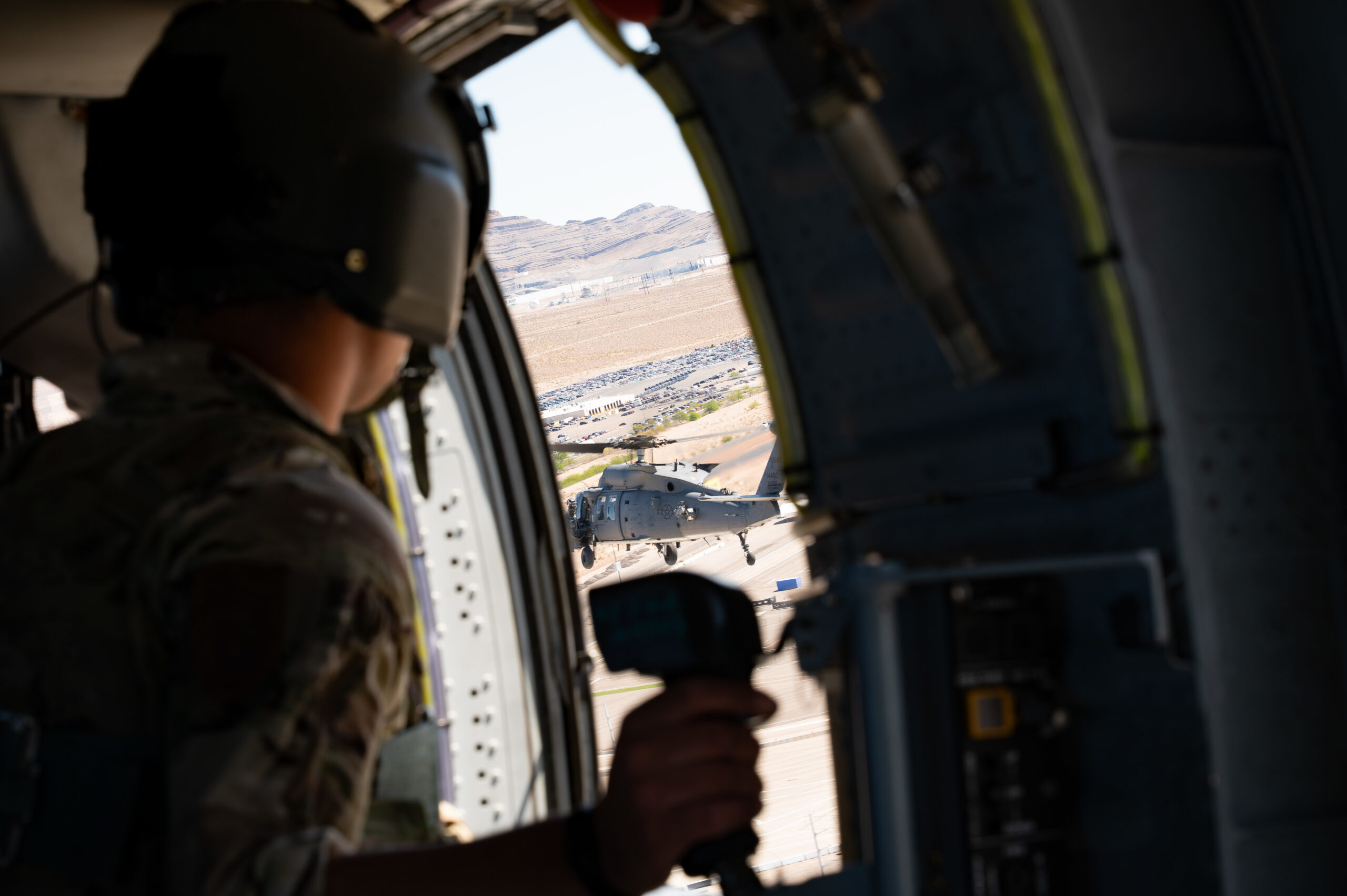
Air Force Rescue Team Saves Navy Aircrew After Emergency Landing in California Mountains
NELLIS AIR BASE, NEV. – A U.S. Air Force search and rescue team from Nellis Air Base successfully extracted five U.S. Navy helicopter crew members last week after their aircraft was forced to make an emergency landing in rugged, mountainous terrain near Naval Air Weapons Station China Lake, California. The mission, spanning over 200 miles, showcased rapid response capabilities, inter-service cooperation, and the critical role of maintenance personnel.
The incident began on August 10 when a Navy MH-60S Seahawk helicopter, engaged in a high-altitude training flight, conducted a hard landing in remote, challenging terrain. A “hard landing” typically refers to an abnormal landing, often caused by mechanical failure, environmental factors, or pilot error, which results in a greater vertical speed or force than desired. Notification of the emergency reached Air Force personnel at Nellis Air Base, Nevada, at approximately 11:30 a.m., prompting an immediate response from the 88th Test and Evaluation Squadron (TES) and the 355th Aircraft Maintenance Squadron (AMXS).
Despite the urgent call, the two HH-60W Jolly Green II search and rescue helicopters designated for the mission were not on immediate standby, necessitating preparation time. Furthermore, a critical mechanical issue emerged, threatening to ground one of the essential rescue aircraft before it could even depart. A circuit breaker problem posed a significant hurdle, exacerbated by the absence of readily available spare parts to rectify the malfunction swiftly.
Staff Sgt. Cody Adams, an avionics craftsman with the 355th AMXS, played a pivotal role in overcoming this challenge. He swiftly diagnosed the issue, identifying a master caution warning press-to-reset button as the root cause of the intermittent circuit breaker trips. Adams then provided a crucial workaround, enabling the system to remain operational and allowing the aircraft to take off on schedule. This quick thinking and technical expertise were instrumental in launching the rescue effort without further delay, demonstrating the indispensable contribution of ground crews to operational success.
By 1:00 p.m., just 90 minutes after receiving the initial alert, the two HH-60W Jolly Green IIs departed Nellis Air Base. The journey involved navigating over 200 miles of airspace across the California desert to reach the remote crash site in the mountainous region near China Lake, an area known for its challenging topography and extreme conditions. By 3:00 p.m., the rescue helicopters had successfully located the five Navy personnel on the ground and established two-way radio communication, confirming their status and condition.
Upon reaching the landing zone, Captain John Howe, a combat rescue officer with the 88th TES, led a specialized pararescue team in assessing the condition of the survivors. Pararescuemen are highly trained combat search and rescue specialists who can provide emergency medical treatment and conduct complex recoveries. The assessment confirmed that none of the five Navy crew members had sustained injuries requiring immediate medical attention, a critical factor in determining the extraction strategy. To minimize the physical exertion required for the Navy personnel to reach the extraction point in the rugged terrain, the pararescue team made the strategic decision to reposition the HH-60Ws to a closer, more accessible landing area.
This tactical adjustment facilitated a swift and safe extraction. All five Sailors were successfully airlifted from the mountainous terrain by 3:50 p.m. They were then transported safely to their unit’s ramp at Naval Air Weapons Station China Lake, where further evaluation could be conducted, before the Air Force rescue helicopters returned to Nellis. The entire operation, from initial notification to the safe transfer of personnel, was completed within approximately four and a half hours, highlighting the efficiency and coordination of the rescue teams.
Lieutenant Colonel Kenneth “Buddy” Wilkins, the flight lead for the rescue mission and commander of the 88th TES, underscored the fundamental motivation behind such operations. “That is why people join these career fields—because they want to have an impact and they want to be able to be there for their fellow service members in a time of need,” Wilkins stated in an Air Force press release. He added, “We have trained our whole careers to execute in these circumstances, and we have prepared and executed so many similar missions, that to us, it just felt like Monday. It feels great to do the mission and help those in need.”
Leaders from both the 88th TES and the 355th AMXS attributed the success of the rapid response to a robust, pre-existing relationship between the maintenance and operations units. Lieutenant Colonel Joshua Bedel, commander of the 355th AMXS, commented on the synergy: “There’s an immense amount of trust, and that was evident. You can tell there’s a deep respect for each other when it comes to getting that aircraft off the ground.” Lieutenant Colonel Wilkins corroborated this, noting that he had confidence the maintainers would have the aircraft ready, reflecting lessons learned from previous exercises and a culture of mutual reliance.
The HH-60W Jolly Green II is the U.S. Air Force’s dedicated combat search and rescue (CSAR) helicopter, specifically designed to penetrate contested airspace to recover downed personnel. It was selected in 2014 to replace the aging HH-60G Pave Hawk fleet, which had been in service for decades. The HH-60W boasts enhanced defensive systems, greater fuel capacity, and improved avionics, making it more capable in modern combat environments. The first production models were delivered to the Air Force in 2021. The acquisition program has seen various adjustments, reflecting evolving defense priorities and budget constraints.
Originally, the Air Force planned to procure 113 HH-60Ws. However, this total was reduced to 85 aircraft—comprising 75 production airframes and 10 test aircraft—in the 2023 budget plan, reflecting a strategic re-evaluation. Congress subsequently intervened, adding funds for an additional 10 aircraft in 2024 and four more in 2025, bringing the projected production total to 89. The 2026 budget request further clarified the program’s outlook, indicating that “funding is available to procure 100 aircraft,” including 11 test airframes. These fluctuations highlight the complex interplay between military requirements, executive branch budget proposals, and congressional oversight in defense acquisition, often influenced by geopolitical shifts and fiscal pressures.
A more recent development in 2025 involved a decision to modify 26 of the HH-60Ws for an executive airlift mission, replacing the aging UH-1 Hueys currently operating out of Joint Base Andrews, Maryland. This mission involves contingency response for government operations and senior leadership transportation within the Air Force District of Washington’s area of responsibility, a role traditionally performed by less specialized helicopters.
The modifications, detailed in budget plans, include reconfiguring the helicopter cabins to accommodate up to 11 passengers. Crucially, this repurposing entails removing specialized combat search and rescue equipment, such as the gun system for self-defense, chaff/flare buckets for defensive countermeasures against missile threats, armor plating for crew protection, and personnel litter systems used for medical evacuations. These alterations are slated to begin in fiscal year 2028 and continue through 2030, marking a significant shift in the operational role for a portion of the HH-60W fleet, from front-line combat recovery to VIP transport.
Why This Matters
This successful rescue operation underscores several critical aspects of modern military readiness and inter-service capabilities. First, it highlights the paramount importance of rapid response and specialized search and rescue assets. In environments as challenging as mountainous terrain, often remote and hostile, swift action can be the difference between life and death. The ability of the Air Force’s 88th Test and Evaluation Squadron to deploy quickly, locate the distressed Navy crew, and execute a safe extraction demonstrates a high level of operational proficiency and validated training protocols designed for complex recovery scenarios. It reassures service members that they will not be left behind, even in difficult circumstances.
Second, the incident serves as a testament to the essential, often unsung, role of maintenance and support personnel. The quick diagnosis and workaround by Staff Sgt. Cody Adams exemplify how technical expertise on the ground is just as vital as flight skills in the air. Without the diligence, ingenuity, and readiness of the 355th Aircraft Maintenance Squadron, the rescue mission could have been critically delayed or even jeopardized, illustrating the symbiotic relationship between aircrews and their maintenance teams. This successful collaboration between operations and maintenance units reinforces the concept that military effectiveness is a collective endeavor, where every specialty plays an indispensable role.
Third, the inter-service nature of the rescue—Air Force personnel saving Navy personnel—showcases the seamless cooperation and shared commitment to safety across different branches of the U.S. military. Such joint operations are fundamental to national defense, ensuring that all service members, regardless of branch, can rely on robust support systems when in peril, particularly during training exercises that push the boundaries of equipment and human endurance. This level of integration is crucial for effective military operations, both domestically and internationally.
Finally, the broader context of the HH-60W Jolly Green II program highlights ongoing debates within defense procurement and resource allocation. The fluctuations in planned aircraft numbers and the recent decision to modify a portion of the fleet for executive airlift raise questions about strategic priorities and the optimal use of specialized assets. While using existing airframes for multiple missions can be an efficient use of resources and potentially save costs in some areas, diverting specialized combat search and rescue helicopters for executive transport could potentially impact the dedicated CSAR capacity, either by reducing the number of available airframes for their primary mission or by requiring new acquisitions to fill the gap. This decision necessitates careful consideration of the balance between various defense needs and the specific, high-risk mission for which these advanced aircraft were originally designed. It reflects the continuous challenge faced by military planners in balancing budget realities with evolving operational requirements and maintaining a versatile, yet focused, force posture capable of addressing a wide range of national security demands.