
This article’s audio content is presented by the Air & Space Forces Association, commemorating and backing our service members and their kin. Discover more at afa.org
AURORA, Colo.—For the initial time, the Air Force has outfitted its novel unmanned combat aircraft with non-explosive armaments and intends to carry out actual weapon trials in the coming months. These actions coincide with the service’s endeavor to introduce its new drone wingmen into operation at an accelerated pace compared to conventional planes.
“The development of Collaborative Combat Aircraft is advancing swiftly,” Gen. Kenneth S. Wilsbach, Air Force Chief of Staff, informed a packed assembly hall of military personnel and general public present.
Wilsbach described the service’s wider undertaking to revitalize its antiquated aircraft contingent and tackle its restricted operational volume, stating, “Our upgrading initiatives are dual-faceted. Initially, we will ensure immediate combat readiness. We must absolutely guarantee the combined military power maintains dominance of the skies. Protracted or extended schedules could constrain our capacity to achieve this, thus transitioning systems from idea to deployment with utmost speed is our primary objective. However, we also need to be prepared to engage in conflict in the foreseeable future.”
Besides advancements in the CCA program, Wilsbach also mentioned that the upcoming F-47 sixth-generation combat aircraft “is still scheduled for an imminent maiden flight,” and the initial B-21 units are slated for delivery to Ellsworth Air Force Base, S.D., next year.
This recent CCA achievement marks the most current in an initiative that has sustained consistent advancement across successive presidential tenures and several leadership changes.
Wilsbach remarked, “Transitioning from idea to preliminary model in 16 months, and recently incorporating non-explosive armaments, the development teams are proceeding significantly quicker than a conventional undertaking.”
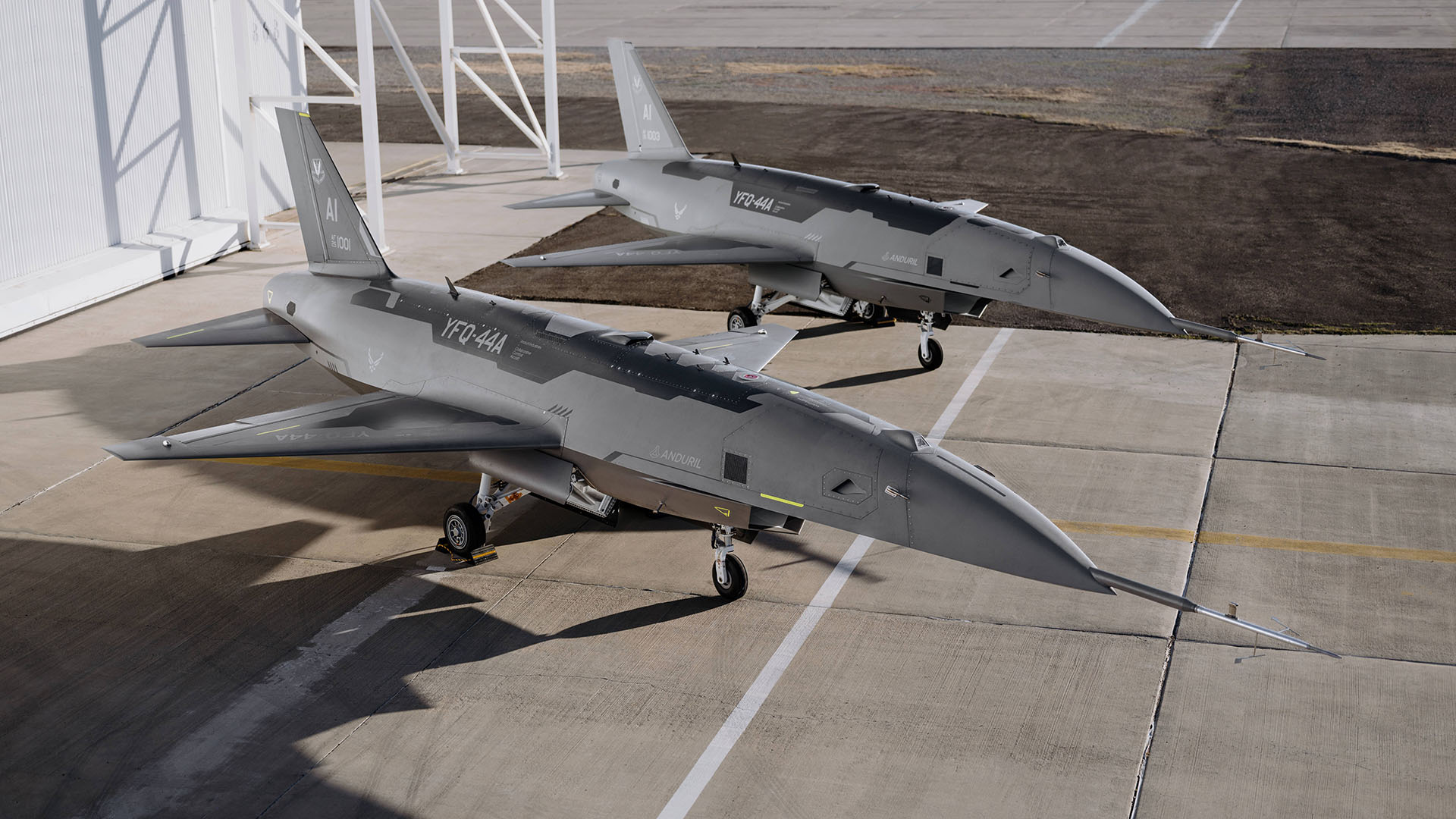
An Air Force representative informed Air & Space Forces Magazine that Collaborative Combat Aircraft lately transported non-explosive AIM-120 AMRAAM aerial munitions. This functionality underwent trials under two years subsequent to granting the initial design agreements, and approximately six months following the maiden flights of the two preliminary model planes, General Atomics’ YFQ-42A and Anduril’s YFQ-44A.
The representative stated that both platforms are progressing as planned with armament incorporation. Air Force authorities indicate the service has not yet pledged to acquire a particular model—or models. A determination regarding the YFQ-42A and YFQ-44A will be reached by the service later this year.
In a statement, Wilsbach affirmed, “We are adhering to the identical meticulous methodology employed in all other aircraft advancement trial initiatives to verify airframe integrity, aerodynamic attributes, and secure detachment. This guarantees the CCA’s secure incorporation of non-explosive armaments prior to subsequent operational use.”
The service’s representative indicated that Andruil’s YFQ-44A—which bears its armaments on its exterior—has undertaken flights with the non-explosive version of the AIM-120, known as Captive Air Training Missiles. General Atomics’ YFQ-42A, dubbed Dark Merlin by the company earlier Feb. 23, “is anticipated to commence this identical stage imminently.” The YFQ-42A possesses an enclosed armament compartment, unlike its primary rival, and will house the munitions within.
The Air Force representative stated, “Presently, CCA armament incorporation initiatives for both the YFQ-42A and YFQ-44A platforms are centered around aerial combat armaments, employing diverse versions of the AIM-120 guided munition framework.”
The initial CCAs are conceived as planes designed for aerial combat operations, complementing piloted planes such as the F-35A and upcoming F-47, thereby augmenting armament payload and mitigating danger for flight personnel—what the Air Force terms a “collaborative human-AI unit.”
Wilsbach further stated, “CCA represents an essential component within an extensive, interconnected network of systems that will provide our combatants a decisive upper hand. This initiative focuses on providing a web of impacts designed to detect, engage, and protect our forces in disputed operational zones. We are authorizing our groups to undertake calculated hazards and expedite the provision of this capacity, guaranteeing our ability to dissuade and, should it be required, vanquish any foe.”
Air Force officials emphasized that the service is not currently prepared to deploy actual armaments in active service from CCAs. They further underscored that human operators—not self-governing programs—will maintain the power to authorize weapon discharge throughout the progression of trials, and the armaments will be utilized in the same manner as on a piloted plane.
In an official statement, the Air Force clarified, “CCA is intended to function within the bounds of pre-existing command hierarchies and regulatory guidelines overseeing all Air Force armament apparatuses.”
Shield AI is creating the functional programming for Anduril’s YFQ-44A, while Collins Aerospace is creating the software for General Atomics’ YFQ-42A, as the service disclosed prior this month. This designated “mission” self-governing software will enable CCAs to execute sorties alongside piloted combat jets, performing intricate maneuvers based on simple instructions from a pilot.
The Air Force further stated it was carrying out its armament trials in a “methodical and open fashion” as it upgrades its military capabilities via “accountable advancement.”
This article’s audio content is presented by the Air & Space Forces Association, commemorating and backing our service members and their kin. Discover more at afa.org