
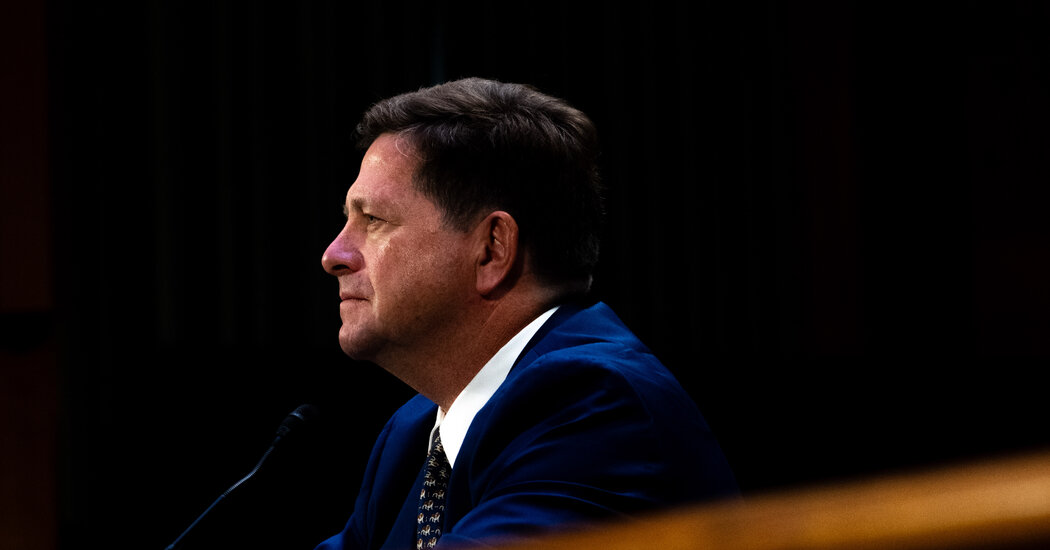
Jay Clayton, who received Senate confirmation last week to lead the U.S. Intelligence Community, officially assumed his role as the Director of National Intelligence (DNI) on Monday, as announced by his office. The swearing-in ceremony marks his formal commencement in a position critical for coordinating the seventeen disparate agencies that comprise the nation’s intelligence apparatus, including the CIA, FBI, and various military intelligence units. The DNI’s office was established in the wake of the September 11, 2001 attacks, as part of a broader intelligence reform effort aimed at improving information sharing and strategic coordination across the intelligence community.
Mr. Clayton’s confirmation by the Senate took place the previous Tuesday. However, the White House did not immediately proceed with his swearing-in. This delay extended the tenure of Bill Pulte as the acting Director of National Intelligence for several additional days, a situation that drew scrutiny and prompted inquiries from a number of lawmakers. Mr. Pulte, who had been characterized as a close associate of President Trump, had served in the interim capacity since the previous month. Details surrounding Monday’s swearing-in ceremony for Mr. Clayton were not immediately provided by his office.
During his month-long period as acting director, Mr. Pulte undertook several notable actions. He oversaw the declassification of certain documents related to foreign interference in elections. Additionally, he publicly asserted that he had reduced the size and staffing of the Office of the Director of National Intelligence (ODNI). This claim, however, was met with questions from both current and former government officials regarding the precise number of positions that had been eliminated and the overall impact of such reductions on the ODNI’s operational capacity and effectiveness.
In a statement released on Monday, Mr. Clayton expressed his anticipation of leading what he described as a “streamlined organization.” His remarks, however, did not explicitly detail any plans for further personnel reductions, nor did they suggest an intent to significantly downsize or abolish the office. The question of the ODNI’s size and scope has been a recurring point of discussion. Members of Congress, including Senator Tom Cotton of Arkansas, who serves as the chairman of the Senate Intelligence Committee, have publicly advocated for reducing the office’s footprint. Similarly, President Trump had reportedly voiced private reservations about the relevance of the ODNI and had encouraged Mr. Pulte to implement staffing cuts during his acting tenure.
“It is more important than ever for the Intelligence Community to deliver the best possible intelligence to the President, policymakers, military leaders, and Congress,” Mr. Clayton stated in his remarks. He further emphasized the critical nature of intelligence gathering, adding, “Intelligence is our first line of defense, and we must get it right.” These statements underscore the DNI’s central role in ensuring that accurate and timely information reaches key decision-makers across the U.S. government.
Prior to his confirmation as DNI, Mr. Clayton served as the U.S. Attorney for the Southern District of New York, a highly prominent and influential prosecutorial role within the federal justice system. His nomination for the DNI position initially garnered support from a broad spectrum of lawmakers, receiving endorsements from both Democratic and Republican senators ahead of his confirmation hearing. This bipartisan backing reflected an initial consensus on his qualifications for the sensitive role.
However, the confirmation hearing itself became largely focused on questions surrounding the outcome of the 2020 presidential election and Mr. Clayton’s willingness to provide intelligence assessments that might contradict the preferences of President Trump. During the hearing, Mr. Clayton declined to unequivocally affirm that Joe Biden had won the election. This stance proved to be a pivotal moment, leading to a withdrawal of support from many Democratic senators who argued that an intelligence chief must be able to deliver objective, unvarnished assessments regardless of political implications.
In his Monday statement, Mr. Clayton did not present a comprehensive agenda for his term in office. Nevertheless, he committed to ensuring transparency and accountability within the intelligence community, often referred to as the I.C. This commitment is particularly significant given ongoing public and political debates regarding the appropriate boundaries and oversight of intelligence activities.
“This includes ensuring the vital work of our I.C. is never weaponized for political motives,” Mr. Clayton affirmed. This statement addresses a persistent concern among critics of intelligence agencies, who have, at various times, alleged that intelligence information or processes have been improperly influenced or utilized for partisan ends. His emphasis on preventing such weaponization signals a priority to uphold the non-partisan integrity of the intelligence community.
Why This Matters
The appointment of a new Director of National Intelligence (DNI) holds significant implications for U.S. national security and the functioning of its government. The DNI is not merely a bureaucratic head; the position is central to the nation’s ability to anticipate and respond to a vast array of global threats, from terrorism and cyberattacks to geopolitical rivalries and health crises. The office was created specifically to overcome historical failures in intelligence coordination, and its effectiveness directly impacts the quality of information provided to the President, military leaders, and Congress for critical decision-making.
Jay Clayton’s tenure begins at a time of heightened scrutiny and political tension surrounding the intelligence community. The debate during his confirmation hearing, particularly his reluctance to affirm the outcome of a presidential election, underscores the paramount importance of the DNI’s perceived political independence. The role demands an ability to deliver objective, unvarnished intelligence assessments, even when they may be inconvenient or unwelcome to political leadership. Any perception of political influence or bias in intelligence reporting can erode trust, both domestically and internationally, undermining the credibility and effectiveness of the entire U.S. intelligence apparatus.
Furthermore, the preceding acting director’s actions—including declassifying documents and claims of organizational restructuring—highlight ongoing discussions about the transparency, accountability, and appropriate size of the intelligence community. A DNI’s approach to these issues can set precedents for how intelligence agencies operate, how they are overseen, and how information is shared with the public and policymakers. Clayton’s stated commitment to preventing the “weaponization” of intelligence for political motives signals an awareness of these concerns and suggests a potential focus on reinforcing the apolitical nature of intelligence work.
Ultimately, the DNI’s success in fostering collaboration among diverse intelligence agencies, maintaining impartiality, and ensuring accurate intelligence delivery is crucial for safeguarding national interests. A strong, unified, and respected intelligence community is vital for informed foreign policy, effective military operations, and robust domestic security. The challenges and priorities that Jay Clayton sets for the Office of the Director of National Intelligence will therefore have far-reaching consequences for how the United States understands and navigates a complex global landscape.