
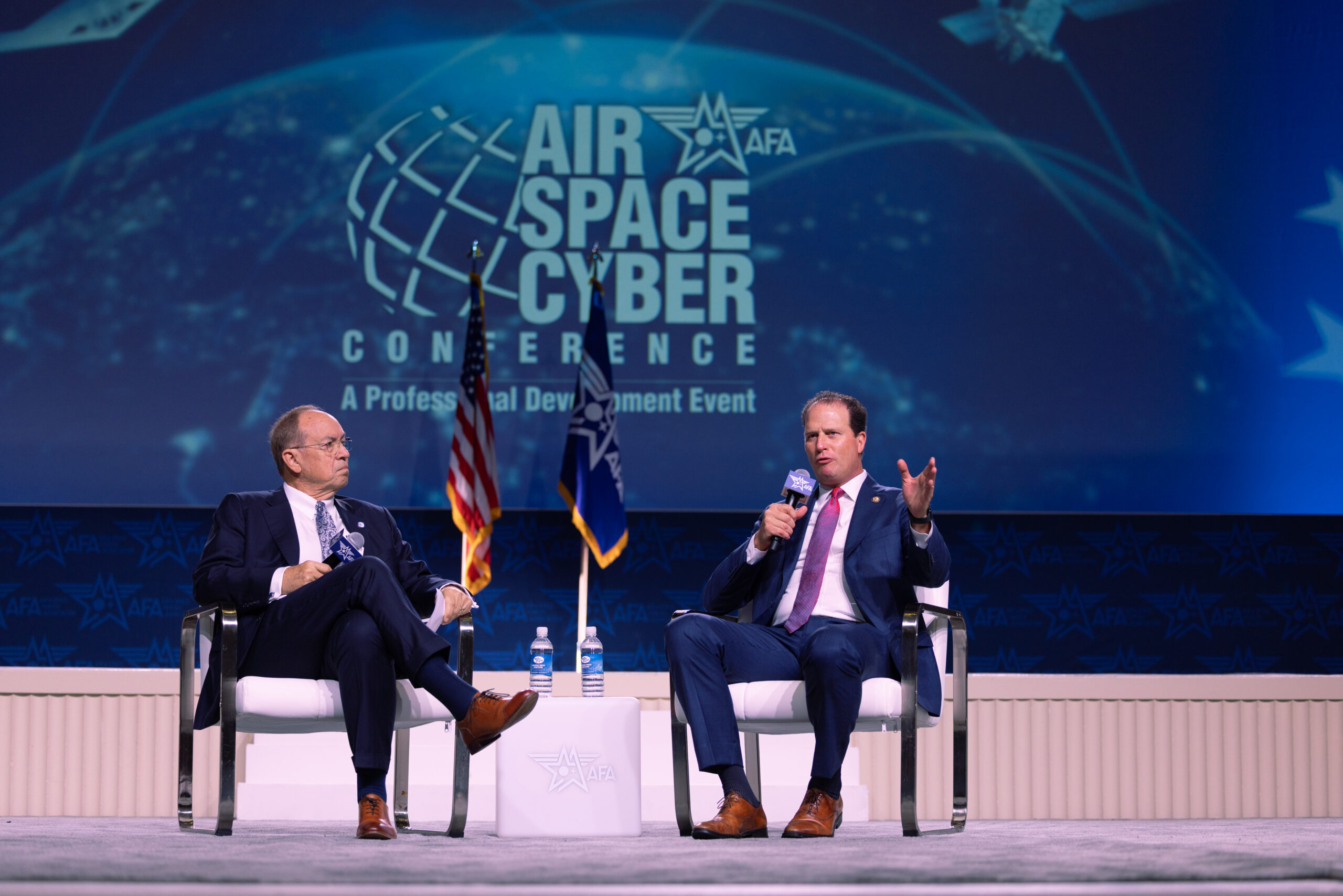
NATIONAL HARBOR, Md.—Speaking on September 16 at the Air & Space Forces Association’s (AFA) Air, Space & Cyber conference, Rep. August Pfluger (R-Texas) highlighted a significant projected imbalance in military veteran representation for the 119th U.S. Congress, which is scheduled to convene in January 2025.
Pfluger, an Air Force veteran who piloted F-15 and F-22 fighter jets, pointed out that while the upcoming Congress is expected to include a record seven former Navy SEALs among its members, he anticipates being the sole former Air Force fighter pilot. He contended that this disparity in specialized expertise could hinder the Air Force’s ability to secure essential resources for modernizing its aging aircraft fleet.
“I am the only fifth-generation pilot in Congress,” Pfluger stated, underscoring the scarcity of lawmakers with direct experience in modern air combat. “I need some wingmen to come join me. … God bless my Navy SEAL friends, and they are dear friends, but we’ve got a lot of them in Congress. What we don’t have is a lot of air and space expertise.”
Indeed, an analysis of the 96 military veterans currently serving in Congress reveals a disproportionate representation across service branches. Only 15 of these veterans, or 15.6 percent, served in the Air Force. This contrasts sharply with 45 Army veterans, 24 Navy veterans, and 12 former Marines. The U.S. Space Force, established less than seven years ago, has not yet seen any of its former Guardians elected to Congress.
Among the 15 former Airmen on Capitol Hill, not all are aviators, and Pfluger remains the only former Air Force fighter pilot. Other notable Air Force veterans include Rep. Don Bacon (R-Neb.), who flew on EC-130H and RC-135 aircraft; Rep. Troy Downing (R-Mont.), who served in combat search and rescue; and Rep. Zach Nunn (R-Iowa), an airborne intelligence officer.
Pfluger initiated the “Mach 1” caucus in 2022 with three former Navy fighter pilots to promote understanding of airpower issues. However, four years and two election cycles later, the caucus has seen its membership decline from four to three: Pfluger, Rep. Jake Ellzey (R-Texas), and Rep. Scott Franklin (R-Fla.).
With such limited representation, Pfluger argued, the Air Force faces increased difficulty in communicating its operational requirements and strategic importance to fellow lawmakers. “What I have done in Congress is try to educate my colleagues on what the Department of the Air Force does and why we, as a department, are really carrying the load in each of the conflicts—whether it’s Epic Fury, Midnight Hammer, Absolute Resolve, or any of the previous conflicts, the Department of the Air Force has been there every single time,” Pfluger emphasized.
He asserted that airpower uniquely provides strategic effects in military operations, making modernization efforts critical for national security. Pfluger expressed concern that without adequate support and understanding in Congress, the Air Force might struggle to recapitalize its fleet. “We … need the help to make the case that while we are the oldest and the smallest, it’s not too late. We can recapitalize,” he said, lamenting that budget increases often cannot be evenly distributed among services if the Air Force is to continue shouldering a significant operational burden.
While more Airmen in Congress would aid his advocacy, Pfluger acknowledged the support he receives from lawmakers representing key Air Force installations. He also issued a direct call to Air Force leadership, urging them to be more assertive in their budgetary requests. “We need Air Force leaders to be bold,” Pfluger stated. “We need you to be bold to tell the truth, to say we’re underfunded.”
Multiyear Procurement
Beyond direct funding, Pfluger also advocated for congressional reforms to provide more consistent resource allocation for the Air Force, particularly through multiyear procurement authorities. Pentagon officials frequently highlight how annual budget cycles, continuing resolutions, and potential government shutdowns disrupt planning, increase costs, and delay critical defense programs.
Pfluger concurred that a “predictable environment” is essential for effective defense acquisition. Multiyear procurement allows the Pentagon to award contracts for multiple years, rather than being confined to annual appropriations. Proponents of this approach argue that it saves taxpayer money by allowing bulk purchasing and locking in lower prices, while also providing a stable demand signal that benefits the defense industry by facilitating long-term planning and investment.
Historically, some lawmakers have raised concerns about oversight with multiyear contracts. However, there has been a growing openness within Congress to grant more of these authorities, particularly for major acquisition programs. Congress has already implemented multiyear procurement for various munitions programs.
Additionally, members of the House and Senate Armed Services Committees have voted to authorize multiyear procurement for key aircraft, including the F-35 fighter and the F-15EX Eagle II, as part of the proposed 2027 defense policy bill. While that bill is still pending legislative approval, Pfluger expressed optimism about the prospect of expanding these authorities. “I’m very convinced that we’re very close to getting some of these things accomplished,” Pfluger concluded.
Why This Matters
The discussion surrounding veteran representation in Congress and the advocacy for the Air Force’s modernization efforts carries significant implications for U.S. national security, defense spending, and the legislative process.
First, the argument that a lack of specialized “air and space expertise” in Congress could impede the Air Force’s ability to secure adequate resources directly links to the broader concern of maintaining a competitive edge against potential adversaries. As Rep. Pfluger highlighted, the Air Force plays a critical role in various global conflicts, and its ability to project power and maintain air superiority relies heavily on a modern, well-equipped fleet. An aging fleet, if not recapitalized effectively, could compromise operational readiness and increase risks for service members, potentially impacting the nation’s capacity to respond to future threats. The strategic importance of airpower in contemporary warfare necessitates that decision-makers understand the nuances of its development and deployment.
Second, the call for multiyear procurement addresses fundamental issues in defense acquisition and fiscal efficiency. The current system, often plagued by continuing resolutions and the threat of government shutdowns, creates instability that drives up costs and delays critical programs. Multiyear procurement, by providing a more predictable funding stream, could lead to substantial taxpayer savings through economies of scale and allow defense contractors to invest more confidently in their workforce and supply chains. This stability is crucial for sustaining the industrial base that supports U.S. military capabilities, ensuring that necessary equipment and technology are delivered on time and within budget. The ongoing debate over its implementation for major platforms like the F-35 and F-15EX reflects a broader legislative effort to improve the effectiveness and cost-efficiency of defense spending.
Finally, the imbalance of veteran representation in Congress raises questions about how well the legislative branch understands the diverse needs and challenges of each military service. While all veterans bring valuable perspectives, specific operational experience, such as that of a fighter pilot, can provide unique insights into the technological, logistical, and strategic demands of a particular domain. A perceived lack of such specialized knowledge among lawmakers could potentially lead to misinformed decisions regarding resource allocation, strategic planning, and the overall direction of defense policy. This issue also reflects a broader trend of declining veteran representation in Congress, which some argue could diminish the legislative body’s direct connection to military realities and service members’ experiences.