
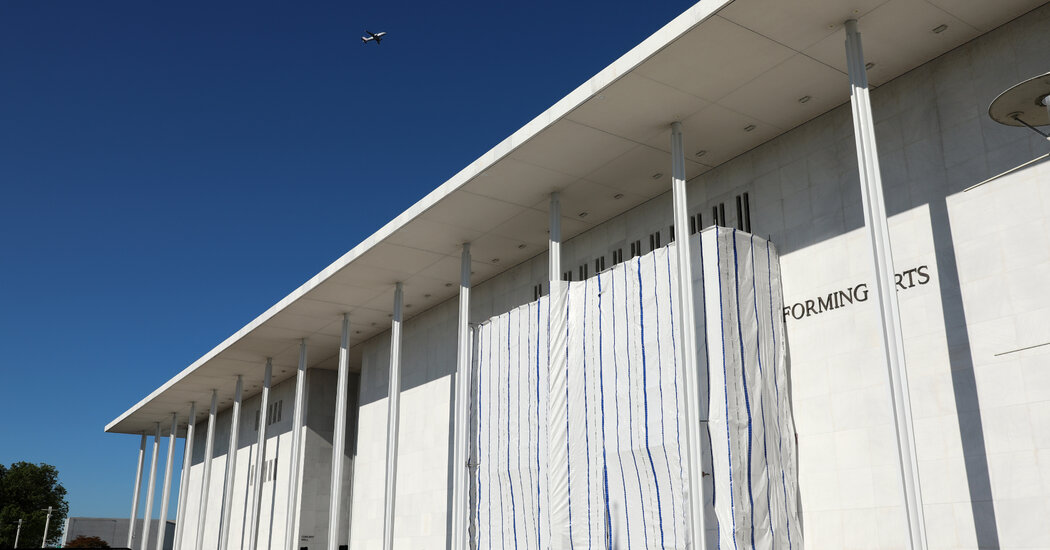
Washington, D.C. – The John F. Kennedy Center for the Performing Arts, a prominent national memorial and cultural institution in the United States capital, found itself at the center of a protracted legal and public debate this past Saturday. Patrons and visitors observed a facade still shrouded in tarps, even as the institution certified to a federal court that the name of former President Donald J. Trump had been removed from its exterior, in compliance with a recent judicial order.
The situation unfolded at midday, following a court-imposed deadline for the center to confirm the removal. Approximately 150 individuals had gathered outside the building, anticipating a public unveiling of the restored facade. The federal court mandate stemmed from a ruling late last month by Judge Christopher R. Cooper of the Federal District Court in Washington, which determined that the center’s board lacked the authority to alter the name of the institution, originally dedicated by Congress in 1964 as a living memorial to President John F. Kennedy.
Despite the certification, the white- and blue-striped tarps remained, obscuring the front of the building and leaving observers without immediate visual confirmation. This ambiguity underscored the ongoing legal uncertainty surrounding the center’s governance and future operations. The move to add Mr. Trump’s name in December was initiated by allies on the center’s board, who argued it was essential for the institution’s revitalization and fundraising efforts.
Among those present was Katy Bigge, a student from Rutgers University, who expressed a desire for a clear reveal. Her father, Philip Bigge, attempted to peer through a gap in the tarp, believing he could discern the absence of the letters. “I think overall the message is that the process works,” he remarked, reflecting a sentiment among some who view the court’s intervention as a validation of legal processes governing public institutions.
However, the immediate satisfaction for critics of the name change, some of whom had also gathered the previous evening, may be temporary. Representatives for the Kennedy Center did not provide immediate comment regarding plans for the facade’s unveiling. Moreover, the center’s board, whose members had voted to affix Mr. Trump’s name, continues to challenge Judge Cooper’s order in an appeals court. Should a higher court overturn the ruling, the possibility remains that the name could be reinstated.
The legal dispute extends beyond the naming convention to encompass Mr. Trump’s proposal for a two-year closure of the center for extensive renovations. Judge Cooper’s ruling also temporarily halted this plan, citing insufficient scrutiny by the board regarding the potential consequences of such a shutdown. The center’s future, including its operational status and artistic programming, remains contingent on the outcomes of these appeals.
The institution faces significant operational challenges irrespective of the legal resolution. Reports indicate a staff depleted by firings, layoffs, and voluntary departures, a significantly reduced programming calendar, and financial pressures exacerbated by boycotts from artists and audiences. Cathleen O’Malley, a former manager in the center’s artistic programming department who departed in February, highlighted the deeper impacts.
Ms. O’Malley, who observed the facade removal efforts on Friday, emphasized that while the name change was the most visible point of contention, considerable damage had already occurred over the preceding 16 months. She specifically pointed to the loss of experienced employees who had cultivated long-standing relationships with artists and donors as a critical challenge. According to O’Malley, those who anticipate a swift return to normalcy once the name issue is resolved “are missing the breadth and depth of damage that has been done.”
The controversy underscores a broader debate concerning political influence within cultural institutions and the balance between donor contributions and institutional integrity. The Kennedy Center, established as a non-profit cultural organization and a federal bureau, operates with a unique dual mandate that often places it at the intersection of arts, politics, and public service.
Conversely, former President Trump and his supporters maintain that the rebranding initiative yielded substantial benefits for the institution. A briefing filed by the Justice Department with the U.S. Court of Appeals for the District of Columbia Circuit asserted that millions of dollars in donations were contingent upon Mr. Trump’s name being displayed on the building. This argument posits that the name change was a strategic move to bolster the center’s financial health and secure vital funding.
The Justice Department filing articulated that the “removal of President Trump’s name threatens to impede the center’s fund-raising efforts and contribute to the financial decline of the center.” This perspective highlights the complex financial realities facing large cultural institutions, which often rely on significant philanthropic contributions and government support. While no public financial documents have yet detailed the precise economic impact of Mr. Trump’s involvement as chairman, tax filings covering a portion of his tenure are anticipated for release in the coming months, which may offer further clarity.
Amidst the ongoing legal and financial uncertainties, resident ensembles like the National Symphony Orchestra face a precarious future. Without an approved budget for its upcoming season, the orchestra’s operations are in limbo. A scheduled concert on Saturday may represent its last performance at the center before a potential closure. The situation has also divided Kennedy Center supporters, with some advocating for boycotts of symphony and other programs to protest the board’s decisions, while others contend that such actions only harm the performing artists.
Paige Carter, a recent graduate of American University’s law school, expressed a personal sense of loss, noting her decision to let her Kennedy Center membership lapse following the controversies. “I have so many amazing memories here,” she stated, adding, “I desperately miss it,” reflecting a sentiment shared by many long-time patrons who regret the current state of affairs.
Mr. Trump’s proposed two-year renovation plan, for which he helped secure $257 million from Congress last year, aimed to modernize the institution, which originally opened in 1971. Matt Floca, the center’s executive director and the president’s primary liaison for the renovation, has consistently emphasized the urgent need for maintenance, citing critical issues such as significant water leaks, outdated equipment, and discolored exterior marble. These infrastructure concerns are not disputed by judicial or public observers, with Judge Cooper acknowledging that maintenance was “sorely needed.”
However, Judge Cooper’s temporary injunction on the closure was predicated on the board’s perceived lack of due diligence. He ruled that the board had been “ill-informed” in its swift approval of Mr. Trump’s renovation plan and had failed to properly assess the potential consequences of shuttering Washington’s pre-eminent arts institution for an extended period. The judge’s order provided the board with an option to conduct a more thorough assessment of the implications of a two-year closure before proceeding. It remains unclear whether the board will pursue this path or prioritize an appeal to overturn the judicial injunction.
The physical appearance of the center, with its facade obscured by tarps and scaffolding, already presents the image of an active construction site. The work to remove the name on Friday night extended past the initial midnight deadline set by Judge Cooper, necessitating a 12-hour extension. Mr. Floca attributed the delay to thunderstorms, a request the court granted.
The commencement of the removal work itself appeared contingent on the appellate court’s decisions, proceeding only after both the district court and an appeals court denied the Kennedy Center’s requests for a stay on the order. Lawyers representing Representative Joyce Beatty, an Ohio Democrat and an ex officio board member whose lawsuit led to the court ruling, did not oppose the extension but expressed skepticism regarding the delay. They noted in a court filing that “Defendants had two weeks to comply with the order, and only need an extension because of their inexcusable delay.” The timeline for the removal of the tarps and the full revelation of the facade remains unspecified, awaiting further communication from Mr. Floca, who maintains regular contact with former President Trump.
Why This Matters
This protracted dispute at the John F. Kennedy Center for the Performing Arts transcends a mere naming controversy; it illuminates critical questions about governance, federal oversight, the integrity of national memorials, and the intersection of politics with cultural institutions in the United States. As a living memorial to President John F. Kennedy and a hub for performing arts, the center holds a unique place in American cultural landscape, balancing its role as a federal entity with its need for private funding and artistic independence.
The legal battle highlights the importance of the judiciary in upholding established legal frameworks, particularly concerning federal institutions. Judge Cooper’s ruling reinforces the principle that fundamental changes to federally dedicated memorials require congressional approval, not merely board consensus. This sets a precedent for how public and federal property, especially those with historical and commemorative significance, are managed and protected from potentially partisan influences.
Furthermore, the controversy has significant implications for the center’s operational and financial health. The proposed two-year closure, stalled by judicial review, raises concerns about the continuity of arts programming, the livelihood of artists and staff, and the accessibility of cultural experiences for the public. Boycotts and internal divisions threaten the institution’s ability to attract talent, maintain its audience base, and secure essential funding. The argument that naming rights are crucial for fundraising against the concerns over perceived politicization underscores the precarious balance cultural institutions must strike between financial viability and artistic mission.
Globally, this situation reflects a broader trend where cultural institutions grapple with external pressures, whether from political figures, major donors, or societal shifts. It serves as a case study in how the governance of such institutions, intended to be bastions of art and culture, can become entangled in political agendas, impacting their reputation, financial stability, and public trust. The resolution of these appeals will not only determine the future of the Kennedy Center but may also influence policies regarding the autonomy and oversight of similar national cultural entities worldwide.