
Key Takeaways:
- The Sonos Play brilliantly combines a compact desk speaker with portable convenience, thanks to its dock and integrated battery, making it ideal for flexible home use.
- It delivers balanced and detailed audio for personal listening and small spaces, boasting impressive instrument separation and the new auto-Trueplay calibration.
- While the Sonos app still presents occasional quirks, these are largely manageable, and the speaker’s versatility, durability, and sound profile offer strong value for its target audience.
The Hybrid Harmony: Sonos Play Blends Workspace Audio with Portable Freedom
In today’s remote work landscape, the quest for optimal home audio often leads down two distinct paths: immersive personal listening via headphones or room-filling sound from dedicated speakers. For those like myself, who primarily work from home, the dilemma is real. I’ve long relied on headphones or AirPods for my daily audio diet, yet harbored a desire for a desk speaker – something that offered a more open, less isolating experience without monopolizing precious workspace. Enter the new Sonos Play, the latest innovation from a company known for redefining home audio, and a fitting introduction to the Sonos ecosystem for this reviewer.
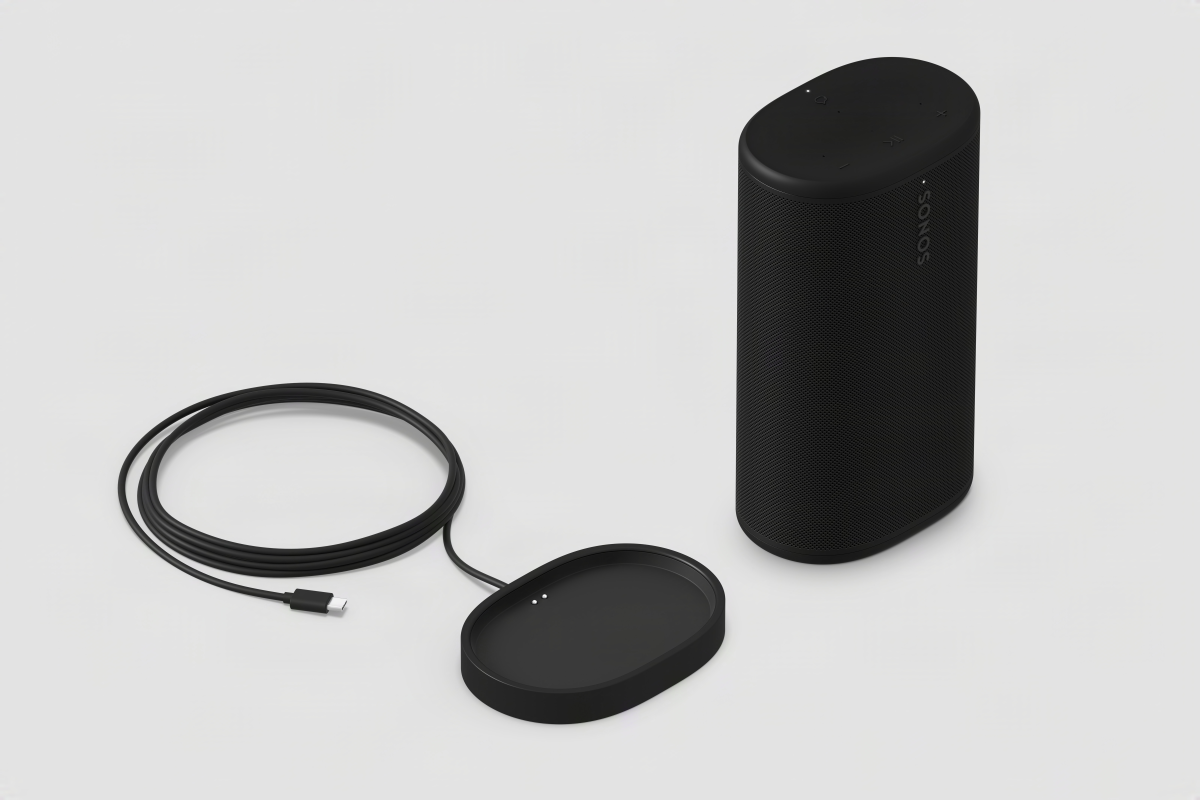
Launched in March, the $299 Sonos Play represents more than just Sonos’s first new device in over a year; it’s a deliberate pivot towards versatility. This speaker is a true hybrid, ingeniously designed to serve both as a stationary companion and a portable sound hub. Its sleek, pill-shaped dock anchors it firmly on your desk, providing power and a dedicated home. Yet, at a manageable 1.3 kilograms, complete with a distinctive “utility loop” on the back, the Play actively encourages you to detach it and carry your audio experience with you – whether to another room, out to the patio, or even beyond. This dual functionality immediately sets it apart, promising seamless transitions from focused work to relaxed leisure.
Design & Portability: A Thoughtful Blend of Form and Function
My testing experience quickly revealed the Play’s genius in practice. What began as a podcast session at my desk seamlessly transitioned as I grabbed the speaker and carried it to the kitchen to prepare coffee or cook. This immediate benefit over traditional headphones or AirPods became evident: the Play allows you to remain fully aware of your surroundings, ensuring you don’t miss conversations or crucial ambient sounds. It fosters a more connected, less isolated audio experience within the home environment. The integration of both Sonos Assistant and Alexa means voice commands are readily available, though the thoughtful inclusion of physical controls offers another layer of convenience.
These physical controls, positioned subtly on the speaker’s silicone top, proved invaluable, especially when hands might be messy from cooking or gardening. Adjusting volume or skipping tracks on AirPods with greasy fingers is notoriously awkward; the Play’s buttons, while discreet, are far more forgiving. However, their understated design – being the same color as the surface and barely raised – initially led to some fumbling. It took a few days to commit their positions to muscle memory, a minor frustration that could have been easily mitigated with better tactile feedback or contrasting colors. This small design oversight, however, does little to diminish the overall utility and intuitive nature of the speaker’s interaction points.

Beyond its ergonomic design, the Play boasts impressive durability. Its sturdy construction and IP67 rating mean it’s not just splash-resistant but capable of handling rain and even brief submersion. A quick test under a running tap confirmed its resilience without a hitch. This ruggedness extends its utility far beyond the confines of a desk, making it a reliable companion for outdoor gatherings, poolside relaxation, or even a picnic in the park. Adding to its outdoor appeal is a clever, often overlooked feature: the ability to charge your phone in a pinch. Doubling as a power bank, this is a genuinely welcome addition for any portable device, saving you from carrying an extra battery pack on your adventures.
Audio Performance: A Sweet Spot for Personal & Intimate Spaces
When it comes to sound, the Sonos Play is engineered with precision for its intended purpose. Under its minimalist exterior lies a sophisticated acoustic architecture: dual-angled tweeters, a dedicated mid-woofer, and three digital amplifiers work in concert to deliver clear, balanced audio. For outdoor use or when a little more heft is desired, two passive radiators diligently reinforce the bass, adding depth without overwhelming the mix. The result is a sound profile that is consistently balanced and remarkably detailed, particularly at moderate listening volumes. Instrument separation, a crucial element for discerning audio enthusiasts, is notably good, allowing individual elements of a track to shine through with clarity.
However, it’s important to set expectations for the Play’s soundstage. It tends to be somewhat narrow, meaning the music can feel contained rather than expansive, especially when compared to larger, dedicated home speakers. This characteristic is perfectly acceptable given its design as a personal or small-space speaker. At higher volumes, the mix does exhibit some loss of its pristine clarity, hinting that its sweet spot truly lies in providing quality audio for a listener or a small group, rather than attempting to fill a large room with sound.
For those aiming to envelop an entire living space, Sonos itself offers alternatives like the Era 100 SL, which launched alongside the Play and is better suited for broader room coverage. Yet, the Play offers its own spatial enhancement: two units can be paired into a stereo configuration. This is achievable either through the Sonos app or, more intuitively, by simultaneously holding the play/pause button on both speakers. This stereo pairing makes a noticeable and positive difference for music, enriching the soundstage and immersion. While it can connect to TV audio, these speakers aren’t primarily designed for that purpose, and the impact on television sound is less pronounced than for music.

A significant enhancement in the Play is Sonos’s Trueplay technology. This feature, which intelligently calibrates the speaker’s sound based on its environment, has received a welcome upgrade. Older iterations of Trueplay often required users to wave their phone around the room – an awkward, almost comical workaround that would be particularly ill-suited for a portable speaker. The new implementation handles this automatically, using the speaker’s built-in microphones to assess and adjust the audio profile, ensuring optimal sound quality wherever the Play finds itself. This seamless, ‘set it and forget it’ approach is a testament to Sonos’s continuous refinement of its user experience.
The Sonos Ecosystem & App Experience: A Work in Progress
No discussion of a Sonos product is complete without addressing its accompanying app, an area where the company has faced well-publicized struggles, ranging from disappearing speakers to glitchy volume controls. While Sonos has undeniably made meaningful improvements in recent updates, a few rough edges regrettably persist with the Play. For instance, audio sync between the Play and my MacBook occasionally exhibited noticeable lag, impacting the seamlessness of multimedia consumption. Similarly, playing or pausing audio on YouTube sometimes produced a frustrating delay before the speaker responded, disrupting the flow of content.
Switching audio sources and speakers within the Sonos ecosystem also presented mixed results. While AirPlay offered reliable and immediate transitions, attempting the same action through the Sonos app frequently failed until I installed the Apple Music integration. Even then, the process felt more cumbersome than it should be, involving several taps where a single one would suffice. The “Apply” button within the Sonos app, necessary to confirm speaker changes, often felt like an unnecessary extra step, especially when contrasted with AirPlay’s more streamlined, single-tap confirmation.
Furthermore, a specific bug was noted with Pocket Casts integration: podcasts would frustratingly restart from the beginning rather than picking up where they left off, requiring manual scrubbing. These app-related issues, though not entirely dealbreakers, highlight areas where Sonos can still refine its software experience to match the polish of its hardware. It’s worth acknowledging, however, that Sonos has demonstrated a willingness to iterate and improve its app over time, suggesting these remaining quirks are likely on their roadmap for future updates.
Is the Sonos Play Right for You?
Overall, the Sonos Play stands as a remarkably solid and compelling speaker that largely delivers on its innovative premise. It expertly bridges the gap between a personal desk speaker and a portable companion, offering a unique blend of convenience and quality. The app issues, while present, are not catastrophic and are outweighed by the speaker’s core strengths.
If absolute portability isn’t your top priority, and your primary need is simply to fill a room with sound, Sonos offers excellent alternatives. The Era 100 ($219) or Era 100 SL ($189) provide greater volume and a more expansive soundstage for less money, making them superior choices for static, room-filling audio. Conversely, if your adventures demand something even more rugged and truly go-anywhere, devices like the Sonos Roam 2 or the JBL Charge 6 might be worth considering for their specific emphasis on outdoor endurance and extreme portability.
However, if your lifestyle demands a speaker that performs equally well perched on your desk during a video call, carried into the kitchen for background music, or taken onto the back porch for a casual gathering, the Sonos Play makes an exceptionally convincing case for itself. Its unique hybrid nature, combined with robust sound for its size and commendable durability, positions it as an ideal choice for the modern home, blurring the lines between work and leisure, indoors and out.
Bottom Line
The Sonos Play carves out a distinct and valuable niche in the crowded audio market. It’s a beautifully designed, versatile speaker that excels at providing high-quality, personal audio wherever you need it – from your workspace to your patio. While the Sonos app still has room for improvement, the Play’s intelligent design, durable build, balanced sound, and impressive hybrid functionality make it an outstanding choice for anyone seeking a flexible, premium audio solution that adapts effortlessly to their dynamic lifestyle.
When you purchase through links in our articles, we may earn a small commission. This doesn’t affect our editorial independence.
{content}
Source:{feed_title}