
The New York Knicks secured a historic comeback victory in Game 4 of the NBA Finals on Thursday night, defeating the San Antonio Spurs and positioning themselves one win away from their first championship in decades. This dramatic win, achieved after overcoming a substantial deficit, followed a day marked by public controversy involving the team’s owner, James L. Dolan, and New York City Mayor Zohran Mamdani, setting a complex backdrop for the night’s events.
The day’s events commenced with an escalation of a long-standing dispute between Mr. Dolan and Mayor Mamdani. In a radio interview prior to the game, Mr. Dolan publicly attributed heightened security measures around Madison Square Garden to decisions made by the Mayor and Police Commissioner Jessica S. Tisch. This dispute reportedly led Mr. Dolan to cancel a planned outdoor watch party, despite having obtained a permit from the city, citing concerns over the city’s approach to event security and management for large public gatherings.
During the same interview, Mr. Dolan also publicly defended former President Donald Trump, who had attended a previous game in the owner’s suite two nights prior and was met with a vocal negative reaction from fans when shown on the arena’s video screen. Despite these pre-game tensions and political overtones, Mr. Dolan publicly expressed confidence in the team’s ability to win Game 4 and, subsequently, the overall championship series.
The game itself began unfavorably for the New York Knicks. The San Antonio Spurs established a significant lead early on, with consistent scoring that challenged Mr. Dolan’s earlier assurances of victory. The Knicks struggled to contain the Spurs’ offense, and the early deficit suggested a potential loss. Neither a video appearance from pop star Taylor Swift, wearing a jacket that read “Stevie Knicks,” nor a halftime performance by the hip-hop group Wu-Tang Clan, initially seemed to alter the atmosphere or the team’s performance, as the crowd’s mood remained subdued.
However, in the second half, the momentum began to shift dramatically. The crowd inside Madison Square Garden, initially quieted by the Spurs’ dominance, became increasingly vocal with each positive play, generating a palpable energy that Knicks coach Mike Brown later credited with inspiring the team’s turnaround. Outside the arena, where no official watch party was sanctioned due to the earlier dispute, some New Yorkers gathered to follow the game’s progression, leading to interactions with law enforcement personnel, some of whom were reportedly in riot gear.
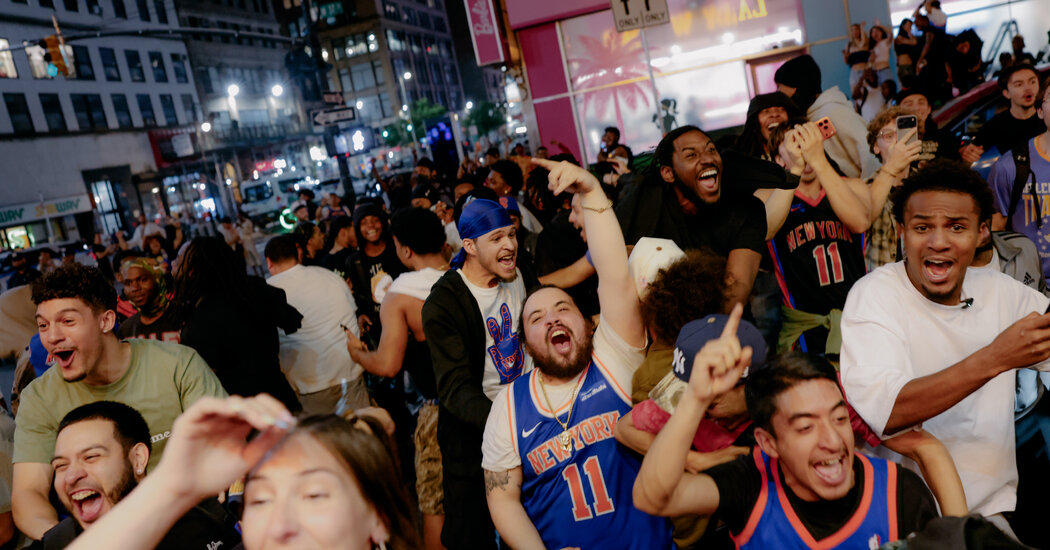
The Knicks steadily closed the scoring gap, culminating in a dramatic final sequence. With mere seconds remaining on the clock and the team trailing by one point, Knicks forward OG Anunoby executed a critical tip-in after an initial shot attempt bounced off the rim, securing a one-point lead. The Spurs’ subsequent attempt to win the game in the final moments failed, triggering widespread celebrations both inside and outside the arena.
Across Midtown Manhattan, Avenue A in the East Village, and Park Slope in Brooklyn, residents reacted to the victory with spontaneous public demonstrations. Traffic was partially halted in some areas as jubilant fans chanted “Knicks in five!” and the team’s anthem, “Go New York, Go New York, Go!” Vehicle horns blared in solidarity with hundreds of celebrating individuals, some of whom were observed climbing on cars, food carts, and scaffolding in their excitement. The enthusiastic response was noted by visitors, with Cara O’Donnell, a 24-year-old from Dublin, describing the scene as “insane.” In Brooklyn, the eruption of cheers from a restaurant crowd watching the game was reportedly audible from the underground subway station, underscoring the widespread nature of the celebration.
Inside Madison Square Garden, the post-game atmosphere was one of triumphant anticipation. The Journey song “Don’t Stop Believin'” blared through the arena minutes after the final horn. A security guard reportedly bid departing fans farewell with the confident remark, “Good night. See you at the parade.” The Knicks now hold a 3-1 lead in the best-of-seven series, requiring only one more victory to claim the championship title.
Kaja Andric, Tania Ganguli, Andrew Keh, Jesse McKinley, Bayliss Wagner and Wesley Parnell contributed reporting.
Why This Matters
The New York Knicks’ dramatic Game 4 victory transcends typical sports headlines, offering a multifaceted lens into urban identity, civic engagement, and the intersection of culture, commerce, and politics within a major global city.
Cultural and Civic Impact:
For New York City, a Knicks championship would end a decades-long drought, tapping into a deep well of civic pride and collective memory. Sports teams often serve as powerful symbols of urban identity, and the Knicks, with their home in Madison Square Garden, are particularly central to Manhattan’s cultural fabric. A championship run galvanizes communities, fostering a sense of shared purpose and celebration that momentarily transcends social divisions. The widespread street celebrations immediately following Game 4 demonstrate the team’s capacity to unify diverse populations under a common banner, reinforcing New York’s reputation for passionate public expression. This collective effervescence can create lasting memories and stories that become part of the city’s lore.
Economic Implications:
While difficult to quantify precisely, a championship victory has tangible economic benefits. Increased tourism, particularly from out-of-town fans, can boost local hospitality, restaurant, and retail sectors. Merchandising sales, from jerseys to commemorative items, would surge, generating revenue for the team and associated businesses. Local bars and restaurants often experience heightened patronage during playoff runs, and a championship parade would draw millions, stimulating further economic activity through direct spending and media exposure. Beyond immediate gains, a successful sports franchise can enhance a city’s global brand, attracting further investment and talent, and projecting an image of vitality and success.
Political and Corporate Dynamics:
The pre-game dispute between Knicks owner James L. Dolan and Mayor Zohran Mamdani highlights the complex relationship between private enterprise, public governance, and urban space. Mr. Dolan’s decision to cancel a public watch party, citing city security policies, underscores ongoing tensions regarding control over public events and resources. This incident serves as a microcosm of broader challenges faced by major cities in balancing private commercial interests with public safety and access. The involvement of political figures, including the defense of former President Trump, further illustrates how professional sports can become intertwined with wider political narratives, impacting public perception and civic discourse. The resolution of such disputes, or their continuation, can influence future public event planning and the dynamic between powerful private entities and municipal authorities.
Historical Significance:
The potential end of a championship drought stretching back to the early 1970s carries significant historical weight for the Knicks franchise and its multi-generational fanbase. A victory would not only mark a new chapter but also connect contemporary fans with the team’s storied past, potentially inspiring a new generation of enthusiasts. In the context of NBA history, a comeback of this magnitude in the finals, leading to a championship, would be a notable achievement, solidifying the team’s place in the league’s annals. This victory, therefore, is more than just a basketball game; it is a significant cultural event with economic, political, and historical dimensions that resonate deeply within New York City and beyond.