
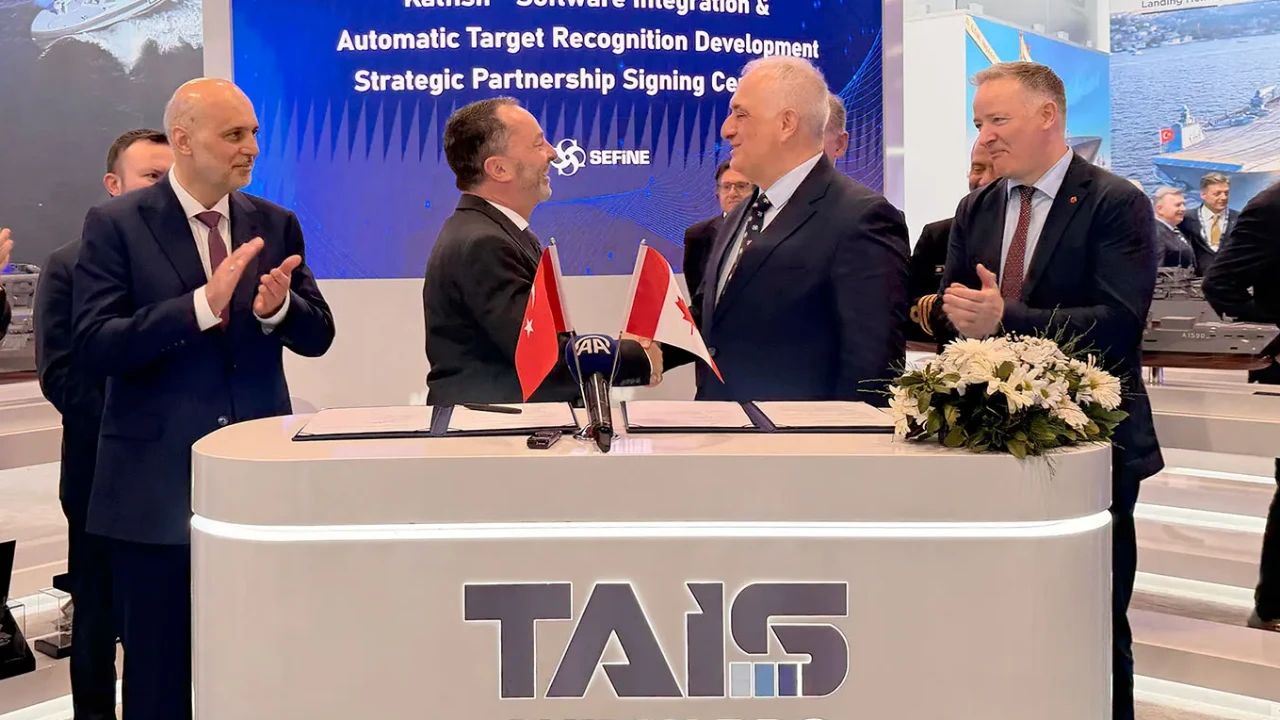
Kraken Robotics and SEFINE SISAM Forge Strategic Partnership for Advanced Maritime Unmanned Systems
In a significant development for autonomous maritime defense capabilities, Kraken Robotics, a Canadian leader in seabed technology, has announced the signing of a Memorandum of Understanding (MOU) with SEFINE SISAM, a prominent Turkish research firm specializing in strategic unmanned systems. This agreement marks a crucial step towards enhancing the integration and operational effectiveness of advanced sonar technology in autonomous platforms.
The core of the new partnership centers on two key objectives. Firstly, Kraken will collaborate with SISAM to seamlessly integrate its cutting-edge KATFISH towed synthetic aperture sonar (SAS) into SISAM’s existing mission planning software. This integration aims to create a unified operational environment, allowing for more efficient planning and execution of underwater missions. Secondly, the collaboration will focus on developing sophisticated automatic target recognition (ATR) capabilities specifically for Kraken’s synthetic aperture sonar system, a move designed to significantly reduce the human analytical burden and accelerate the identification of objects on the seafloor.
This MOU is not merely a theoretical agreement; it builds upon a successful real-world demonstration conducted earlier this year. During the at-sea trials, Kraken’s KATFISH system was launched and recovered from SEFINE’s RD-22 unmanned surface vessel (USV) off the coast of Istanbul. This demonstration proved the system’s robust capability to swiftly detect and classify mine-like objects and other critical underwater infrastructure with high resolution within an active operational environment. The success of these trials provided a strong foundation for the formalization of the partnership, validating the potential for combining Kraken’s sensor technology with Turkish unmanned platforms.
Bernard Mills, Executive Vice President of Defence at Kraken Robotics, emphasized the strategic importance of the collaboration. “We’re pleased to continue our work with SEFINE following a successful at-sea demonstration earlier this year,” Mills stated in a press release. He further elaborated on the geographical and industrial advantages this partnership brings: “This partnership poises us to rapidly develop and deliver relevant capability in a region that combines industrial excellence and operational need. Together, we are advancing fully integrated, autonomous solutions for seabed warfare and mine countermeasures, enhancing the speed, accuracy, and efficiency of maritime security operations.” His remarks underscore a recognition of Turkey’s growing prowess in defense technology and the strategic importance of the surrounding maritime areas for advanced security solutions.
The KATFISH system is a high-speed towed sonar specifically engineered for critical missions such as mine countermeasures (MCM) and detailed seabed surveys. It excels at producing exceptionally detailed acoustic imagery of the ocean floor, crucial for identifying potential threats or mapping complex underwater terrains. Synthetic aperture sonar, in general, represents a paradigm shift in naval mine countermeasures. Unlike conventional sonar, SAS technology processes multiple acoustic pings from different positions to synthesize a much larger aperture, resulting in substantially higher resolution imagery at operationally relevant speeds. This capability drastically improves the chances of detecting and classifying small or difficult-to-find objects on the seabed.
The planned addition of automatic target recognition (ATR) capability is a pivotal enhancement. ATR systems use advanced algorithms and machine learning to analyze sonar data and automatically highlight potential targets or anomalies. This technology is intended to significantly reduce the analytical burden on human operators, who traditionally spend extensive periods sifting through vast amounts of sonar imagery. By accelerating the classification of detected objects, ATR addresses a key bottleneck in mine hunting operations, where speed and accuracy are paramount for minimizing risk and ensuring safe navigation.
Turkey has strategically invested heavily in the development of its domestic unmanned systems industry in recent years, aiming to bolster its national defense capabilities and establish itself as a significant player in the global defense market. SEFINE and SISAM are prominent among a growing number of Turkish entities actively engaged in developing sophisticated maritime autonomous platforms, catering to both national defense requirements and the burgeoning international export market for such technologies. This domestic focus aligns with a broader trend among nations seeking self-reliance in critical defense sectors.
The signing of this MOU with SISAM adds to what has been a particularly active period for Kraken Robotics. In March 2026, the Canadian company announced its ambitious plans for the acquisition of Covelya Group Limited, a UK-based provider of a diverse range of underwater technology solutions. Covelya’s subsidiaries include several highly respected names in the maritime technology sector, such as Sonardyne International (known for acoustic navigation and communication), EIVA (specializing in hydrographic and oceanographic software), Forcys (autonomous systems integration), Wavefront Systems (sonar processing), Voyis Imaging (underwater optical inspection), and Chelsea Technologies (environmental sensors). At the time of the SISAM announcement, this significant acquisition was pending regulatory approval and was anticipated to close during the second quarter of 2026. The Covelya acquisition is poised to substantially expand Kraken’s portfolio, market reach, and technological capabilities, positioning it as a more comprehensive provider of underwater solutions.
Why This Matters
This strategic partnership between Kraken Robotics and SEFINE SISAM carries significant implications across several dimensions – technological, geopolitical, and economic – for maritime security and the global defense industry.
Advancing Autonomous Maritime Warfare:The collaboration directly addresses the growing demand for advanced autonomous solutions in seabed warfare and mine countermeasures. By integrating Kraken’s high-resolution synthetic aperture sonar with SISAM’s mission planning software and developing automatic target recognition, the partnership is set to create more efficient, accurate, and rapid mine hunting capabilities. This shift towards intelligent automation reduces the exposure of human personnel to hazardous environments and speeds up critical decision-making processes, fundamentally changing how maritime threats are identified and neutralized. It signifies a major step in the evolution of unmanned systems from mere data collectors to intelligent, autonomous operational assets.
Geopolitical Significance and Regional Security:The partnership’s focus on a “region that combines industrial excellence and operational need” implicitly points to the strategic importance of the Black Sea and Mediterranean. These waterways are crucial for international trade, energy security, and military movements, and they have seen increased geopolitical tensions and naval activity. The presence of advanced mine countermeasures technology developed and deployed within this region, particularly by a nation like Turkey with its strategic position, enhances overall maritime security. It allows for better protection of critical underwater infrastructure—such as pipelines and communication cables—and ensures safer navigation for both commercial and military vessels, contributing to regional stability and deterrence.
Strengthening Indigenous Defense Capabilities:For Turkey, this MOU underscores its commitment to strengthening its indigenous defense industry and reducing reliance on foreign suppliers. By partnering with a leading Canadian technology firm, SISAM gains access to cutting-edge sonar technology while simultaneously building expertise in integrating and developing advanced features like ATR. This fosters technological self-sufficiency and positions Turkey as a significant developer and exporter of advanced unmanned maritime systems, aligning with its broader national security and economic development goals.
Kraken’s Global Market Expansion:For Kraken Robotics, this partnership with SISAM is a strategic move to deepen its footprint in a critical and growing defense market. By demonstrating its technology’s interoperability with Turkish platforms and contributing to the development of advanced capabilities, Kraken enhances its reputation and market opportunities not only in Turkey but potentially across other allied nations seeking similar advanced solutions. Furthermore, when viewed in conjunction with the major acquisition of Covelya Group, this MOU signals Kraken’s aggressive strategy to become a dominant, comprehensive provider of underwater technologies, from sensing to navigation and imaging, broadening its appeal to a wider range of global customers.
Economic and Collaborative Growth:Beyond military applications, the collaboration fosters economic growth through technological exchange and joint development. It highlights the increasing trend of international cooperation in defense technology, where specialized firms from different nations combine their strengths to address complex global security challenges. This synergy can lead to innovative solutions that might be unattainable through singular national efforts, creating jobs, stimulating research, and driving further advancements in the rapidly evolving field of robotics and autonomous systems.