
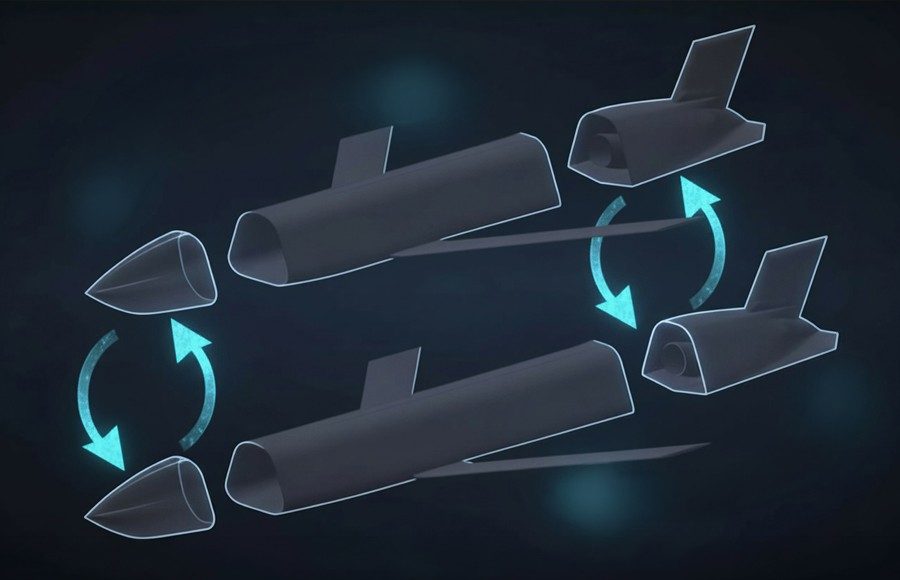
NATIONAL HARBOR, Md.—Lockheed Martin, a prominent defense contractor, has unveiled a new conceptual design for a modular version of the U.S. Air Force’s primary air-to-ground cruise missile, the Joint Air-to-Surface Standoff Missile (JASSM). This proposed design, dubbed the AGM-158 FLEX airframe, aims to introduce significant adaptability and a wider range of potential applications for the established weapon system.
The FLEX concept was showcased at AFA’s Air, Space & Cyber conference this week, highlighting a design that emphasizes reconfigurability. Key features include a removable nose cone, which would allow for the integration of various sensors or payloads depending on mission requirements, and a reconfigurable tail section designed to accommodate different launch mechanisms. These modifications are intended to enable the missile to be launched from a broader array of platforms beyond its traditional air-launch role.
According to a Lockheed Martin spokesperson, the development of the AGM-158 FLEX airframe concept is a direct response to strategic imperatives facing modern defense. In an email to Air & Space Forces Magazine, the spokesperson elaborated that the initiative is driven by “a strategic need to keep pace with rapidly evolving threats, insert emerging technologies quickly, manage obsolescence, and provide, at scale, a cost-effective missile family that can be repurposed for a wide range of missions while delivering timely, relevant capability to the warfighter.” This statement underscores a broader industry trend toward more agile and adaptable weapons systems capable of evolving with the threat landscape.
While Lockheed Martin has publicly presented the FLEX concept, the company did not disclose whether the Air Force has placed a contract or an order for this particular design, nor did it specify the current stage of its development. However, Lockheed Martin has affirmed its commitment to the idea, stating in a release that it has invested $35 million of its own capital into the concept. This investment is based on what the firm describes as “a demand from our customers to have increased options,” suggesting a perceived need within military circles for greater flexibility in munitions.
The U.S. Air Force has previously expressed interest in modular munitions. In January 2025, the Air Force Life Cycle Management Center issued a notice to industry seeking technological solutions for modular components within its Extended Range Attack Munition (ERAM) project. The ERAM itself is a recently developed standoff cruise missile, intended as a cost-effective option to augment existing weapons stockpiles. This prior interest indicates a strategic alignment between Lockheed Martin’s FLEX concept and the Air Force’s broader acquisition goals.
The context for this increased emphasis on modularity and expanded weapons options is partly rooted in recent global events. The U.S. military, along with its allies, has drawn down its weapons inventories significantly, particularly following extensive operations in the Middle East. An analysis by the Center for Strategic and International Studies (CSIS) in April indicated that the U.S. utilized approximately 1,100 JASSM missiles within the first 39 days of the ongoing conflict in the Middle East alone. Such high rates of consumption highlight the critical need for robust production capabilities and diverse munition options to maintain strategic readiness and deterrence.
In response to this substantial usage and the consequent demand, the Air Force plans to significantly increase its production of the JASSM and its naval variant, the Long-Range Anti-Ship Missile (LRASM). Lockheed Martin views the FLEX concept as a potential means to further enhance these stockpiles by offering additional versatility and mission profiles for the baseline JASSM airframe.
The company’s release emphasizes that the FLEX concept “will allow customers to quickly integrate capabilities” and enable the JASSM to be configured for launch from various platforms, including surface vessels, sub-surface platforms (such as submarines), and ground-based systems. Despite these expanded options, the air-launched version of the FLEX missile is designed to remain fully compatible with all current and future JASSM and LRASM air-launched platforms, ensuring seamless integration with existing aerial assets.
The proposed FLEX airframe would also come in different size configurations, catering to varying range requirements. These include a 206-inch option, which mirrors the dimensions of the existing JASSM-XR (Extreme Range) variant, and a 168-inch extended-range version, comparable to the JASSM-ER. Both configurations are designed to provide users with “significantly increased standoff attack range,” allowing launch platforms to engage targets from a greater distance, thereby enhancing survivability and operational flexibility.
A notable potential application for the modular FLEX weapon system lies within the latest iteration of a longstanding U.S. Air Force effort known as “Rapid Dragon,” which has now transitioned into the “Dragon Cart” program. This program focuses on developing the capability to launch cruise missiles from palletized loads that are dropped from the cargo ramps of transport aircraft, such as the C-130 Hercules and C-17 Globemaster III. This innovative deployment method aims to transform cargo planes into temporary missile platforms, expanding the military’s strike capacity and operational reach.
The Lockheed Martin spokesperson confirmed the potential synergy, stating, “As Rapid Dragon transitions into a Dragon Cart program of record, it becomes a viable deployment platform for a variety of Air Force munitions, both in inventory and in development.” While specific examples of munitions compatible with Dragon Cart were not provided, the spokesperson added, “Lockheed Martin does consider all potential launch platforms in maturing munition offerings,” indicating a deliberate design philosophy to ensure broad compatibility and future-proofing for the FLEX concept.
Why This Matters
The unveiling of Lockheed Martin’s AGM-158 FLEX concept represents a significant development in military munitions strategy, with implications for global security, defense industrial trends, and the future of warfare. Its importance can be understood through several key aspects:
Strategic Flexibility and Adaptability:The modular design of the FLEX airframe directly addresses the challenge of rapidly evolving global threats. By allowing for easy swapping of sensors and reconfiguring for diverse launch platforms (air, surface, sub-surface, ground), the U.S. military could quickly adapt its existing JASSM inventory for new missions without requiring the development and procurement of entirely new missile systems. This enhances the military’s ability to respond to a wider range of adversaries and scenarios, from peer-state competition to regional conflicts, and supports doctrines like Agile Combat Employment (ACE).
Economic Efficiency and Obsolescence Management:Investing in modularity can lead to long-term cost savings. Instead of replacing entire missile systems when components become obsolete or when new technologies emerge, only specific modular sections would need to be upgraded or replaced. This approach can extend the service life of missile airframes, reduce research and development costs for new variants, and streamline logistics and maintenance, ensuring that the U.S. maintains a cutting-edge arsenal more efficiently.
Maintaining a Competitive Edge:In an era of renewed great power competition, maintaining a technological advantage is paramount. The ability to quickly integrate advanced sensors or electronic warfare capabilities into a proven missile airframe like JASSM allows the U.S. to counter sophisticated air defense systems and maintain its standoff strike capability against increasingly capable adversaries. Increased standoff range also enhances the safety of launch platforms and personnel.
Logistical Resilience and Stockpile Replenishment:The high rate of munition expenditure in recent conflicts has underscored vulnerabilities in defense supply chains and the need for robust stockpiles. By offering a multi-mission, multi-platform capable missile from a common airframe, the FLEX concept could simplify production lines and accelerate the replenishment of critical munitions. This helps ensure that the U.S. military has sufficient firepower to deter aggression and sustain operations in prolonged conflicts without quickly depleting its reserves.
Evolving Warfare Doctrines:The potential integration of FLEX with programs like “Dragon Cart” signifies a fundamental shift in how the U.S. military envisions strike capabilities. Transforming cargo aircraft into temporary missile launchers drastically expands the number of potential strike platforms, complicates adversary targeting, and enhances distributed lethality. This provides greater operational flexibility and resilience in contested environments, fitting into broader concepts of multi-domain operations and decentralized warfare.