
Congressional Republicans have expressed significant skepticism regarding the feasibility and implications of a potential peace agreement between the United States and Iran, even as President Trump publicly reaffirmed his support for ongoing negotiations to conclude a nearly three-month period of hostilities.
Officials from both the U.S. and Iran have outlined an emerging framework for a deal. U.S. representatives indicate that the proposal includes the reopening of the strategically vital Strait of Hormuz and a commitment from Iran to dispose of its highly enriched uranium. Iranian officials, conversely, have stated that detailed negotiations on nuclear matters would commence within 30 to 60 days following an initial agreement.
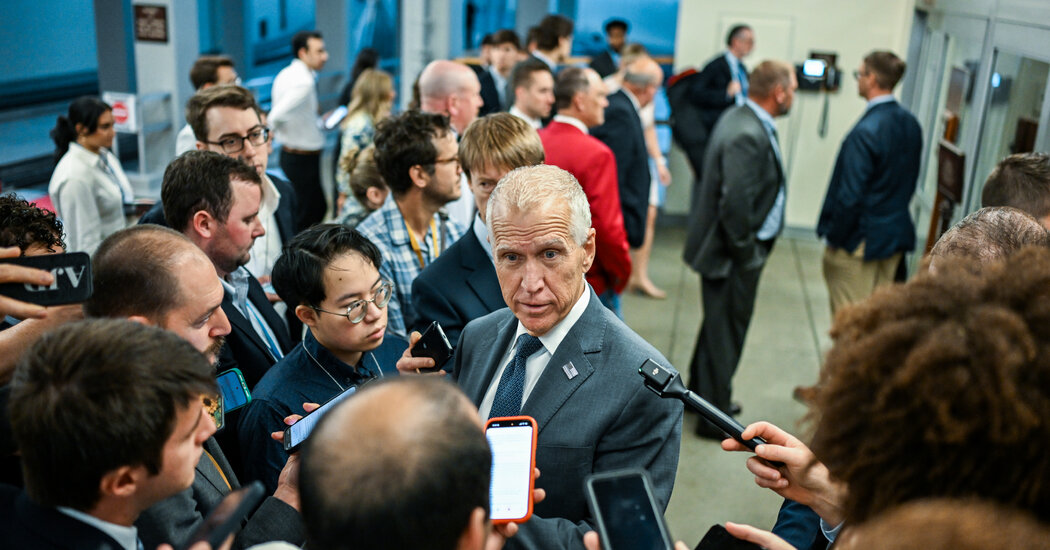
The prospective terms have drawn sharp criticism from several Republican senators. Senator Thom Tillis, a Republican from North Carolina, articulated his reservations on Sunday during an appearance on CNN’s “State of the Union.” Senator Tillis stated, “It doesn’t make too much sense to me,” questioning the reliability of Iran’s commitment to reopen the Strait of Hormuz without a fully finalized peace deal. He added that “there are a lot of things that need to be explained” regarding the structure and enforceability of the proposed agreement.
Further Republican opposition came from Senator Roger Wicker, Chairman of the Senate Armed Services Committee. Writing on social media Saturday, Senator Wicker warned that a “60-day ceasefire — with the belief that Iran will ever engage in good faith — would be a disaster.” His statement underscored a prevalent concern among some lawmakers regarding Iran’s past compliance with international agreements and the sincerity of its diplomatic overtures.
President Trump responded to these criticisms on social media Sunday afternoon, robustly defending his administration’s diplomatic efforts. He characterized any deal he would negotiate as “good and proper,” and dismissed his critics as “losers, who are critical about something they know nothing about.” The President had announced on Saturday that the United States and Iran had “largely negotiated” an agreement aimed at de-escalating the conflict.
Even some of the President’s traditional allies have voiced concerns. Senator Lindsey Graham, a Republican from South Carolina, expressed his misgivings on social media Saturday. Senator Graham suggested that striking a peace deal at this juncture could inadvertently solidify a perception that the United States was acknowledging Iran as a dominant regional power, thereby “requiring a diplomatic solution.” He described such an outcome as “a nightmare for Israel,” highlighting potential implications for key U.S. allies in the Middle East. Senator Graham also posed a rhetorical question, stating, “It makes one wonder why the war started to begin with,” implying dissatisfaction with the apparent outcome of the recent hostilities.
Senator Ted Cruz, a Republican from Texas, also conveyed his “deep concern” regarding the prospective deal. Senator Cruz argued that any agreement allowing Iran to retain control of the Strait of Hormuz and maintain its capability to enrich uranium would constitute “a disastrous mistake.” His remarks reflect long-standing anxieties within a segment of the Republican party about Iran’s nuclear ambitions and its strategic influence in crucial maritime choke points.
Conversely, some Republicans, including House Speaker Mike Johnson, offered a more supportive or cautious stance, advocating against premature judgment before the official terms of any deal are publicly released. Speaker Johnson, appearing on “Fox & Friends Weekend” on Sunday, expressed confidence that the deal would “take care of the nuclear dust” — a term President Trump has used to refer to Iran’s stockpile of enriched uranium. He commended the President for his “resolute” commitment to curbing Iran’s nuclear program.
Senator Rand Paul, a Republican from Kentucky and often a critic of certain Trump administration policies, encouraged other critics to exercise patience. On social media Sunday, Senator Paul suggested they “should give President Trump the space to find an American first solution,” indicating a belief that the President’s diplomatic approach might ultimately serve U.S. interests, even if unconventional.
Democratic senators also joined the chorus of critique on Sunday. Senator Cory Booker of New Jersey stated on CNN that the President was “being played as a fool,” suggesting a lack of trust in Iran’s negotiating posture. Senator Chris Van Hollen of Maryland characterized the emerging framework as merely “a return to the prewar status quo,” implying that the terms would not fundamentally alter the dynamics or eliminate the underlying tensions that led to the recent conflict.
The ongoing debate in Washington underscores the deep divisions within the U.S. political landscape regarding foreign policy towards Iran, particularly concerning nuclear capabilities, regional influence, and the efficacy of diplomatic engagement versus coercive measures. The outcome of these negotiations and the subsequent congressional response will likely have significant ramifications for U.S. foreign policy and stability in the Middle East.
Why This Matters
The potential peace deal between the United States and Iran carries profound implications for global security, regional stability, and international economics. A formal cessation of hostilities, after nearly three months of conflict, would immediately de-escalate tensions in a volatile region, potentially preventing wider military confrontation that could draw in other global powers. For the United States, a successful diplomatic resolution could be framed as a major foreign policy achievement for the Trump administration, demonstrating an ability to resolve conflicts without prolonged military engagement. However, the strong congressional skepticism, particularly from within the President’s own party, highlights the domestic political challenges and the difficulties in achieving bipartisan consensus on critical national security issues.
Economically, the reopening of the Strait of Hormuz is paramount. This narrow waterway, through which a significant portion of the world’s oil supply passes, is a critical chokepoint for global energy markets. Any disruption or threat to shipping in the Strait can cause oil prices to spike, impacting economies worldwide. A firm commitment from Iran to ensure safe passage, as part of a peace deal, would bring much-needed stability to energy markets and reassure international trade partners.
From a nuclear proliferation standpoint, Iran’s commitment to dispose of highly enriched uranium is a central component. Highly enriched uranium can be used to develop nuclear weapons, and international efforts have long focused on preventing Iran from acquiring such capabilities. A verifiable agreement on this matter would be a significant step toward non-proliferation, though its effectiveness will depend heavily on robust inspection regimes and Iran’s adherence. The skepticism expressed by some senators reflects concerns about the long-term sincerity and transparency of Iran’s nuclear program.
The deal also has significant geopolitical repercussions for the Middle East. Allies such as Israel and Saudi Arabia view Iran’s regional ambitions with deep suspicion and often advocate for a more assertive U.S. stance. Senator Graham’s concern that the deal might legitimize Iran as a dominant regional force highlights the anxieties among these allies, who fear that a U.S.-Iran rapprochement could undermine their security interests and shift the balance of power in the region. The perception of whether the U.S. is adequately protecting its allies’ interests will be a critical factor in how the deal is received internationally.
Ultimately, this ongoing debate reflects a fundamental tension in U.S. foreign policy: how to manage adversarial relationships through diplomacy while safeguarding national interests and ensuring the security of allies. The precise terms of any final agreement, and the extent to which they address the diverse concerns of U.S. policymakers and international partners, will determine its long-term viability and impact.
Annie Karni and Taylor Robinson contributed reporting.