
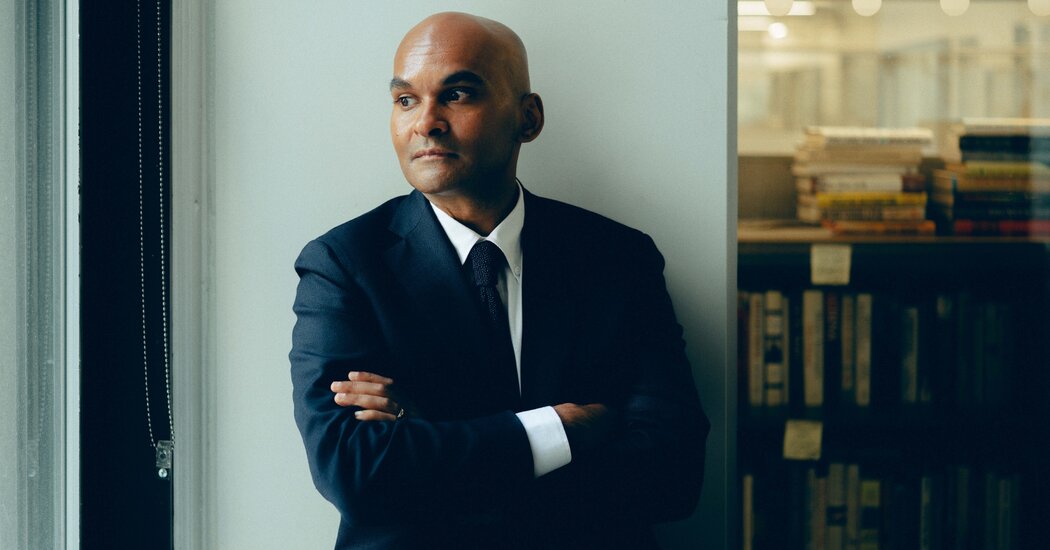
A significant ideological contest is unfolding in New York City, pitting the conservative vision of Reihan Salam, president of the Manhattan Institute, against the democratic socialist agenda of Mayor Zohran Mamdani. Despite their political opposition, the two men share a notable number of personal commonalities and a profound concern for the future trajectory of their shared city.
Both Salam, 46, and Mayor Mamdani are South Asian Muslim men who attended rival public high schools in New York City. They are also both noted for their ability to recall faces and names, and both have shown a preference for merchandise featuring a specific 1970s cursive “City of New York” insignia. Beyond these shared traits, they are united by a conviction that New York City faces a profound crisis. However, their diagnoses of this crisis, and their proposed solutions, diverge sharply. For Mayor Mamdani, the central challenge is affordability, while for Mr. Salam, the primary concern is the mayor’s political and policy direction.
Speaking from his Brooklyn neighborhood, which overwhelmingly supported Mayor Mamdani in the recent election, Mr. Salam articulated his apprehension: “You have a couple of decades of prosperity that are slipping away. We are squandering this incredible opportunity to show that urban life can work.” He expresses concern that many New Yorkers have been persuaded by what he perceives as the mayor’s critical stance toward the city’s wealthiest residents. He also fears that Mayor Mamdani’s vision, which includes proposals for free public transportation, free childcare, and frozen rents, could lead New York City into a financial downturn reminiscent of the fiscal crisis of the 1970s. Mr. Salam labels some of these initiatives “unlimited welfarism for the near-rich,” suggesting they extend social benefits to individuals who may not require them, potentially straining public finances.
In response to this perceived threat, Mr. Salam is working to position the Manhattan Institute, a conservative think tank known for its focus on urban policy, as the intellectual hub of opposition. The institute aims to challenge the prevailing political momentum and the mayor’s popular movement, a task that has proven difficult for other groups. The city’s prominent business community, for instance, reportedly invested tens of millions of dollars in an unsuccessful effort to convince voters that Mayor Mamdani’s views on capitalism and Israel were too radical for the city. The Democratic establishment in New York has largely been unable to effectively counter the mayor’s significant political strength. Furthermore, elected Republicans hold such a minority position in New York City that they possess little institutional power to impede the mayor’s agenda.
The Manhattan Institute itself, with a half-century history of advocating for reduced city bureaucracy and the empowerment of private industry, finds its policy objectives currently far from the centers of power in New York. The election of a democratic socialist mayor might be seen as a setback for the institute’s long-standing goals. Nevertheless, Mr. Salam, who has led the organization since 2019, identifies an opportunity. He believes Mayor Mamdani’s dynamic campaign has generated an unusual level of public interest in fundamental questions about the efficacy of different governmental approaches in urban administration.
While some critics from the right have resorted to hyperbolic attacks against Mayor Mamdani, portraying him in extreme terms, Mr. Salam and his colleagues at the Manhattan Institute are pursuing a more measured strategy. Their approach involves a direct analytical critique of the mayor’s policy proposals, leveraging their deep understanding of city history and policy expertise. They aim to introduce a voice of skepticism into the city’s public discourse. For example, they raise questions such as:
- Is it truly necessary for individuals earning hundreds of thousands of dollars annually to receive free childcare services?
- Might a rent freeze inadvertently reduce the number of available apartments by disincentivizing people from relocating, thereby driving down vacancy rates and potentially destabilizing the housing market?
- Could making bus services free lead to public transit routes, like the M4, becoming de facto daytime shelters for individuals experiencing homelessness, creating new operational and social challenges?
The Mayor’s office has declined to comment directly on the Manhattan Institute’s critiques. Mayor Mamdani has consistently articulated his belief that it is the government’s responsibility to provide high-quality services to all residents, rather than to selectively determine who receives those services, especially in the context of the city’s pervasive affordability crisis. In his inaugural address, the mayor addressed critics of “big government,” stating his commitment that “No longer will City Hall hesitate to use its power to improve New Yorkers’ lives.”
While fundamentally altering the mayor’s political philosophy may be beyond their reach, Mr. Salam and his team of policy analysts hope to influence other key figures within New York’s intellectual and civic landscape, including activists, leaders of nonprofit organizations, city commissioners, and journalists. Their goal is that this influence might be sufficient to temper the momentum behind what they view as an expansive government agenda. Mr. Salam stated, “I vehemently believe that we are defenders of the beautiful mosaic,” referencing a phrase coined by former Democratic Mayor David N. Dinkins to describe New York’s intricate diversity. He added, “But it means that you need to not be an idiot.”
‘I try to be constructive’
The historical context of New York City’s past challenges heavily informs the Manhattan Institute’s perspective. Half a century ago, the city faced severe blight and was on the brink of complete financial collapse due to decades of poor fiscal management. Visible signs of the city’s distress were ubiquitous: subway cars covered in graffiti, a high incidence of street crime, accumulating trash, landlords resorting to arson for insurance payouts, and widespread looting during a 25-hour blackout. This era represents a significant cautionary tale for those who advocate for conservative fiscal policies.
Currently, New York City’s financial health, while not pristine, is considerably more stable than in the 1970s. Fiscal experts predict the city will encounter substantial budget deficits within the next few years. However, both the city and state implemented significant guardrails decades ago to prevent a recurrence of the irresponsible accounting practices and financial instability that characterized the 1970s. The Manhattan Institute does not anticipate an immediate financial emergency. Yet, for Mr. Salam and his colleagues, the 1970s fiscal crisis is not merely a historical event; it functions as a foundational narrative—a “Great Flood” whose enduring legacy should serve as a perpetual warning to the city’s leadership that conditions can deteriorate rapidly.
Why This Matters
The ideological clash between Reihan Salam and Mayor Zohran Mamdani in New York City is significant because it encapsulates a broader national and global debate about urban governance, economic policy, and the role of government in addressing societal challenges. New York City, as a global financial and cultural hub, often serves as a microcosm for these larger discussions, and the policy choices made there can have ripple effects.
Firstly, this conflict highlights the tension between different economic philosophies: democratic socialism, which advocates for expanded public services and greater government intervention to address inequality and affordability, versus conservative principles that emphasize fiscal restraint, the efficiency of private markets, and limited government. The outcomes of these differing approaches in a major city like New York can provide case studies for other municipalities grappling with similar issues such as housing crises, public transit challenges, and social welfare provisions.
Secondly, the debate over specific policies like free childcare, rent freezes, and free public transport delves into fundamental questions about economic equity, social safety nets, and the sustainability of public spending. Mr. Salam’s concerns about “unlimited welfarism for the near-rich” and the potential for financial instability underscore the ongoing policy challenge of balancing social welfare with fiscal responsibility. The historical reference to New York’s 1970s fiscal crisis serves as a potent reminder of the potential consequences of perceived fiscal mismanagement, influencing policy debates across various jurisdictions.
Finally, this narrative underscores the critical role of think tanks and intellectual discourse in shaping public policy. Even when directly out of power, organizations like the Manhattan Institute seek to influence the public narrative, challenge prevailing assumptions, and offer alternative policy frameworks. This intellectual “resistance” is vital for a robust democratic process, ensuring that diverse perspectives and potential downsides of popular policies are thoroughly examined and debated. The ongoing dialogue in New York City, therefore, offers valuable insights into the dynamics of urban political leadership and the persistent struggle to define the optimal balance between social ambition and economic pragmatism.
In New York City, a critical policy debate is unfolding between the newly elected progressive Mayor Mamdani and the Manhattan Institute, a prominent conservative think tank. At its core, the discussion revolves around the fundamental role of government in urban life, fiscal responsibility, and the lessons gleaned from past economic challenges, particularly the city’s near-bankruptcy in 1975. As Mayor Mamdani embarks on an agenda prioritizing expanded social services and affordability initiatives, the Manhattan Institute is actively working to inject fiscally conservative perspectives into the municipal dialogue, advocating for policies that emphasize private sector solutions and restrained public spending.
This dynamic represents a microcosm of broader ideological clashes often observed in major global cities, where the impulse for social welfare and equitable access frequently confronts arguments for economic efficiency and limited government intervention. The Institute’s efforts aim not merely to criticize the current administration but to offer concrete, alternative policy recommendations that align with its foundational principles of fiscal conservatism and market-oriented governance.
A pivotal historical event anchoring much of this debate is the New York City fiscal crisis of 1975. Decades later, this period serves as a potent reminder of the perils associated with municipal overspending and unchecked budgetary growth. Just weeks after Mayor Mamdani’s election, the Manhattan Institute hosted a panel discussion titled “The Fiscal Crisis at 50: Lessons for a New Era of City Government,” highlighting the enduring relevance of this historical episode. The event, held at the institute’s headquarters near Grand Central Terminal, attracted significant attention, including from high-ranking officials within the new administration.
Dean Fuleihan, a seasoned Democratic operative and newly appointed as Mayor Mamdani’s most senior aide, notably attended the packed gathering, even having to search for a seat amidst the crowd. In an impromptu exchange during the event, Mr. Fuleihan acknowledged the positive impact of reforms implemented in the wake of the 1975 crisis, stating they were “making my life easier.” He later affirmed to The New York Times that it is the “responsibility of government to listen to the opinions of the people they serve, even when it leads to spirited discussions about the 1975 fiscal crisis.” This engagement from a key mayoral adviser was viewed as a positive indicator by the Manhattan Institute, signaling a potential opening for their ideas to be considered by city leadership.
Established in 1978, the Manhattan Institute initially carved out a niche with a broad national focus, engaging in conservative policy debates across various sectors. While many of its 85 scholars contribute to national discussions, including contentious “culture wars” surrounding issues like public safety and transgender rights, a dedicated cohort of New York-focused experts is now working intensively to develop municipal solutions. These solutions are crafted to align with the Institute’s principles, often emphasizing market-based approaches, deregulation, and fiscal prudence, even as they address problems the current mayor aims to solve through public expenditure.
This current strategy moves beyond simple opposition. According to Eric Kober, the Institute’s local housing expert, the goal is to be “constructive.” He articulated the think tank’s revised approach, stating, “It’s not enough to simply criticize him; it’s also necessary to offer something that he could do.” This philosophy underpins their current engagement with the Mamdani administration, seeking to offer practical, albeit ideologically distinct, pathways to address the city’s complex challenges.
Among the core group of Manhattan Institute scholars attempting to influence city policy, several individuals are spearheading specific proposals. Eric Kober, who brings 35 years of experience from the city’s planning department under various mayoral administrations, is focusing on housing. His recommendations often involve modifying Mayor Mamdani’s policy proposals to achieve cost savings and greater reliance on the private sector. For instance, instead of government mandates on parking space requirements for commercial businesses, Mr. Kober suggests rolling back such regulations, allowing developers to determine needs based on market demand. This, he argues, could foster greater investment and development within the city. Similarly, regarding a proposed $30 million municipal grocery store in East Harlem with taxpayer-subsidized prices, Mr. Kober advocates for an alternative: redirecting those funds to upgrade existing small supermarkets or incentivize the entry of discount chains like Aldi and Lidl, aiming for broader impact and fiscal efficiency.
Stephen Eide, a fellow specializing in social services, seeks to align his recommendations with what he perceives as Mayor Mamdani’s interest in “sewer socialism.” This concept, as interpreted by Mr. Eide, implies a progressive government’s laser focus on improving essential city services. Mr. Eide posits that a strategic reduction in overall government spending can, paradoxically, enable local authorities to concentrate more effectively on truly urgent problems that only government can adequately address. Examples he cites include enhancing treatment for mentally ill individuals on the subway system or improving response times for 911 calls, thereby making government more efficient and impactful within its core functions.
Nicole Gelinas, an expert on transit and fiscal policy, is another prominent voice from the Institute whose analyses are often recognized for their rigor, even by political opponents. Brad Lander, a notable ally of Mayor Mamdani, acknowledged having “learned a lot” from Ms. Gelinas despite frequent disagreements. Her central thesis during the Mamdani administration has been that the mayor has presented an ambitious vision that is financially unsustainable and, therefore, undeliverable. Ms. Gelinas views it as her responsibility to help recalibrate public expectations regarding the city’s fiscal capacity.
She has highlighted instances where Mayor Mamdani has already exhibited fiscal restraint, such as delaying an expensive cap on public-school class sizes and scaling back a proposed multi-billion-dollar expansion of a housing voucher program – both significant reversals from his campaign promises. However, Ms. Gelinas contends that funding expansive new initiatives like free buses and increased free child care will inevitably necessitate difficult budgetary trade-offs, forcing the mayor to make unpopular decisions about what essential services receive funding and what do not. Her stark assessment is that “The idea that you are going to have some magic bag of tricks and the city will become affordable, it’s just not going to happen,” underscoring her belief in the limitations of municipal finances.
The Mamdani administration’s reception of the Manhattan Institute’s engagement has been varied. While Dean Fuleihan’s presence at the fiscal crisis panel indicated an openness to dialogue on budgetary matters, another senior adviser presented a more nuanced view. Patrick Gaspard, a top adviser to Mayor Mamdani and former leader of the Democratic National Committee, praised the intellectual rigor and thoughtfulness of the Manhattan Institute’s work. He acknowledged their scholars for fostering “the kind of conversation reasonable people can have about the appropriate role of government, the relationship to the private sector, what it means to general growth.”
However, Mr. Gaspard simultaneously expressed a skeptical view regarding the Institute’s contemporary political and cultural influence. He asserted that, despite the quality of their research, “They have neither the political heft or the cultural currency to be consequential. They just don’t.” This perspective suggests that while the administration might engage with the Institute’s ideas on an intellectual level, there is a perception that their ability to significantly sway policy or public opinion in the current political climate is diminished compared to past eras.
‘Someone is going to have to pick up the pieces’ – The Shifting Influence of the Manhattan Institute
This perceived decline in direct political “heft” contrasts sharply with the Manhattan Institute’s significant influence in previous decades. In the 1990s, the think tank played a demonstrably powerful role in shaping New York City policy. Rudolph W. Giuliani, the city’s Republican mayor at the time, famously quipped about having “plagiarized” the Institute’s ideas, underscoring their direct impact on his administration’s agenda. During that era, the Manhattan Institute identified pressing urban challenges such as rampant crime, deteriorating city services, and struggling public schools.
The Institute’s scholarly work and policy recommendations were instrumental in steering city government toward solutions that many credit with making New York City safer and more functional. A cornerstone of their influence was the advocacy for the “broken windows” theory of policing. This theory posited that visible signs of crime and civil disorder – such as broken windows, graffiti, and public urination – create an urban environment that encourages more serious crime. Therefore, by aggressively policing minor infractions, authorities could prevent more significant criminal activity and restore order. While this approach was credited by many with contributing to a dramatic drop in crime rates and an overall improvement in the quality of life in New York City, it has also faced considerable criticism for its disproportionate impact on minority communities and its potential to foster over-policing.
The historical narrative of the Manhattan Institute thus reflects a cycle of influence, from a period of direct policy shaping to its current role as an intellectual provocateur seeking to engage with a ideologically different administration. The ongoing debate with Mayor Mamdani’s office illustrates this contemporary dynamic, where rigorous analysis is presented and acknowledged, yet its immediate political adoption remains uncertain.
Why This Matters
The ongoing policy dialogue between New York City Mayor Mamdani’s progressive administration and the conservative Manhattan Institute transcends local politics, offering crucial insights into broader trends in urban governance and political discourse globally. This dynamic illustrates the enduring tension between the societal demand for expanded social services and the imperative for fiscal prudence, a challenge faced by countless cities worldwide.
Firstly, it highlights the critical importance of fiscal history. The specter of New York City’s 1975 fiscal crisis serves as a potent reminder for contemporary leaders about the long-term consequences of unchecked municipal spending. As cities globally grapple with increasing demands for infrastructure, social safety nets, and climate resilience, the lessons from past financial distress become ever more relevant. Debates about how to fund ambitious public programs without jeopardizing long-term financial stability are central to sustainable urban development.
Secondly, this case study illuminates the evolving role of think tanks in shaping public policy. While the Manhattan Institute’s direct political “heft” may have shifted, its continued ability to produce rigorous research and engage with opposing political factions underscores the enduring value of independent policy analysis. Such institutions often serve as vital incubators for alternative ideas, challenging prevailing orthodoxies and enriching public debate, even when their recommendations are not immediately adopted. Their influence can be indirect, shaping the terms of discussion and providing a benchmark against which government performance is measured.
Finally, the dialogue between Mayor Mamdani and the Manhattan Institute reflects a fundamental ideological divide on the appropriate scope and scale of government intervention. Mayor Mamdani’s emphasis on expanding social services and ensuring affordability through public initiatives represents a progressive vision common in many urban centers today. Conversely, the Institute’s advocacy for private sector solutions, deregulation, and focused government functions champions a more fiscally conservative approach. Understanding how these contrasting philosophies interact, compromise, or conflict in a high-profile urban environment like New York City provides a valuable template for observing similar political and economic tensions in cities and nations across the globe. The outcomes of these debates in New York could influence approaches to urban planning, social welfare, and economic development far beyond its city limits.
The Manhattan Institute, a prominent conservative think tank, continues to exert significant influence on policy discourse in New York City and across the United States. Advocating for principles of free markets, individual liberty, and limited government, the Institute frequently presents a counter-narrative to the city’s increasingly progressive political landscape. Its impact is particularly evident in its critiques of current city leadership and its proposals for urban governance, shaping an ongoing ideological debate about the city’s future direction.
Founded on conservative urban policy tenets, the Manhattan Institute gained considerable traction during the 1990s, a period often associated with the administration of former Mayor Rudolph Giuliani. During this era, the Institute notably advocated for “broken windows” policing strategies, which emphasized strict enforcement against minor offenses as a means to prevent more serious crimes. Proponents credit these policies with contributing to a significant reduction in New York City’s crime rate. However, critics contend that these strategies disproportionately targeted Black and Latino residents, which in turn exacerbated racial tensions within the city. This period also marked a significant shift towards policies that, critics argue, contributed to New York’s escalating desirability and cost of living, gradually making the city unaffordable for its working-class, middle-class, and even some reasonably well-off residents. The Institute’s enduring core argument posits that prosperity is best achieved through individual initiative and market forces, rather than through extensive state intervention or wealth redistribution, a philosophy it continues to champion.
In the contemporary political climate, the Manhattan Institute remains an active and vocal participant in public discourse. Reihan Salam, the Institute’s current president, outlined its mission at its annual black-tie fundraising gala in Midtown, an event attended by hundreds of donors, with tables costing as much as $250,000. Outside the venue, protesters chanted “tax the rich,” a slogan indicative of the city’s recent political shifts. Inside, Mr. Salam characterized the protesters’ viewpoint as believing that “prosperity is something to be handed out by the state, and that the only thing standing in between them and the lives they want is someone else’s wealth.” He asserted that the Manhattan Institute “exists to confront this seductive lie and to stand for something better.”
The Institute employs various channels to disseminate its ideas and engage with public opinion. Its local fellows contribute to “The Bigger Apple,” a weekly Substack newsletter focused on city government. “City Journal,” the Manhattan Institute’s in-house magazine, frequently publishes investigative reports, including a recent scoop regarding a city commissioner’s meeting with an Iranian diplomat without the mayor’s knowledge. Educational initiatives also form a part of its outreach; one fellow, Daniel Golliher, teaches a New York civics course that requires students to attend community board meetings and memorize sections of city law, with the stated goal of fostering more educated voters and potential future public servants.
Despite its New York City origins, the Manhattan Institute is undeniably integrated into the broader national conservative movement. While not identified as central to the MAGA movement, it receives funding from some of the same conservative megadonors who support former President Trump. The Institute also develops policy proposals that resonate in national political debates, such as draft legislation that would reclassify disruptive protest actions, like blocking roads, as “civil terrorism” felonies. Christopher Rufo, a conservative activist and writer on the Institute’s payroll, has been a leading figure in the national movement against diversity, equity, and inclusion (DEI) initiatives.
These national connections and some of the Institute’s local critiques have drawn considerable pushback. Critics, including influential state senator Liz Krueger (D-Manhattan), have described the Institute’s output as biased, with Senator Krueger stating she stopped reading most of its publications years ago. Senator Krueger commented that “too many of the far-right messengers in today’s era are nut jobs,” though she clarified she does not know if that includes the Manhattan Institute as she no longer reads their material. Some of the Institute’s New York-focused scholars have also been perceived as less than collaborative in their criticisms of the mayor (referred to as Mr. Mamdani in the original context). For instance, Ms. Gelinas authored a New York Post column titled: “Mamdani acts like a petulant teen in front of the king and queen.” Another Manhattan Institute fellow accused the mayor of being a “show-off,” more interested in photo opportunities “than the dirty work of governing.” After the mayor asked New Yorkers to keep their air-conditioners at 78 degrees during a heat wave—a common recommendation from previous administrations—a Manhattan Institute fellow posted a video showing himself turning his air-conditioning down to 67 degrees while playing the song “God Bless the U.S.A.,” a gesture interpreted by some as defiant.
Reihan Salam describes himself as “an aggro partisan of urban life,” seeking to distinguish the Institute from elements on the right that view cities as inherently doomed. He emphasizes the Institute’s commitment to “a multiethnic, metropolitan future for the country,” explicitly rejecting the notion that cities are “hopeless or deserving of their misery.” Born to Bangladeshi immigrant parents in Borough Park, Mr. Salam expresses a deep connection to New York, stating it is the only place he has ever wanted or could live, partly due to his never having obtained a driver’s license.
His personal narrative significantly informs his philosophical outlook. He recounts an “admittedly idealized memory” of his childhood during the Giuliani years, when his parents, through hard work and saving, progressed from living in a partially finished basement and renting out upper floors to owning their entire home in Kensington. Now, earning approximately $800,000 annually as the Institute’s president and residing with his family in a nearby neighborhood, Mr. Salam views New York as the quintessential symbol of ambition, prosperity, and capitalism. He contrasts his own family’s upward mobility with what he perceives among some of his current neighbors in an affluent area near Prospect Park. He observes that while these neighbors possess significant social and cultural capital, and often some inherited wealth, they appear to believe the city owes them more, such as free childcare, improved transit, or cheaper groceries.
Mr. Salam states he does not expect all New Yorkers to agree with every position held by the Institute. He suggests that if some can acknowledge agreement on specific points despite general ideological disagreement, “that’s wonderful.” Regarding the mayor, Mr. Salam doubts they have ever met or would find much common ground for discussion, noting the mayor “seems to have a rather well-developed theory about the world,” a sentiment Mr. Salam admits could also apply to himself.
The ideological chasm between the Manhattan Institute’s conservative framework and the progressive agenda espoused by current city leaders appears profound. Mr. Salam, steadfast in his belief in free-market principles and individual responsibility, anticipates that the mayor’s progressive initiatives will ultimately fall short of their promises. He views this as an inevitable outcome, stating, “Someone is going to have to pick up the pieces,” and asserts, “And I think that’s going to be our responsibility.” This statement underscores the Institute’s long-term strategic vision: to remain a steadfast intellectual force, ready to offer conservative solutions should progressive policies, in their view, prove unsuccessful.
—
Why This Matters
The ongoing ideological contest between the Manhattan Institute and progressive forces in New York City represents a microcosm of broader national and global debates concerning urban governance, economic policy, and social equity. The outcomes of this struggle carry significant implications for the city’s future and offer valuable lessons for other metropolitan areas worldwide.
1. **Shaping Urban Policy:** Think tanks like the Manhattan Institute play a critical role in developing and promoting policy ideas that can directly influence legislation and public administration. Their arguments for limited government, market-based solutions, and specific policing strategies have tangible impacts on issues such as housing affordability, public safety, economic development, and social services for millions of residents. The debate over these approaches directly dictates the daily lived experience of New Yorkers and provides a case study for cities facing similar challenges.
2. **Economic Disparity and Affordability:** The Institute’s historical advocacy for policies emphasizing economic growth and deregulation, coupled with criticisms that these policies contributed to rising costs, highlights an enduring tension in urban development. The question of whether a city can remain accessible and affordable for a diverse range of residents while pursuing economic prosperity is a central theme, highly relevant to major global cities grappling with gentrification, income inequality, and displacement.
3. **The Role of Ideology in Governance:** The stark contrast between the Institute’s conservative vision and the progressive agenda championed by current city leaders underscores fundamental ideological differences that animate political discourse. This ongoing clash illustrates how competing worldviews about the role of government, individual responsibility, and collective welfare directly shape policy priorities and public spending, impacting everything from education to public transportation.
4. **National Implications of Local Debates:** New York City, as a global financial and cultural hub, often serves as a testing ground for policy ideas that can later gain national traction. The Manhattan Institute’s dual local and national focus, its funding from conservative megadonors, and its involvement in national debates like “civil terrorism” or anti-DEI initiatives demonstrate how local policy discussions can quickly escalate into broader national political battles, influencing the direction of conservative thought and activism across the country.
5. **Maintaining Democratic Discourse:** The existence of well-funded, ideologically driven organizations like the Manhattan Institute ensures a robust, albeit often contentious, public debate. While criticized for bias by opponents, these institutions provide alternative perspectives and analyses that challenge dominant narratives, fostering a more diverse marketplace of ideas essential for a healthy democracy, even as they contribute to political polarization. Their influence underscores the importance of understanding the various forces shaping public opinion and policy, both within and beyond electoral politics.