
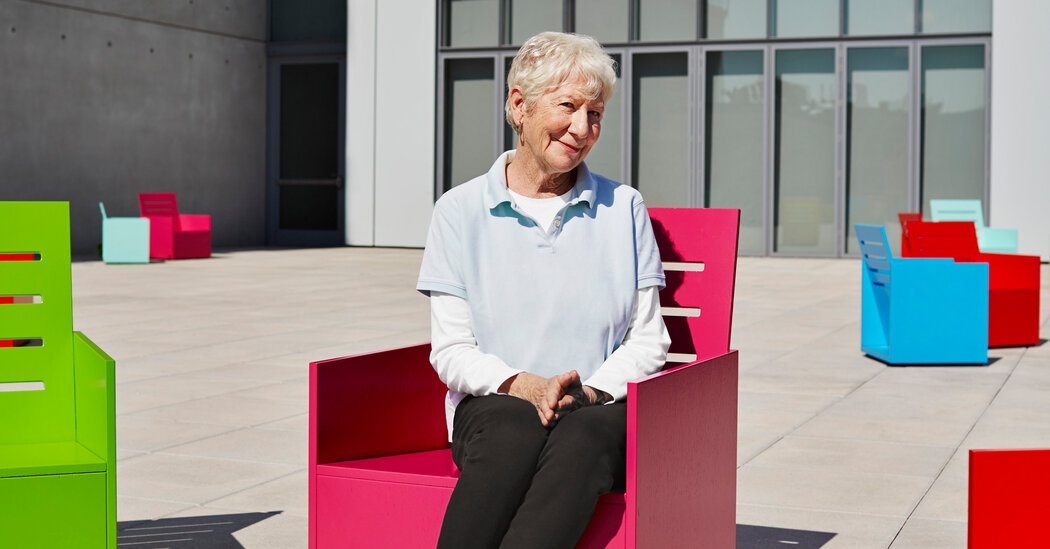
Mary Heilmann, an influential American abstract painter whose vibrant, often asymmetrical works gained belated widespread acclaim for their playful subversion of artistic conventions, died on Friday in Riverhead, N.Y., on Long Island. She was 86.
Her death, which occurred at a hospital, was confirmed by Liane Thatcher, Heilmann’s studio manager. Ms. Thatcher indicated that the cause of death was complications stemming from a recent fall. Heilmann, recognized for her “ebulliently colored, loose-limbed, often lopsided” canvases, began receiving significant institutional recognition in her 60s, establishing her as a unique voice in contemporary art.
Ms. Heilmann’s paintings are distinctive for their challenging yet accessible aesthetic, particularly their playful critique of the rigid geometric precision favored by many of her Minimalist contemporaries. She developed a signature style characterized by what has been described as a “wobbly line,” intentionally destabilizing and skewing the rectilinear grids that had been a hallmark of artists from Piet Mondrian in the 1920s to Sol LeWitt in the 1960s. This approach aimed to divest Modernism of its perceived lofty concepts and utopian aspirations, instead imbuing it with an offhand charm and a sense of spontaneity.
Some of her most acclaimed works convey an impression of having been created with a deliberate lack of precision, as if a T-square or ruler had been intentionally set aside. This subversion of formal rigidity marked a significant departure from prevailing artistic dogmas of her time, offering a more human and less dogmatic alternative to abstract expression.
Originally trained as a ceramist, Ms. Heilmann often employed high-key colors in her paintings, allowing them to drip and run in a manner reminiscent of glazes on pottery. Her preference for shades like hot pinks and oranges, colors often associated with popular culture or “teenage-girl taste,” constituted another subtle yet potent challenge to the more austere and “virile” artistic sensibilities that dominated the past. This color palette, combined with her informal lines, contributed to a unique blend of sophistication and casualness in her work.
Artist Laura Owens, a former student of Ms. Heilmann, commented on this aspect of her influence. “Mary confronted all the macho nonsense of the time with cool confidence,” Ms. Owens stated in an interview. She added, “At a time when painters took their own importance too seriously, Mary doubled down, paradoxically, on the casual gesture.” This perspective highlights Heilmann’s role in introducing a more human and less pretentious element into abstract art.
Within the art world, Ms. Heilmann’s career path became symbolic of the professional hurdles frequently encountered by women artists of her generation. Reflecting on her journey without bitterness in a 2008 interview with The New York Times, she remarked, “I was such an underdog for so long.”
This interview coincided with the impending opening of her first major museum retrospective, modestly titled “Mary Heilmann: To Be Someone,” at the New Museum in New York City. The exhibition had previously been showcased at the Orange County Museum of Art in Newport Beach, Calif., where it garnered significant critical acclaim.
At 67, Ms. Heilmann finally received widespread recognition as a pivotal influence on a new generation of prominent artists, including Ms. Owens, Jessica Stockholder, and Elizabeth Peyton. These artists found inspiration in what they described as the liberating, “don’t-overthink-it lightness” of her artistic sensibility. Even Ellsworth Kelly, often considered a dean of American hard-edged abstract painting, acknowledged her impact at the time, stating, “I’ve always felt that Mary Heilmann is the best of the new abstractionists.”
Mary Ann Heilmann was born on January 3, 1940, in San Francisco, California. She grew up in a religiously observant Irish Catholic family. Her mother, the former Mary Florence Webb, worked as a nurse, while her father, John Sherman Heilmann, was a civil engineer primarily involved in road construction.
When Ms. Heilmann was seven years old, her father’s work building freeways led the family to relocate to El Segundo, a seaside village south of Los Angeles. She often recounted the joy of her childhood there, living in a bungalow near the beach and experiencing the thrill of tumbling down sand dunes and swimming in the ocean.
At the age of 12, she began intensive training as a competitive swimmer and diver, commuting daily on an hour-long bus ride to the Los Angeles Athletic Club after school. This promising athletic pursuit abruptly ended less than a year later when her father died of colon cancer, prompting her mother to move the family back to San Francisco.
Ms. Heilmann pursued higher education at the University of California, Santa Barbara, where she majored in English literature. Her early fascination with ceramics, particularly throwing pots on a wheel, led her to graduate school at the University of California, Berkeley. There, she studied both ceramics and sculpture under Peter Voulkos, a renowned artist known for his experimental approach to clay, often incorporating Abstract Expressionist principles into his work.
Ms. Heilmann often recalled Voulkos’s unconventional teaching methods, such as his habit of carrying a homemade pot across the classroom, then “faking a trip” to smash it on the floor. He would then collect the broken shards and reassemble them into new, often surprisingly interesting sculptures, emphasizing process and deconstruction. This early exposure to challenging traditional notions of art-making profoundly influenced Heilmann, shaping her willingness to experiment.
Her own initial sculptures reflected this influence, consisting of raw, “ragged-looking objects” crafted from readily available and inexpensive craft-shop materials, including plastic clay, tin foil, cotton balls, bamboo, and glitter. These works similarly aimed to highlight the very process of their creation, rather than striving for polished, finished forms.
In 1968, after earning her master’s degree from Berkeley, Ms. Heilmann moved to New York City with the aspiration of establishing herself as a sculptor. Her high school friend, Richard Serra, was already in Manhattan, building an underground reputation for his “splash sculptures” created by tossing molten lead. Serra introduced Ms. Heilmann to Max’s Kansas City, a popular artists’ haunt of the era.
In the back room of Max’s, bathed in the hazy red light of a Dan Flavin fluorescent tube installation, she became acquainted with a prominent circle of sculptors, including Robert Smithson, John Duff, and Carl Andre. This group famously advocated the notion that painting as an art form was “dead.” Ms. Heilmann initially aligned with their perspective, believing sculpture to be the more relevant medium for contemporary artistic expression.
However, launching a successful career as a female sculptor proved exceptionally challenging during this period. The stark gender imbalance was evident in significant exhibitions; for instance, the Whitney Museum of American Art’s landmark 1969 exhibition “Anti-Illusion: Procedures/Materials” featured 20 male artists out of 22 participants. Ms. Heilmann experienced profound disappointment when she was overlooked for this and several other pivotal group shows, underscoring the systemic barriers women artists faced.
In response to these setbacks, and hoping to navigate the professional obstacles, she made a decisive and seemingly audacious pivot: abandoning sculpture to take up painting. This decision was considered unconventional, given her lack of formal academic training in painting and her age of 30. Yet, Ms. Heilmann found satisfaction in the very contrariness of her act, embracing a new medium against prevailing trends and expectations and carving out her own artistic niche.
During this transitional period, Ms. Heilmann supported herself by teaching at the State University of New York at Stony Brook. She often credited both her university students and younger pupils she had taught earlier with providing her with fresh ideas and approaches for her burgeoning painting practice. For example, in her 1973 work “Little 9 x 9,” she introduced an off-kilter grid onto a predominantly red canvas by strategically wiping away pigment with her fingers, a technique reminiscent of finger painting that further underscored her rejection of rigid formality and embraced spontaneity.
As her distinct artistic style evolved, it consistently maintained an “aura of playful ease” and a deliberate lack of pretension. In 1979, after joining the prestigious Holly Solomon Gallery in SoHo, Ms. Heilmann exhibited a significant series of paintings featuring rectangles rendered in striking combinations of pink and black. This particular color pairing was deliberately chosen for its “saccharine” quality, intentionally evoking associations with popular culture, such as Good & Plenty candy, further reinforcing her critique of the art world’s traditional gravitas and introducing elements of pop aesthetic into high art.
Why This Matters
Mary Heilmann’s death marks the passing of an artist whose singular vision profoundly impacted contemporary abstract painting. Her work matters for several key reasons, reflecting her enduring legacy within the art world and beyond.
Firstly, Heilmann played a crucial role in expanding the definition of abstract art. At a time when Minimalism was dominant and often characterized by austere, systematic approaches, she injected abstraction with a vibrant, human, and often humorous sensibility. By intentionally embracing “wobbly lines,” unconventional color palettes, and techniques that recalled craft or even childhood art, she challenged the perceived seriousness and intellectual rigor of Modernism. Her paintings demonstrated that abstraction could be both sophisticated and accessible, imbued with personality and wit, rather than solely focused on formal purity. This approach helped pave the way for a more expansive and inclusive understanding of what abstract art could be.
Secondly, her career serves as a significant case study in the professional obstacles faced by women artists, particularly during the mid to late 20th century. Her initial struggles to gain recognition as a sculptor, leading to a pivotal shift to painting, highlights the systemic biases and gender imbalances that limited opportunities for women. Her eventual success, achieved relatively late in life, underscores the importance of perseverance and the slow, often belated, recognition of truly groundbreaking work. She became an emblem of resilience, inspiring subsequent generations of female artists to forge their own paths and assert their unique voices against established hierarchies.
Finally, Heilmann’s influence on younger artists is undeniable. Her “don’t-overthink-it lightness” and willingness to subvert established norms provided a liberating framework for those seeking to move beyond rigid academic or market-driven artistic trends. Her embrace of color, personal narrative, and a distinctly anti-heroic approach to painting opened new avenues for expression, proving that art could be both intellectually rigorous and deeply personal. Her legacy is one of joyful rebellion, proving that sincerity and a sense of play can be powerful tools for artistic innovation and critique, continuing to resonate with artists and audiences today.
Mary Heilmann, a pioneering American artist whose vibrant abstract paintings and functional, sculptural furniture defied conventional artistic norms and influenced generations of younger artists, passed away in October 2023 at the age of 83. Heilmann, celebrated for her unique blend of geometric abstraction with a deeply personal sensibility, left an indelible mark on the contemporary art landscape, challenging the austerity of Minimalism while offering an alternative to the excesses of the 1980s art scene.
Heilmann’s career, spanning several decades, was initially met with a mixed critical reception. Her early works, characterized by their seemingly spontaneous and often vibrant palettes, sometimes bewildered critics who struggled to categorize her distinctive style. In a notable instance, a review appearing in The Village Voice by critic Kay Larsen, specifically addressing Heilmann’s pink-and-black paintings, expressed a desire for more overt artistic rigor. Larsen concluded that the works could benefit from “real muscle,” famously quipping that Ms. Heilmann “hasn’t been doing her push-ups.” This critique, particularly impactful as it came from a female peer, reportedly caused Ms. Heilmann considerable personal distress, highlighting the challenges artists faced in having their innovative approaches understood within the prevailing critical discourse of the time.
Despite these initial critical hurdles, Heilmann persevered. A pivotal moment in her career arrived in 1986 when she joined the Pat Hearn Gallery in the East Village. Described by Heilmann in her 1999 memoir, “The All Night Movie,” as “a powerful, radical painting gallery,” this move signaled a significant turning point. Her entry into the gallery was facilitated by her friend and fellow artist, Ross Bleckner, who also exhibited there. The Pat Hearn Gallery, known for its avant-garde programming and support for artists pushing boundaries, provided Heilmann with a crucial platform. Over the next decade, this association led to a growing and increasingly devoted following, particularly among a cohort of younger artists. These artists were actively seeking new directions and found in Heilmann’s work a refreshing counterpoint to the dominant artistic trends of the 1980s, an era often characterized as “cash-drunk” and largely defined by the “portentous style of Neo-Expressionism.” Heilmann’s work, with its more introspective, informal, and often playful approach to abstraction, offered a much-needed alternative perspective.
Beyond her acclaimed paintings, Ms. Heilmann also gained significant recognition for her distinctive, boxy plywood chairs, which she began crafting in 2002. These furniture pieces, while clearly acknowledging a conceptual debt to the geometric furniture designs of Minimalist artist Donald Judd, simultaneously offered a subtle yet pointed critique of his stripped-to-the-bone aesthetic. Judd’s furniture, known for its stark functionality and often uncomfortable rigidity, prioritized form and concept over user experience. Heilmann, however, approached her chairs with a different philosophy. As she told Vogue magazine, “Judd’s chairs were not very comfortable, but mine are.”
Indeed, her chairs often incorporated elements designed for comfort, such as webbed seats and backs crafted from strips of polypropylene, reminiscent of classic aluminum lawn chairs. This infusion of practicality and comfort into a minimalist-inspired form underscored Heilmann’s broader artistic ethos: an embrace of the everyday and the human experience within abstract and conceptual frameworks. A notable highlight of her furniture’s acclaim came in 2015 when 45 of her chairs were specially commissioned and installed on an outdoor terrace to mark the inauguration of the Whitney Museum of American Art’s new building in the Meatpacking District of New York City. For this occasion, the chairs were made from weatherproofed marine plywood and painted in vibrant, “lollipop shades” of lemon yellow and cherry red, further cementing their status as both functional objects and playful, site-specific art installations.