
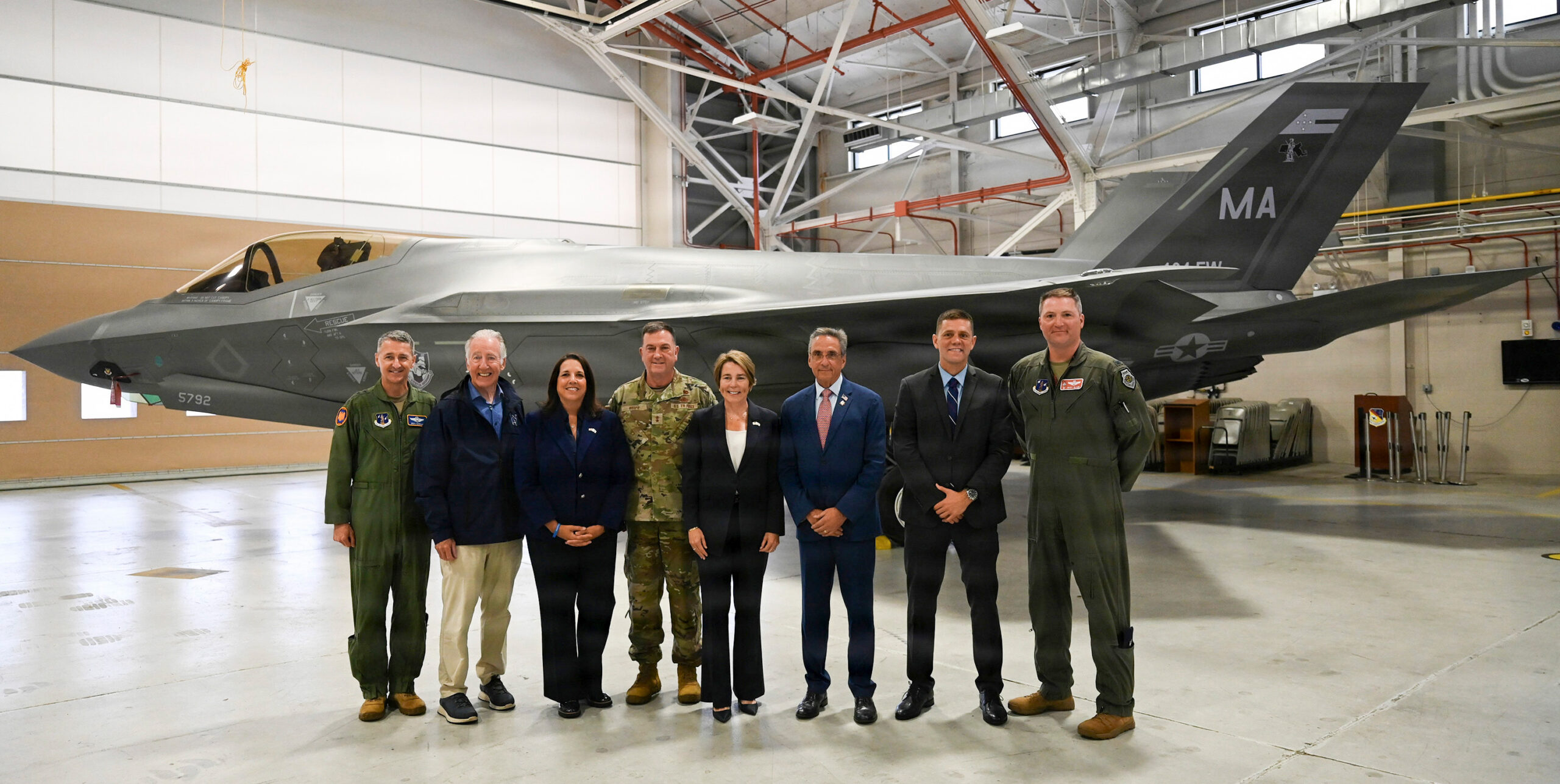
The Massachusetts Air National Guard’s 104th Fighter Wing officially received its first F-35A Joint Strike Fighter on September 13, 2026, marking a significant modernization milestone for the unit. This delivery makes the 104th Fighter Wing, based at Barnes Air National Guard Base in Westfield, Massachusetts, the latest component of the U.S. Air Force to integrate the advanced fifth-generation combat aircraft into its fleet.
The arrival of the F-35A signifies a comprehensive transition for the 104th, which has operated legacy F-15 Eagle fighters for decades. A formal ceremony was held to commemorate the event, attended by key officials including Massachusetts Gov. Maura Healey and Air Force Gen. Steven Nordhaus, Chief of the National Guard Bureau. The ceremony underscored the strategic importance of the F-35 to both national defense and the state’s military readiness.
During the ceremony, Governor Healey remarked on the unit’s history, stating, “For generations, men and women at the 104th Fighter Wing have answered the call, protected the skies, served our state, and defended our country.” She further emphasized the long-term impact of the F-35’s arrival: “The arrival of the F-35A represents a new chapter for this great military installation here. And it’s also an affirmation of the extraordinary professionalism and readiness of this wing that has existed decade after decade after decade.”
The integration of the F-35A at Barnes Air National Guard Base follows a decade-long collaborative effort involving military officials, Massachusetts state leaders, lawmakers, and local civic partners. The National Guard officially selected Barnes to host the F-35A in December 2024. Subsequently, the base underwent extensive preparations, which included the construction of new infrastructure such as specialized sunshades designed for the F-35, the acquisition of necessary support equipment, and comprehensive training programs for Airmen who will pilot and maintain these sophisticated jets.
The unit’s transition was completed with the departure of its last three F-15s in October 2025. Among the pilots who flew these final F-15 missions was Capt. Kyle “Nuke” Eckert, who has since transitioned to flying the F-35. Reflecting on his experience, Captain Eckert noted, “It was an honor to be part of the final three-ship of Eagles to leave Barnes back in October of 2025. To now be one of the first F-35A pilots at Barnes Air National Guard Base is an amazing full circle moment.”
Col. Michael “Shot” Glass, who assumed command of the 104th Fighter Wing in December 2025, highlighted the advanced capabilities of the new aircraft. He stated that the fifth-generation jets “provides our wing with increase and unmatched capabilities to safeguard both our country and the great city of Westfield as we execute our new 104th Fighter Wing mission and vision.”
Brig. Gen. David “Moon” Halasi-Kun, the former commander of the 104th, also emphasized the operational advantages of the F-35. He explained, “The F-35A brings with it incredible capabilities that will be able to support combatant commanders around the world, as well as continued defense of the United States from our 24-hour alert site.” General Halasi-Kun expressed confidence in the unit’s personnel, adding, “I know that our Airmen will be up to the challenge as we start to begin our conversion.”
Barnes Air National Guard Base is now the 15th installation across the U.S. Air Force to host the F-35, and the fifth base within the Air National Guard to receive the aircraft. The global deployment of the F-35 continues, with Misawa Air Base in Japan also receiving its first F-35 in 2026. Looking ahead, Kingsley Field Air National Guard Base in Oregon is slated to receive its initial F-35 jets in summer 2027.
F-35 Locations
Future locations in italic bold
| Base | State/Country | Component | First Aircraft Arrival | Mission |
|---|---|---|---|---|
| Edwards Air Force Base | California | Active | 2011 | Test |
| Eglin Air Force Base | Florida | Active | 2011 | |
| Nellis Air Force Base | Nevada | Active | 2013 | FTU |
| Luke Air Force Base | Arizona | Active | 2014 | |
| Hill Air Force Base | Utah | Active | 2015 | FTU |
| Burlington Air National Guard Base | Vermont | Guard | 2019 | |
| Eielson Air Force Base | Alaska | Active | 2020 | |
| Royal Air Force Lakenheath | UK | Active | 2021 | |
| Truax Field Air National Guard Base | Wisconsin | Guard | 2023 | |
| Dannelly Field | Alabama | Guard | 2023 | |
| Tyndall Air Force Base | Florida | Active | 2024 | |
| NAS-JRB Fort Worth | Texas | Reserve | 2024 | |
| Jacksonville Air National Guard Base | Florida | Guard | 2025 | |
| Misawa Air Base | Japan | Active | 2026 | |
| Barnes Air National Guard Base | Massachusetts | Guard | 2026 | |
| Kingsley Field Air National Guard Base | Oregon | Guard | 2027 | FTU |
| Moody Air Force Base | Georgia | Active | 2030 | |
| Homestead Air Reserve Base | Florida | Reserve | 2034 |
Why This Matters
The integration of the F-35A Joint Strike Fighter into the Massachusetts Air National Guard’s 104th Fighter Wing represents a critical step in the ongoing modernization of U.S. air power and has significant implications at both national and local levels.
Modernizing National Guard Capabilities:The Air National Guard plays a dual role, serving both state governors for domestic emergencies and the federal government for national defense missions. Equipping Guard units with the F-35 ensures that these forces possess the most advanced capabilities available. This is crucial for maintaining readiness and interoperability with active-duty components and allied nations. The F-35, a fifth-generation fighter, offers stealth technology, advanced sensor fusion, and networked capabilities far superior to the F-15s it replaces, significantly enhancing the Guard’s ability to operate in contested environments and conduct complex air-to-air and air-to-ground missions.
Strategic Defense Posture:The F-35 is a cornerstone of the U.S. and its allies’ air defense strategy. Its deployment at Barnes Air National Guard Base, along with other locations globally, reinforces America’s strategic presence and deterrence capabilities. The aircraft’s ability to gather and share intelligence, perform electronic warfare, and execute precision strikes contributes to a more robust and responsive national defense system, capable of addressing a range of threats from peer competitors to regional adversaries.
Economic and Local Impact:The decision to base F-35s at Barnes has a substantial economic impact on the local community of Westfield, Massachusetts, and the surrounding region. The decade-long preparation included significant infrastructure investment, creating construction jobs and ensuring the long-term viability of the base. Furthermore, the specialized training and technical expertise required to operate and maintain the F-35 fleet secures high-skill jobs for Airmen and support personnel, fostering a skilled workforce and injecting economic stability into the area for decades to come.
Technological Advancement and Training:The transition from fourth-generation F-15s to fifth-generation F-35s represents a major leap in aviation technology. This change necessitates extensive retraining for pilots, maintainers, and support staff, ensuring they are proficient in the complex systems of the new aircraft. This continuous investment in human capital and technological advancement keeps the U.S. Air Force, including its Guard components, at the forefront of military aviation, ready to adapt to evolving global security challenges.
In essence, the arrival of the F-35A at Barnes Air National Guard Base is more than just an aircraft delivery; it is an investment in national security, a commitment to technological superiority, and a reaffirmation of the critical role played by the Air National Guard in protecting the nation and its interests.