
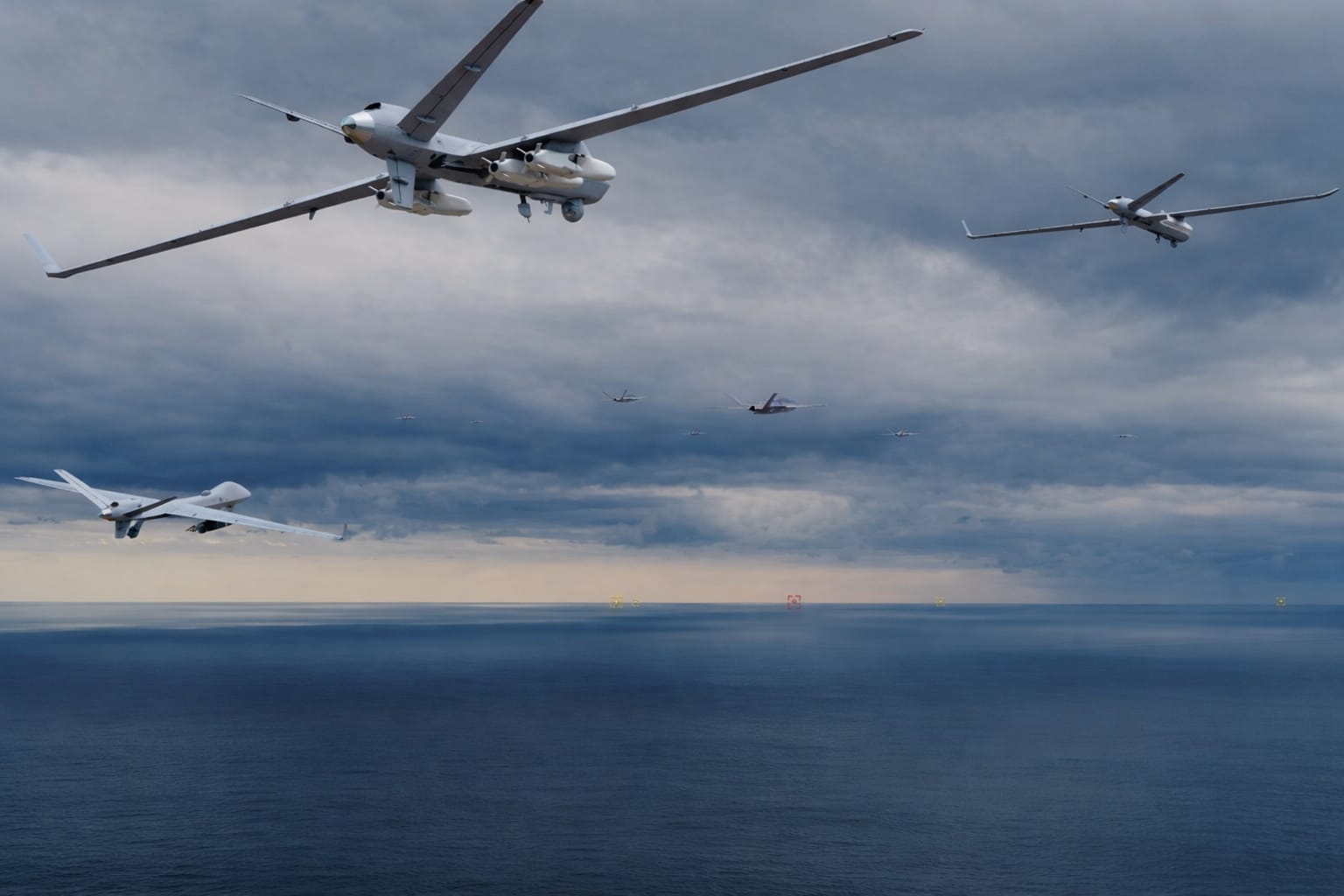
General Atomics Aeronautical Systems (GA-ASI) is crafting an extended-range offensive missile capability for its MQ-9B unmanned aerial vehicle, thereby broadening the aircraft’s operational portfolio to encompass maritime and deep standoff attack roles.
The firm stated that efforts are progressing to incorporate far-reaching accurate armaments onto the MQ-9B SkyGuardian and SeaGuardian models. This initiative addresses a requirement from aerial and naval forces for systems capable of posing a threat to objectives across immense oceanic and aerial territories, especially in the Western Pacific.
“The MQ-9B persists in making an impact during operations, and we continually expand our international client base,” remarked GA-ASI President David R. Alexander.“We aim to further enhance the worth of this unmanned system by broadening its operational roles. Given the MQ-9B’s remarkable carrying capability, it is logical to augment our mission sets with the capacity to transport extended-range armaments.”
An evaluation of its capabilities, as per GA-ASI, suggests that the aircraft is capable of transporting such weapons across considerable ranges without compromising its sustained operational time and steadfastness. Technical specialists are proceeding with incorporation efforts and honing prospective operational doctrines.
Armaments under consideration encompass the Lockheed Martin Joint Air-to-Surface Standoff Missile (JASSM), the Long-Range Anti-Ship Missile (LRASM), and the Kongsberg/Raytheon Joint Strike Missile (JSM). The company indicated its plan to carry out an aerial trial with a minimum of one of these weapons potentially by 2026.
A hypothetical operational scenario outlined by GA-ASI envisions MQ-9Bs departing from friendly bases in the Western or Southern Pacific. They would then proceed to a designated waiting area beyond an adversary’s weapons engagement zone and, should instruction be given, deploy extended-range munitions in concert with U.S. or allied forces.
The MQ-9B series comprises the SkyGuardian and the maritime-focused SeaGuardian, in addition to the Protector RG Mk1, which is presently being deployed with the Royal Air Force. This system has obtained a global clientele such as Belgium, Canada, Denmark, Germany, India, Japan, Poland, and Taiwan, besides U.S. operators, thus highlighting its expanding significance in partnered aerial and naval endeavors.