
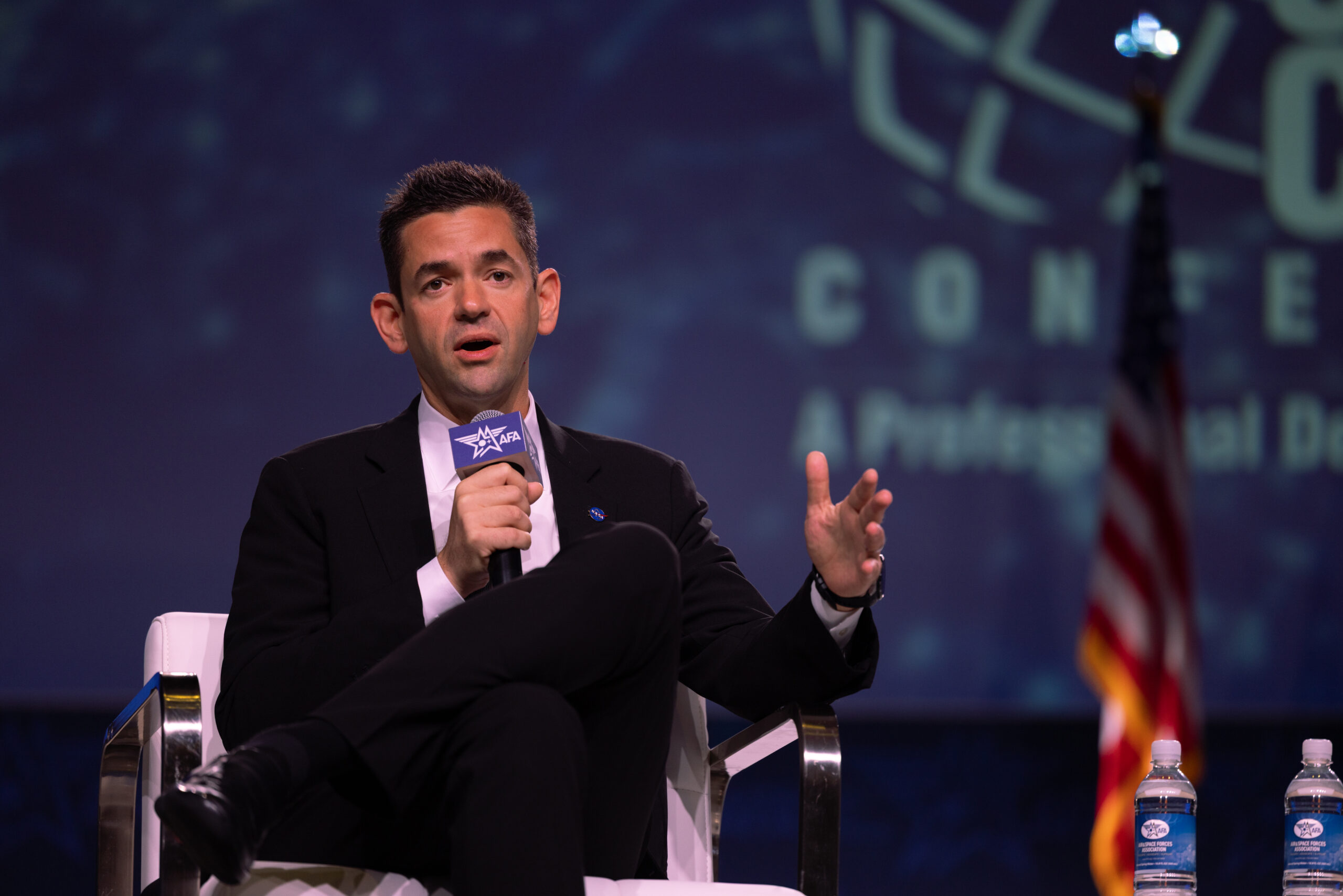
NATIONAL HARBOR, Md.—NASA is intensifying efforts to return astronauts to the lunar surface by 2028, a timeline largely influenced by national security concerns regarding China’s own ambitious lunar program, according to Administrator Jared Isaacman. Speaking at the Air & Space Forces Association’s Air, Space & Cyber conference on Sept. 15, Isaacman underscored the strategic importance of the United States maintaining leadership in lunar exploration.
Isaacman highlighted a fundamental distinction between the U.S. approach to space exploration and that of the People’s Republic of China (PRC). He noted that NASA, a civilian agency, operates distinctly from the Pentagon, while China’s lunar ambitions do not clearly delineate between military and civilian space operations. This difference, he suggested, carries significant implications for the future of space governance and security.
“Success in this endeavor will be measured in months, not years,” Isaacman stated, emphasizing the urgency of the mission. He added, “Our allies and adversaries are watching. So is every nation deciding whose technology to buy, whose standards to adopt, whose security relationships to deepen, and whose vision of the future to follow.” This statement frames the lunar race not just as a scientific or exploratory pursuit, but as a critical determinant of global influence and technological leadership.
The U.S. aims for a 2028 manned lunar mission, a target that has been described as ambitious and subject to fluctuation. China, meanwhile, has set a goal of 2030 for its first crewed lunar landing. This perceived two-year lead for the U.S. is precarious, Isaacman acknowledged, noting it could easily diminish or disappear.
Isaacman detailed China’s capabilities, explaining, “They have an achievable two-launch architecture to put their Taikonauts on the moon,” referring to a strategy of launching crew and lander components separately before orbital rendezvous. He further noted, “They have demonstrated reusability with their rockets. They have the expertise, and history has shown they could even be early—and we could easily be late.” This assessment suggests a high level of confidence in China’s technical prowess and commitment to its lunar program.
Beyond national prestige, tangible advantages are associated with being the first to establish a presence in key lunar regions. The moon’s south pole, in particular, is considered rich in potentially valuable resources, notably water ice, which could be critical for sustaining future lunar bases and producing rocket fuel for missions deeper into space, such as to Mars. This environment also presents a challenging proving ground for technologies and human endurance, making it an ideal testbed for future deep-space exploration.
However, these desirable locations are finite. Isaacman described them as “limited parking spots,” stating, “It creates an urgency, and we must, because the Chinese are going to the exact same locations.” This highlights a direct competition for strategic lunar territories, which could have long-term implications for resource control and scientific access.
American credibility and reliability on the global stage are also at stake, Isaacman suggested. He articulated concerns about how a failure to meet U.S. lunar objectives could be perceived internationally. “If we come up short, if we fail in this regard, and the Chinese are able to get there … It causes all our allies to question whose security guarantees again do you trust? Whose technology should I follow? Whose standards should I adhere to?” These questions, he argued, have “real implications” for U.S. foreign policy and alliances.
Isaacman drew a parallel to the first space race, arguing that the U.S. victory in landing on the moon in 1969 had a profound impact on national security. “I’d love to think July 20, 1969, sent a message to all our adversaries around the world: ‘I wonder what else America is capable of achieving, and maybe I should think twice before I encroach on their interests.’ And I absolutely believe the inverse is true, and it invites encroachment if you fail.” This historical perspective underscores the belief that leadership in space translates directly into geopolitical strength and deterrence.
While the Soviet Union never achieved a manned lunar landing, Isaacman expressed conviction that the PRC will not falter in its lunar ambitions. “China will accomplish what the Soviets never could,” he asserted, signaling a recognition of China’s current capabilities and determination in space.
More X-Planes and Enhanced Collaboration
The integrated nature of the PRC’s military and civilian space endeavors means that any Chinese lunar outpost could potentially serve dual purposes, carrying national security implications. In contrast, NASA has historically focused on the peaceful exploration of space, having been established outside the purview of the Department of Defense.
Despite this distinction, Isaacman emphasized that collaboration between NASA and the Pentagon is not only common but essential. He noted a long history of shared knowledge and resources between the two entities, which he believes must continue, especially concerning the cislunar environment—the region of space between Earth and the moon. “We should absolutely be collaborating, especially as we think about the cislunar environment, on areas that benefit our civil ambitions, our scientific breakthroughs that we are pursuing, but also enhance our national security footprint farther out into space,” he said.
As an example of beneficial synergy, Isaacman cited the joint pursuit of nuclear power in space. He argued that if NASA and the Pentagon were to pursue separate, parallel projects in this critical area, the resources each could commit would be divided, thereby reducing the overall probability of success. A unified approach, he suggested, would accelerate progress and ensure greater effectiveness.
Beyond space, Isaacman also addressed NASA’s renewed commitment to aeronautics research, a field he believes has been neglected. He noted that the agency’s aeronautics budget has historically been allocated to incremental efficiency improvements in mature engine technologies. “That is not what your NASA’s aeronautics budget should go to,” Isaacman stated, indicating a clear shift in priorities.
Instead, Isaacman aims for NASA to concentrate on “game-changing” technologies. Currently, NASA has only one experimental “X-plane,” the X-59, designed to investigate quiet supersonic flight without disruptive sonic booms. “That will change,” Isaacman promised, signaling plans for a significant expansion of the X-plane program and a renewed focus on pioneering advancements in aviation.
Why This Matters
The renewed urgency in the U.S. lunar program, driven by strategic competition with China, signifies a pivotal moment in global space exploration. This “new space race” extends beyond scientific curiosity, carrying profound geopolitical, economic, and security implications. The competition for lunar resources, particularly water ice at the moon’s south pole, could determine future capabilities for sustaining human presence in space and expanding deep-space missions. Control over these strategic locations is not merely about access but about shaping the future infrastructure and economy of space.
Furthermore, national prestige and technological leadership are deeply intertwined with success in this endeavor. A successful U.S. return to the moon ahead of or concurrently with China would reinforce its standing as a global leader in innovation and space technology, influencing international alliances and the adoption of U.S. standards and technologies. Conversely, a perceived failure or lag could undermine confidence in U.S. capabilities, potentially shifting global influence towards nations demonstrating greater prowess in space. The Administrator’s comments suggest that leadership in space is directly linked to national security, acting as both a deterrent to adversaries and a guarantor of trust for allies.
The distinction between the U.S. civilian-led space program and China’s integrated civil-military approach highlights emerging challenges in space governance and security. As more nations and commercial entities venture into space, the establishment of norms and regulations for activities in orbit and on celestial bodies becomes increasingly critical. The potential for dual-use technologies and infrastructure in space raises questions about the militarization of space and the need for robust international frameworks to ensure peaceful and responsible exploration. The call for enhanced collaboration between NASA and the Pentagon reflects a recognition of the dual nature of space activities—serving both scientific advancement and national defense—and the necessity for a unified strategy to secure U.S. interests in the vast cislunar environment and beyond.