
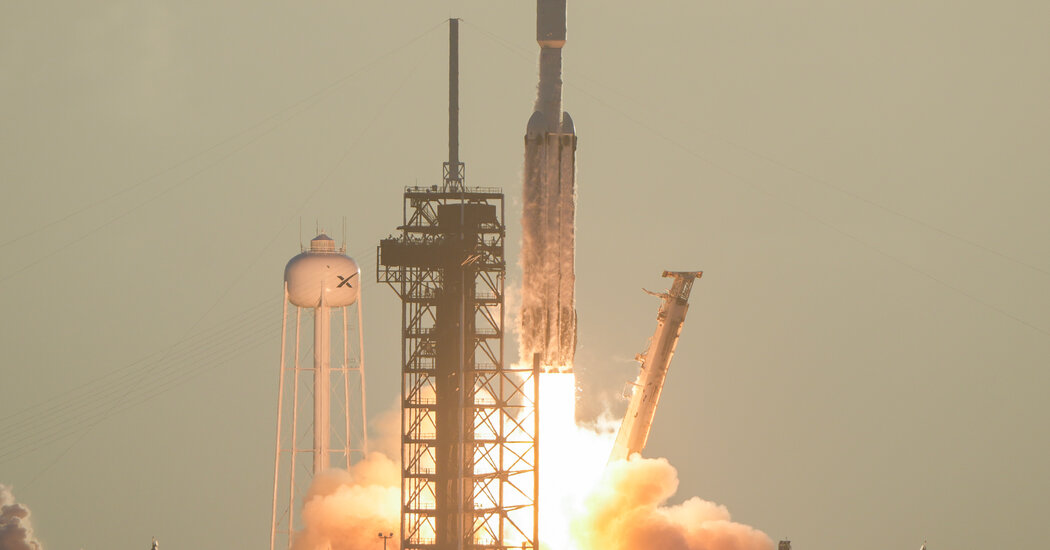
The Nancy Grace Roman Space Telescope successfully launched from Florida’s coastline at 7:26 a.m. Eastern time on Sunday, commencing its mission to conduct extensive observations of the universe. The telescope is designed to capture deep and wide-field views, reaching back to when the cosmos was merely a few hundred million years old.
Named in honor of NASA’s first chief astronomer, Nancy Grace Roman, the $4.3 billion observatory is poised to become a significant tool for mapping the universe. Utilizing its advanced infrared imaging capabilities, the Roman Telescope is expected to chart billions of galaxies, identify hundreds of black holes, and observe the dusty disks around young stars where new planets are in the process of formation. Its observational panorama is so expansive and detailed that, according to NASA, it would require over half a million high-definition televisions to display its full scope simultaneously.
At a news conference held on Saturday morning, Nicola Fox, associate administrator of NASA’s Science Mission Directorate, emphasized that the Roman Telescope’s broad observational capacity would be instrumental in addressing fundamental questions about the universe. These include its operational mechanisms, its composition, and the potential for life beyond Earth.
Dr. Fox further illustrated the Roman Telescope’s capabilities by comparing it to its predecessors. “To put it in perspective, it will be as if Hubble and James Webb kind of peered through a keyhole at the universe,” she stated, referring to NASA’s well-known space telescopes. “Well, Nancy Grace Roman will kick the door down.”
The launch occurred months ahead of its initial schedule, with the Roman Telescope ascending from NASA’s Kennedy Space Center shortly after daybreak. It was carried aloft by a SpaceX Falcon Heavy rocket, lifting off precisely at its scheduled time. Approximately two and a half minutes into the flight, the reusable side boosters separated from the rocket’s second stage, which continued to carry the telescope. These side boosters executed a controlled return and landed at Cape Canaveral Space Force Station approximately seven minutes after launch. Following this, the rocket fairing, which protected the Roman Telescope during ascent, was jettisoned as the spacecraft continued its trajectory into space.
Twenty-four minutes into the mission, the second stage engines ignited for a final burn. Seven minutes later, the Roman Telescope successfully detached from the rocket and began its solo journey through the vacuum of space.
The telescope is now en route to a gravitationally stable point known as L2, located approximately one million miles from Earth. At L2, the gravitational forces from the Sun and Earth effectively cancel each other out, allowing spacecraft to maintain their position with minimal fuel consumption. The transit to L2 is expected to take approximately 100 days, after which Roman will commence its scientific observations, planned for a minimum duration of five years.
Once operational, the Roman Telescope is projected to transmit an immense volume of data back to Earth, estimated at approximately one terabyte per day.
Jeremy Perkins, a Roman scientist at NASA Goddard Space Flight Center, highlighted the scale of this data transmission during the agency’s livestream, stating, “It’s like a million songs that we’re streaming a million miles away every single day for the lifetime of Roman.”
Astronomers intend to utilize Roman’s collected data to investigate the properties of dark matter, an enigmatic, invisible substance that significantly influences the large-scale structure of the universe, and dark energy, an unknown force believed to be responsible for the accelerating expansion of the cosmos. Furthermore, the mission anticipates discovering over 100,000 new exoplanets (worlds beyond our solar system), contributing to a more complete census of planetary bodies within the Milky Way galaxy.
Beyond its defined objectives, a significant aspect of the telescope’s potential lies in unforeseen discoveries that may emerge from its vast datasets.
Julie McEnery, who leads Roman’s science team, commented at an earlier news conference on Saturday, “Roman’s vast reach will allow us to find the weird, the rare and the unusual. We will redefine what it means to find a needle in a haystack.”
While possessing similar infrared resolution to NASA’s Hubble Space Telescope, Roman distinguishes itself with a field of view at least one hundred times wider. Its operational speed is also considerably higher, being up to a thousand times faster; Dr. McEnery noted that Roman could accomplish a sky survey in one month that would take Hubble an entire century to complete.
The telescope’s primary scientific instrument is a 300-megapixel infrared camera. With the images captured by this camera, scientists will analyze various forms of gravitational lensing, a phenomenon where massive objects warp the fabric of spacetime, bending the light emitted from objects located behind them.
The presence and distribution of dark matter, which is thought to be pervasive throughout the cosmos, can be inferred by observing how its gravitational influence distorts the light from more distant background galaxies.
By mapping the structure and spread of dark matter across cosmic time, researchers aim to gain insight into the universe’s expansion over billions of years. This understanding is crucial for elucidating the perplexing behavior of dark energy, which is currently driving the cosmos to expand at an accelerating rate.
Dr. McEnery described this accelerating expansion as “completely crazy. It’s like you throw a ball in the air and instead of it coming down, it goes rocketing away.”
Roman is equipped to shed light on dark energy through two additional methodologies. The telescope will detect a specific type of supernova (Type Ia supernovae) that consistently explodes with a known intrinsic brightness. By observing the apparent brightness and distance of these stellar explosions, scientists can obtain a second independent measurement of the universe’s expansion rate. A third method involves studying the increasing separation rates of galaxies observed in different epochs of cosmic history.
Data from Roman’s camera will also be pivotal in the search for new exoplanets. Astronomers will employ the transit method, identifying planets as they pass in front of their host stars, causing a temporary and detectable dimming of the star’s light. Additionally, the mission will extensively utilize microlensing, a form of gravitational lensing occurring on a smaller scale. In microlensing events, planets orbiting foreground stars can momentarily amplify the light from more distant background stars.
While other planet-hunting techniques are more effective at detecting large, hot, Jupiter-like worlds, microlensing is particularly suited for identifying smaller, cooler planets that bear a closer resemblance to Earth. According to NASA, only a few hundred planets have been discovered using microlensing to date. Roman is projected to significantly increase this number to over a thousand.
Jonathan Fortney, a planetary scientist at the University of California, Santa Cruz, commented on this significant increase, stating, “That’s huge.” He added that this expanding catalog of exoplanets is transitioning scientists “from the era of exoplanet detection to the era of exoplanet characterization.”
Roman is also equipped with a secondary instrument called a coronagraph. This device is designed to directly image already-discovered exoplanets by effectively blocking out the blinding light from their host stars. While NASA’s James Webb Space Telescope (JWST) already features a coronagraph capable of imaging planets a million times fainter than their stars, Roman’s coronagraph aims to photograph worlds that are up to 100 million times fainter.
This new coronagraph serves as a proof-of-concept for NASA’s proposed Habitable Worlds Observatory, a future telescope scientists hope will possess the capability to directly image distant Earth-like planets, potentially identifying signs of habitability.
The Roman Telescope joins two other powerful observatories currently engaged in broad, deep surveys of the universe. The European Space Agency’s Euclid telescope, launched in 2023, is mapping approximately one-third of the sky. (Roman will image a narrower field, covering about 12 percent of the sky.) Additionally, the Vera C. Rubin Observatory in Chile systematically surveys the entire southern sky every few days.
Although Roman’s field of view is narrower than both Euclid’s and Rubin’s, its observations within its scanned area are expected to be significantly sharper.
Jason Rhodes, an astrophysicist at NASA’s Jet Propulsion Laboratory in California, affirmed, “Roman is going to be the gold standard for that area of the sky.”
Dr. Rhodes further noted that the extensive datasets from Euclid, Rubin, and Roman will eventually be integrated. “And that’s where I think the truly revolutionary discoveries are going to come,” he predicted.
NASA’s latest space observatory is named after Nancy Grace Roman, who was appointed as the agency’s first female executive six months after its establishment. Dr. Roman earned the moniker “the mother of Hubble” due to her instrumental role in developing the nation’s space astronomy program. She passed away in 2018.
In 1959, Dr. Roman authored a concise article in which she contemplated the possibility of discovering planets orbiting other stars. Her calculations at the time led her to conclude that a space telescope of sufficient size and accuracy for such a task was unlikely. However, thousands of exoplanet discoveries later, a dedicated space telescope now bears her name, pursuing precisely that goal.
Reflecting on this historical irony, Dr. McEnery remarked with a smile on Saturday, “I think if she was here now, she would really enjoy having been proved wrong.”
Why This Matters
The launch of the Nancy Grace Roman Space Telescope represents a significant leap forward in humanity’s quest to understand the universe. This mission is critical for several interconnected reasons, impacting our knowledge of fundamental cosmic forces, the prevalence of exoplanets, and the future of space exploration.
Firstly, Roman’s primary scientific objectives directly address some of the most profound mysteries in astrophysics: the nature of dark matter and dark energy. These invisible components are believed to constitute approximately 95% of the universe’s mass-energy content, yet their properties remain largely unknown. By employing precise measurements of gravitational lensing, supernovae, and galaxy distribution, Roman will provide unprecedented data to chart the universe’s expansion history and the distribution of dark matter. A deeper understanding of these forces is essential for comprehending the universe’s past, present, and ultimate fate.
Secondly, the telescope is poised to revolutionize the study of exoplanets. With its enhanced microlensing capabilities, Roman is expected to discover thousands of new planets, particularly smaller, cooler worlds that are difficult to detect with other methods. This expanded catalog will move planetary science beyond mere detection towards detailed characterization, providing crucial insights into the diversity of planetary systems and the conditions necessary for life. The search for Earth-like planets is a fundamental step in determining whether humanity is alone in the universe, and Roman’s data will significantly advance this quest.
Thirdly, Roman serves as a vital technological precursor for future, even more ambitious missions. Its advanced coronagraph, designed to image planets 100 million times fainter than their host stars, is a direct testbed for technologies that will be incorporated into the proposed Habitable Worlds Observatory. This future observatory aims to directly image distant Earth-like exoplanets and analyze their atmospheres for potential biosignatures, taking the search for extraterrestrial life to an unprecedented level.
Finally, the Roman Telescope embodies the spirit of international scientific collaboration and the enduring human drive for discovery. Its data, when combined with observations from other powerful observatories like Euclid and the Vera C. Rubin Observatory, promises a holistic view of the cosmos that transcends the capabilities of any single instrument. This collaborative approach ensures that the scientific community can tackle complex cosmic questions with the most comprehensive datasets available, pushing the boundaries of human knowledge and inspiring future generations of scientists and explorers.