
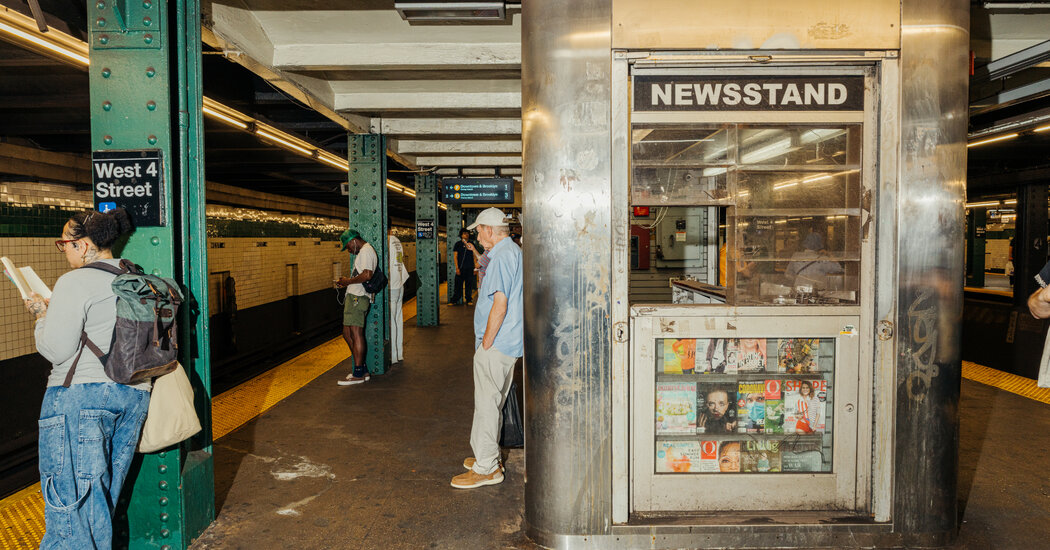
A former newsstand at Manhattan’s West 4th Street subway station is set to open Saturday, offering commuters a range of unconventional, free items and experiences designed to transform their daily transit. Among the items are collectible trading cards featuring biographical details of retired subway personnel, “good luck” keychains incorporating a simulated rat’s foot, and a novel bucket hat equipped with a retractable veil, intended to provide privacy for riders. This initiative aims to engage, entertain, and offer moments of unexpected solace within New York City’s expansive subway network.
The project is the brainchild of Al Mullen, 37, a comedian and writer known for his public engagement projects focused on urban transit. This newsstand represents an evolution of his previous endeavor, “Public Transport Magazine,” a free zine he launched in 2022 from his Brooklyn residence and distributed anonymously on trains and in stations. Mr. Mullen stated during recent preparations for the newsstand opening, “The subway is a ubiquitous space; it’s where I can interact with diverse individuals and potentially bring them a moment of joy.”
To bring this concept to fruition, Mr. Mullen established partnerships with Art on the Ave NYC, a nonprofit organization dedicated to transforming vacant urban retail spaces into art installations, and The David Prize, a philanthropic initiative supported by the Walentas Foundation. These collaborations were instrumental in securing a one-year license from the Metropolitan Transportation Authority (MTA) for the previously decommissioned newsstand location.
Mullen mobilized a network of colleagues and fellow transit enthusiasts to convert the space into an engaging destination for commuters. Noteworthy contributions include a panoramic mural by Edward Steed, a cartoonist whose work has appeared in The New Yorker, depicting various forms of public transportation and urban life. Additionally, a diverse group of comedians, writers, and artists are developing unique travel guides for each of the city’s 472 subway stations, intended for free distribution. Future plans for the newsstand include live performances, such as puppet shows strategically timed between train movements, and an interactive photo booth. This booth features a subway pole, which, when grasped by a participant, is designed to reveal their “inner train line” or “train aura” through a colored circle corresponding to a specific subway route.
Even prior to its official launch, the newsstand, located on the downtown platform serving the B, D, F, and M subway lines, has generated considerable interest. Commuters have frequently approached the site for directions. Anecdotal observations include a group of teenagers engaging playfully with the counter space. A notable installation observed during the preparatory phase featured five large clocks, each displaying the identical time, with individual labels for New York City’s five boroughs. Markus Kusano, a 35-year-old software engineer, commented positively on this artistic choice, describing it as “a humorous representation of New York’s singular focus on its own time.”
The Subway As A Stage
Mullen’s background includes growing up in Scituate, Massachusetts, and pursuing film studies at Occidental College in California. He relocated to New York City in 2011, where he worked as a film and video editor while simultaneously developing his skills as a stand-up comedian. By 2019, Mullen sought a new direction for his creative endeavors. A pivotal moment occurred during jury duty in a Brooklyn courthouse, where observing the diverse cross-section of the city’s population led him to reflect on the perceived insularity of his professional and social circles. He articulated a desire to connect with a broader public, identifying the subway system as the most accessible and representative public forum for such interaction.
This realization prompted Mullen to focus his creative energy on the subway environment. He independently produced “Public Transport Magazine” using a home printer, distributing it through informal placements on trains and within stations. Despite its DIY aesthetic, the publication attracted contributions from notable figures in comedy and writing, including Jack Handey, a former writer for “Saturday Night Live,” and actor-comedian David Cross.
The zine’s growing recognition led to a meeting with Erika Augustine, Executive Director of The David Prize, in 2024. Mullen subsequently applied for the prize, an annual award of $1 million distributed among five New Yorkers recognized for their contributions to improving the city. While not a recipient, his application left a significant impression. Ms. Augustine commended Mullen’s “uniquely New York” affection for the transit system, noting his ability to encourage commuters to view the subway beyond common frustrations such as delays and pest issues.
Building on this connection, Mullen presented his concept for a transit-themed newsstand to Ms. Augustine last year. She facilitated an introduction to Barbara Anderson, Executive Director of Art on the Ave NYC, who is also a 2025 finalist for The David Prize.
Art on the Ave NYC has a proven track record, having orchestrated art installations in 106 vacant retail locations across the city since 2020. Notably, the organization previously repurposed a newsstand at the West 81st Street station into an interactive sound booth, offering commuters a space for musical expression and live performances.
‘No Rats’ And Opportunity
On a Saturday in June, Mr. Mullen received the keys to the West 4th Street newsstand, marking a tangible step forward for the project. He expressed that holding the keys symbolized the realization of a long-held ambition.
Why This Matters
The establishment of this unique newsstand transcends a simple artistic endeavor, representing a significant model for urban engagement and the revitalization of public spaces. In a metropolis like New York City, where millions navigate daily commutes, the quality of public transit environments profoundly impacts residents’ well-being and civic experience. This initiative transforms a formerly vacant newsstand from a dormant commercial relic into an active cultural hub, thereby enhancing the functional and aesthetic value of the subway system.
It offers a crucial counter-narrative to the often-stressful realities of urban commuting, providing moments of unexpected joy, introspection, and communal interaction. By integrating art, humor, and participatory experiences directly into the commuter’s journey, the project democratizes access to creative expression, making it an integral, rather than peripheral, part of daily life. This approach can foster a deeper sense of connection among diverse city dwellers, encouraging them to view shared spaces not merely as transit corridors but as venues for community and creativity.
Furthermore, the collaborative funding and operational model, involving a non-profit organization, a philanthropic foundation, and the MTA, demonstrates how cross-sector partnerships can effectively activate public infrastructure for social and cultural benefit. This project serves as a practical example of how seemingly small interventions can have a disproportionately positive impact on urban residents’ quality of life, fostering a more engaging, humane, and connected urban experience. It highlights the potential for creative initiatives to redefine urban utility, turning mundane journeys into opportunities for discovery and shared delight, ultimately contributing to a more vibrant and resilient city fabric.
New York City’s subway system, a vital artery for millions, is increasingly becoming a canvas for urban revitalization through art and community engagement. At the 53rd Street-Lexington Avenue station, a long-abandoned newsstand has been transformed into an interactive art and community hub, a project spearheaded by local artist and writer Mr. Mullen, as part of a broader Metropolitan Transportation Authority (MTA) initiative.
The project, simply named “Newsstand,” officially opened to the public, marking a significant step in the MTA’s 2023 program designed to reactivate disused retail spaces within the transit network. Mr. Mullen, the driving force behind the transformation, received the keys to the dormant kiosk and embarked on a journey to convert it into a vibrant public space.
Upon initial inspection, the newsstand presented a scene of neglect. Inside, shelves held outdated publications, including Us Weekly and Cosmopolitan magazines dating back to 2016, alongside an unplugged Coca-Cola refrigerator. Graffiti defaced several display cases, and a thick layer of grime covered surfaces. Despite these conditions, Mr. Mullen expressed optimism, noting the considerable potential for renovation and the absence of rodents.
The refurbishment began with a thorough cleaning effort. Mr. Mullen, aided by friends, meticulously scrubbed the interior. During this process, a quarter was discovered and placed on the counter. Shortly after, an individual quickly retrieved the coin and boarded a departing train, an event Mr. Mullen humorously described as “a heist.”
The former newsstand is one of 17 sites currently licensed rent-free through the MTA’s program, which aims to infuse public art exhibits into disused retail units. Other notable projects include another newsstand converted into a sound booth and a former retail space at the Grand Army Plaza station in Brooklyn reimagined as a “bodega for dinosaurs,” showcasing the diverse creative interpretations fostered by the initiative.
To develop and open his “Newsstand,” Mr. Mullen received $10,000 in initial funding from the David Prize. A substantial portion of this, $4,200, was allocated to commissioning and producing a vibrant mural on durable vinyl, which now adorns the exterior of the kiosk. Mr. Mullen intends to compensate other contributing artists and writers, including those developing specialized station guides, with $100 each. As of the project’s launch, Mr. Mullen, who also works as a writer for a game show application, has not drawn a salary for his efforts, viewing the newsstand as a collaborative platform for fostering community connections. He emphasized that being “in company with people, being in community” is a core aspect of New York City culture, and the newsstand serves as a direct extension of this principle.
The “Newsstand” will be staffed by Mr. Mullen and his volunteers from Friday through Sunday. Future operations are contingent upon securing additional funding, which Mr. Mullen hopes to raise to sustain the project for at least the coming year. The collaborative spirit is evident in the diverse contributions to the project. Lily Crandall, 28, a textile artist, volunteered to create unique trading cards depicting subway workers. Her personal connection to the transit system runs deep, as her great-grandfather was involved in the construction of the 8th Avenue line. Crandall expressed enthusiasm for Mr. Mullen’s concepts, finding them engaging and enjoyable to participate in.
The initiative also attracts established creative talent. Recently, comedians Harris Alterman, 34, and Dave Ross, 43, were observed taking measurements at the newsstand. The duo gained viral attention in June for a video in which they installed temporary, satirical tech advertisements in Brooklyn subway stations, spoofing what they described as “annoying and ugly” real ads. Following the video’s success, Mr. Ross posted on social media seeking access to a subway space, to which Mr. Mullen responded, offering the newly acquired newsstand. This collaboration will culminate in a one-day installation of their fake tech ads at the “Newsstand” on August 8.
Mr. Ross reflected on the city’s rich artistic landscape, stating, “I love how much art and music is in the city — and how much isn’t in the zeitgeist but the city supports it anyway. There’s a little scene for everything if you can find it.” This sentiment encapsulates the essence of “Newsstand” and similar MTA initiatives: providing accessible platforms for diverse artistic expressions and fostering community engagement within the bustling environment of New York City’s subway system.
Why This Matters
The transformation of disused subway newsstands into vibrant community and art spaces, exemplified by Mr. Mullen’s “Newsstand” at the 53rd Street-Lexington Avenue station, holds significant implications for urban planning, public art, and community engagement in metropolitan areas worldwide. This initiative by the Metropolitan Transportation Authority (MTA) is more than just a beautification project; it represents a strategic approach to revitalizing neglected public infrastructure and enhancing the daily lives of commuters.
Firstly, it addresses the challenge of dormant urban spaces. As retail habits change, many traditional storefronts and kiosks, particularly in high-traffic areas like subway stations, become vacant. These empty units can contribute to a sense of decay and insecurity. By reactivating these spaces, the MTA’s program injects vitality, improving the aesthetic appeal and overall experience of the public transit environment. This model offers a blueprint for other cities grappling with similar issues of underutilized public real estate.
Secondly, the project fosters genuine community engagement and provides crucial platforms for local artists. In an era where public spaces often feel increasingly commercialized or sterile, initiatives like “Newsstand” offer authentic, grassroots cultural experiences. By offering rent-free spaces and initial funding, the program lowers barriers for artists and creators, enabling them to bring their visions to life in unexpected, accessible locations. The collaborative nature, involving textile artists creating subway worker trading cards and comedians staging satirical installations, reflects a dynamic and inclusive approach to public art, making it relatable and engaging for a diverse audience.
Thirdly, these projects enrich the commuter experience. For millions who navigate daily commutes, subway stations are often seen merely as points of transit. Introducing art, interactive exhibits, and community hubs transforms these utilitarian spaces into destinations for discovery, reflection, and connection. It breaks the monotony of routine, potentially reducing stress and fostering a greater sense of pride and ownership among residents and commuters for their public spaces. This can contribute to a more positive perception of public transportation as a whole.
Finally, the initiative highlights the power of public-private partnerships and innovative funding models. The initial funding from the David Prize, coupled with the MTA’s provision of rent-free space, demonstrates how collaborative efforts can kickstart impactful projects. The ongoing challenge of securing long-term funding, as noted by Mr. Mullen, also underscores the need for sustainable financial models to ensure the longevity of such valuable community assets. If successful and scalable, this model could inspire similar programs globally, redefining how urban infrastructure serves not just functional needs but also cultural, artistic, and social ones.