
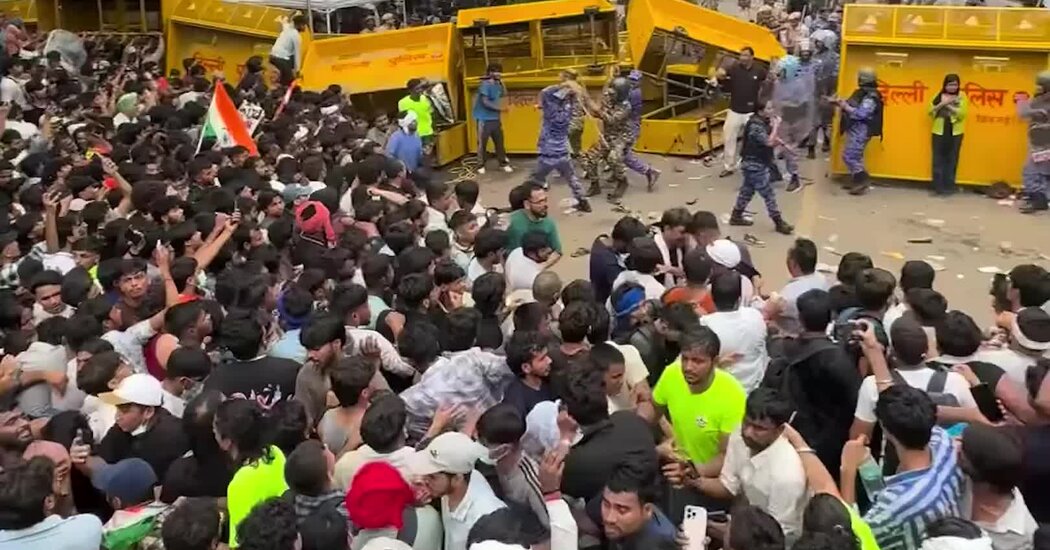
Last month, thousands of university students converged on the Indian Parliament building in a demonstration that escalated into confrontations with security forces. The march, which aimed to draw attention to perceived systemic flaws within the nation’s education system, was met by a significant deployment of riot police officers tasked with preventing protesters from reaching the Parliament complex.
Authorities had implemented an internet blockade in the immediate vicinity of the protest, a measure that initially hampered the rapid dissemination of information regarding the events. However, videos captured by both participants and bystanders soon began to circulate widely online. These recordings depicted security forces using batons, firing tear gas, and deploying pellet guns against the demonstrators. The footage quickly led to widespread accusations of excessive force being used against what organizers described as a largely peaceful assembly.
The New York Times undertook a comprehensive verification and analysis process of the images and video footage shared by protesters, cross-referencing them with multiple witness accounts. This investigation aimed to scrutinize the methods employed by the Delhi Police, the Rapid Action Force (RAF), and other paramilitary units in their handling of the large crowds. Several reporters from The Times were also present at the scene on July 20, the day the march took place, providing firsthand observations.
The evidence gathered through this analysis suggests that the actions of security forces in several instances surpassed the established guidelines for law enforcement in peaceful demonstrations. These guidelines are outlined by both the United Nations and India’s own Home Ministry, which stipulate that force “should be used when it is absolutely necessary, it should be minimum and proportional to the situation.” The assessment focused on whether the level of force applied was commensurate with the perceived threat or disorder.
While incidents involving alleged police brutality are not uncommon in India, particularly when dealing with marginalized communities, the scale and nature of the response to this student protest generated significant public outrage. The demonstrations were primarily driven by young people demanding accountability for issues such as widespread examination paper leaks and perceived deficiencies in the national education framework. Protest organizers reported that at least 150 participants required hospitalization for their injuries, with many more receiving treatment for less severe wounds. Rahul Gandhi, a prominent opposition leader in the lower house of Parliament, publicly condemned the use of “brute” force, stating that “the assault on students is a stain on our democratic country.”
In response to the events, the Delhi Police issued a statement asserting that no official permission had been sought or granted for the march, which commenced after several weeks of continuous, largely peaceful protests at a designated site near Parliament. The police declared the march “strictly prohibited” and maintained that force was deployed only as a last resort to manage the unauthorized assembly. They also reported that 118 police personnel sustained injuries during the clashes and that 70 individuals were detained on charges of violating law and order. The Delhi Police did not provide a comment when approached by The Times regarding the specific video findings documented in their investigation.
Batons and Bamboo Sticks
Security forces utilized lathis—long batons typically crafted from bamboo or polycarbonate—to strike protesters. This tactic is a common method for crowd control in India, often employed when crowds are deemed unruly or fail to disperse after warnings issued via loudspeakers or whistles. According to United Nations guidelines on the use of force, security personnel are advised to avoid overarm strikes and to aim for less vulnerable areas such as the arms or legs. However, multiple firsthand accounts and videos verified by The Times appear to show police personnel, including at least one individual in plainclothes, directing strikes towards the torsos of protesters.
Dheeraj Kataria, an undergraduate student at Delhi’s Hansraj College who participated in the march, recounted his experience, stating, “The policemen treated us like criminals. They hurled all kinds of abuse at us and beat us as if we were animals.” Mr. Kataria reported being struck on the shoulder multiple times by a police officer.
Mr. Kataria, 24, continued to visit the protest site daily until July 25, when the demonstrations concluded following the resignation of India’s education minister. By that time, the three distinct welts on his shoulder had reportedly deepened into dark bruises. Videos circulated by protesters on platforms like Instagram, and subsequently verified by The Times, showcased other individuals displaying scars and injuries they attributed to similar beatings during the march.
Arushi Dave, 19, an aspiring medical student, was photographed with her head bandaged. She described being struck by a police baton “when dozens of policewomen charged at protesters just outside the protest site.” Ms. Dave expressed significant fear upon seeing her own blood soak through her white T-shirt. She was among the 2.2 million students who had taken a medical college entrance examination in May, an exam that was later canceled due to a question paper leak. This incident was a primary catalyst for the widespread student protests.
Unarmed Protesters
The investigation also documented several members of India’s Rapid Action Force (RAF), a specialized riot-control unit, filmed striking protesters with batons. The RAF operates as an armed police force and is distinct from the general police. The unit’s primary mandate is to prevent violent clashes and manage civil unrest, having been established in 1992 following significant student protests in 1990 related to a new policy reserving government jobs for specific castes. The RAF notably adopted the color blue for its uniforms, symbolizing peace and its role in de-escalation.
One particular video segment verified by The Times showed at least three RAF personnel, identifiable by their helmets and shields, taking turns to strike an unarmed man. The individual in the footage did not appear to be engaging in resistance or retaliatory actions against the officers.
Tear Gas
Tear gas, an irritant that affects the eyes, throat, and lungs, was extensively deployed to disperse large crowds that had gathered in areas adjacent to the designated protest site. International standards, specifically UN guidelines, generally advise against the use of tear gas to disperse peaceful protesters. Furthermore, standard procedure dictates that tear gas canisters should typically be fired in an arc, allowing the gas to disperse over a wider area, and not directly into a crowd. However, videos verified by The Times depicted security forces releasing tear gas by hand, often at a lower trajectory, which could increase the risk of direct impact and injury to individuals.
Pellet Guns
In addition to other measures, personnel from the Rapid Action Force were observed firing pellet guns. These non-lethal weapons were first introduced for crowd control in India in 2010, initially deployed against protesters in the Kashmir region. Pellet guns fire small, high-velocity metal pellets that can cause severe injuries, including blindness, when aimed at individuals. While often categorized as “less-lethal,” their use has drawn significant criticism from human rights organizations due to the potential for grievous harm. The circumstances under which these weapons were deployed against the student demonstrators are currently under scrutiny, particularly in light of reports that many protesters were unarmed and not engaged in violent acts.
The protest concluded on July 25, largely prompted by the resignation of the education minister. This development was a significant, albeit partial, victory for the student movement, which had called for greater accountability and reform within the examination system.
Why This Matters
The events surrounding the student protest in Delhi underscore several critical issues with significant implications for India’s democratic health and social stability. Firstly, the incident highlights the ongoing tension between citizens’ rights to peaceful assembly and expression, and the state’s responsibility to maintain public order. Allegations of excessive force against unarmed students, corroborated by verified footage and witness accounts, raise serious questions about adherence to national and international policing standards for crowd control.
Secondly, the protest itself was a direct response to systemic failures within India’s vast education system, specifically concerns over examination paper leaks and a lack of accountability. When these grievances are met with force, it can erode public trust in governmental institutions and exacerbate feelings of disenfranchisement among the youth, who represent a significant demographic and future leadership of the country. Their ability to voice concerns without fear of reprisal is fundamental to a functioning democracy.
Thirdly, the use of tactics like internet blackouts and controversial “less-lethal” weapons such as pellet guns in a major urban center against student protesters draws international attention. It invites scrutiny from human rights organizations and global democratic watchdogs, potentially impacting India’s standing on the international stage. The condemnation from opposition leaders within India further signals the political weight of such incidents, potentially shaping domestic political discourse and future electoral dynamics.
Finally, the outcome—the education minister’s resignation—demonstrates the potential power of public protest to effect change, even when met with forceful suppression. This could serve as both a rallying point for future activism and a cautionary tale regarding the costs of such confrontations. The manner in which authorities respond to dissent, particularly from its youth, sets a precedent for the future of civil liberties and democratic engagement in one of the world’s largest democracies.
Widespread Protests Over India’s Agnipath Scheme Lead to Deaths, Allegations of Excessive Force
NEW DELHI – Amidst nationwide protests sparked by the Indian government’s new Agnipath military recruitment scheme, at least one death has been confirmed, and security forces face growing accusations of using excessive force against demonstrators. The controversial scheme, which aims to modernize the armed forces and reduce the burgeoning pension bill, has ignited significant unrest among India’s youth, particularly those aspiring for a stable career in the military.
The Agnipath Scheme and Public Backlash
The Agnipath scheme, unveiled in June, proposes to recruit soldiers for a four-year term, with only 25% of these “Agniveers” being retained for regular service. While government officials champion the plan as a reform that will create a younger, more agile fighting force and free up funds for military modernization, it has been met with fierce opposition. Critics argue that the scheme dismantles the traditional, long-term career path in the armed forces, offering no guaranteed pension or post-service benefits for the majority of recruits. This is a significant concern in a country where military service has long been seen as a pathway to secure employment and social mobility, particularly for youth in rural areas grappling with high unemployment rates.
Protests erupted almost immediately after the scheme’s announcement, quickly escalating into violent clashes across several states. Demonstrators, predominantly young men, blocked railway lines, torched trains, vandalized public property, and clashed with police. The states of Bihar, Uttar Pradesh, Telangana, and Delhi have been particularly affected, with thousands of arrests reported and widespread disruption to public life.
Confirmed Deaths and Injuries
The protests have turned deadly in several instances. In Telangana, one person was killed in police firing during violent demonstrations at Secunderabad railway station. Reports from other regions, including Bihar and Uttar Pradesh, also indicate additional fatalities, although official confirmation and details often remain contested amidst the chaos. Scores of protesters and security personnel have sustained injuries, ranging from minor wounds to severe trauma, during the confrontations.
In addition to the physical injuries, the crackdown by security forces has led to widespread detentions. Government assurances that detained protesters would not face charges have been contradicted by reports from activists, who advise demonstrators to meticulously document evidence of their participation and any alleged abuses.
Allegations of Excessive Force and Pellet Gun Use
A significant point of contention has been the alleged use of excessive force by various security forces, including the Rapid Action Force (R.A.F.), a specialized wing of India’s Central Reserve Police Force (C.R.P.F.). Videos circulating widely on social media platforms have fueled these allegations. One such video purportedly shows an R.A.F. officer, during protests in the Indian-controlled part of Kashmir – a disputed region also claimed by Pakistan – pointing his weapon off-camera, followed by the sound of firing. The weapons in question are described as pellet guns, which discharge dozens of small metal pellets, or birdshot, capable of inflicting severe injuries.
In another video, a man standing in the area where the R.A.F. officer was seen firing a pellet gun shows at least 18 small red puncture wounds on his abdomen.
The use of pellet guns by security forces in Kashmir has historically been highly controversial, drawing criticism from human rights organizations due to the severe and often blinding injuries they cause. Their alleged deployment during the Agnipath protests in other parts of India, specifically Delhi as implied by the report, raises serious concerns about the proportionality of the state’s response to civilian demonstrations.
The Delhi Police has publicly denied the use of pellet guns in connection with the Agnipath protests in the capital. However, local media outlets have reported that an inquiry into their alleged use has since been initiated. The R.A.F. itself has refrained from commenting on whether these specific weapons were deployed. Gyanendra Pratap Singh, the director general of the Central Reserve Police Force (C.R.P.F.), under whose command the R.A.F. operates, issued a public statement asserting that he would accept responsibility for actions undertaken in the “bona fide discharges of duty.” This statement, while acknowledging oversight, has been interpreted by some as an indirect defense of the security forces’ actions.
The Fallout and Judicial Scrutiny
In response to the alleged brutality, numerous protesters who were detained or targeted by security forces in Delhi and elsewhere have filed petitions with the Supreme Court of India. These petitions accuse security forces of deploying excessive force and seek accountability and punishment for those involved in such actions. The leaders of the Cockroach Janta Party – a group that began as a satirical entity but has emerged as a significant voice within the youth movement – have actively urged protesters to preserve all available videos and photographs as crucial evidence. They have voiced concerns that despite governmental assurances to the contrary, dozens of detained individuals could still face charges, highlighting the volatile legal landscape for demonstrators.
The Supreme Court of India has acknowledged the gravity of these allegations. During hearings on petitions filed by protesters on July 28, the apex court emphasized the necessity of an “evidence-based inquiry” to thoroughly investigate claims of excessive force used by law enforcement agencies. This judicial intervention underscores the serious nature of the allegations and the demand for transparency and accountability.
Why This Matters
The Agnipath protests and the government’s response carry significant implications for India’s social, political, and security landscape:
- Impact on Indian Youth and Employment:The scheme’s introduction and the resultant protests highlight the deep anxieties among India’s vast youth population regarding employment and economic stability. For many, military service represented a secure career path; its alteration through Agnipath could exacerbate youth unemployment and disillusionment, potentially fueling future social unrest. The long-term consequences for the aspirations and morale of young Indians are profound.
- Civil Liberties and Democratic Principles:Allegations of excessive force, use of controversial weapons like pellet guns, and mass detentions raise serious questions about the state’s handling of dissent and the protection of civil liberties in the world’s largest democracy. The Supreme Court’s call for an “evidence-based inquiry” is crucial for upholding the rule of law and ensuring accountability for actions taken by state actors.
- Military Reform and National Security:The Agnipath scheme is a significant reform intended to modernize India’s armed forces. Its implementation amidst such strong public opposition, and the potential impact on recruit motivation and military cohesion, could have long-term consequences for India’s defense capabilities and national security posture. The success or failure of this reform will shape the future of one of the world’s largest armies.
- Government-Citizen Trust:The widespread protests, particularly given the strong public support historically enjoyed by the armed forces, indicate a growing gap in trust between segments of the population and the government. How the government addresses the grievances of the protesters and ensures accountability for alleged excesses will be critical in restoring public confidence and demonstrating its commitment to democratic values.
- Precedent for Future Activism:The outcomes of these protests and the subsequent legal and political processes could set a precedent for how future large-scale demonstrations are managed in India. It will shape the environment for freedom of speech and assembly, influencing the landscape for civic engagement and activism for years to come.