
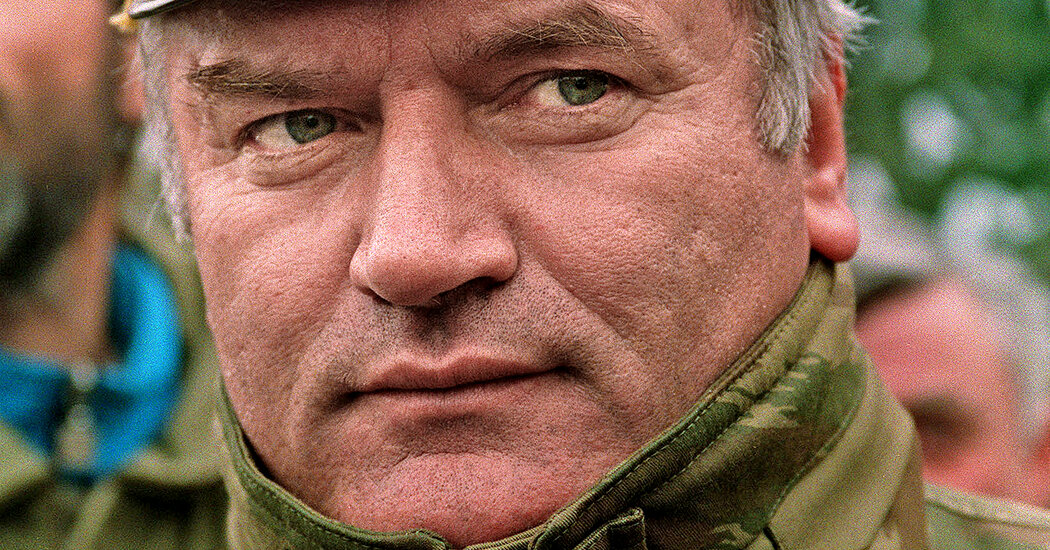
Ratko Mladic, the former Bosnian Serb military commander, has died at the age of 83. Known to many as the “Butcher of Bosnia” due to his command during the Balkan wars of the 1990s, he was convicted of genocide, crimes against humanity, and war crimes, including responsibility for the Srebrenica massacre in 1995. This event, which involved the killing of approximately 8,000 Muslim men and boys, stands as Europe’s deadliest massacre since World War II.
His death was announced on Thursday by Serbian state media, though no details regarding the cause or location of death were immediately provided.
Mr. Mladic’s capture on May 26, 2011, in a farming village north of Belgrade, Serbia’s capital, brought to an end an almost 16-year international manhunt, one of the most extensive in modern history. His subsequent conviction in 2017 by an international tribunal on charges of genocide, crimes against humanity, and war crimes marked a significant judicial closure to a dark period of conflict and atrocities in the Balkans.
In delivering the life sentence, presiding Judge Alphons Orie stated that Mr. Mladic’s crimes were “among the most heinous known to humankind.” The former general appealed the verdict, but it was upheld by the appeals chamber in 2021, cementing his conviction for the widespread abuses committed under his command.
The Balkan wars erupted following the breakup of Yugoslavia in the early 1990s, as various constituent republics sought independence. Slobodan Milosevic, the nationalist president of Serbia, was a central figure in these conflicts, pursuing a vision of a “Greater Serbia.” This ambition reignited historical ethnic and religious tensions, leading to wars that pitted Serbs against Slovenes, Croats, Bosnian Muslims, and the Albanians of Kosovo. The conflicts were characterized by widespread violence, ethnic cleansing, and systematic human rights abuses.
The full scope of the human cost of these conflicts is still being reconciled, but it is estimated that roughly 100,000 people died during the wars, and more than 2.5 million individuals were displaced from their homes, creating a humanitarian crisis across the region.
Mr. Mladic, an officer in the Yugoslav People’s Army, assumed command of the army of the Bosnian Serbs in the early 1990s. He was known for his imposing physical presence, often described as a ruddy-faced and intimidating man with a bellowing voice and piercing blue eyes, characteristics that contributed to a public persona often perceived as reflecting a grandiose sense of self and military authority.
On the eve of the Srebrenica massacre in July 1995, Mr. Mladic publicly declared that he would avenge the conquest of Serbia centuries earlier by the Ottoman Muslim Turks. Over a period of approximately 10 days, forces under his command systematically hunted down, captured, and summarily executed thousands of Bosnian Muslim men and boys. Victims were often lined up with their hands tied behind their backs and shot. Reports also detailed rapes of women. International pleas for a cessation of hostilities and restraint were largely ignored during this period.
Following the executions, Serb forces engaged in an organized effort to conceal the evidence of these war crimes by burying the remains in mass graves, then later exhuming them and scattering them in distant secondary and tertiary mass graves.
Mr. Mladic’s trial was one of the final high-profile cases heard at the International Criminal Tribunal for the Former Yugoslavia (ICTY) in The Hague. The tribunal concluded its work after prosecuting nearly 100 individuals deemed responsible for atrocities committed during the Balkan wars. Among them was Radovan Karadzic, the political leader of the Bosnian Serbs and Mr. Mladic’s superior.
Mr. Karadzic, who was arrested in 2008, was convicted in 2016 on charges largely mirroring those against Mr. Mladic, including genocide, crimes against humanity, and war crimes. His initial 40-year sentence was extended to life in prison three years later following an appeal.
Mr. Mladic’s arrest represented a significant moment for Serbia, signaling its commitment to address its past and facilitate its long-term objective of shedding its international pariah status. His continued evasion had been a major impediment to the country’s aspirations for accession to the European Union, which had consistently pressed successive Serbian governments for his apprehension.
When he was eventually located and apprehended, Mr. Mladic was reportedly hiding in the home of a cousin. Accounts from the time suggested he was in financial distress, with one of his repeated demands being the restoration of his frozen military pension.
During his trial proceedings, Mr. Mladic’s physical condition had noticeably deteriorated. Once considered a formidable military figure, he often appeared frail, a contrast to his historical image. This was partly due to the effects of at least two strokes he suffered while a fugitive, which impaired his right arm and limited his ability to take notes during court sessions. Witness after witness presented harrowing testimony detailing the violence and suffering unleashed under his command.
Despite his physical decline, flashes of his earlier, more domineering personality were still evident. In his initial court appearance in June 2011, he dismissed the charges against him as “obnoxious” and “monstrous.” On other occasions, he was observed yelling at the judges, leading to confrontations within the courtroom.
At one point during the trial, he was absent from a session, reportedly for treatment for high blood pressure. Upon his return, he reacted angrily to the bench, shouting, “Everything you are saying is a pure lie!” This outburst resulted in his removal from the courtroom.
In addition to the Srebrenica massacre, Mr. Mladic was also convicted of numerous crimes associated with the nearly four-year siege of Sarajevo, the capital of Bosnia. This protracted siege, considered the longest in the history of modern warfare, resulted in the deaths of an estimated 10,000 people, including 1,500 children. During this period, Mr. Mladic’s forces subjected the city to continuous shelling from surrounding mountains and terrorized civilians with sniper fire. Judges further found him guilty of the systematic persecution and extermination of non-Serb populations across significant areas of Bosnia.
Within some segments of Serbia, Mr. Mladic’s military leadership and perceived prowess held a legendary status. Ljiljana Bulatovic, who authored a biography of him, stated that he remained a hero to many Serbs, who regarded him as “the mythical protector of the Serbian people,” reflecting a complex and divided legacy.
Conversely, the profound magnitude of the crimes attributed to him, and the immense suffering inflicted upon Bosnians and Croats driven from their homes in territories earmarked for Serbs, generated widespread international condemnation and revulsion. This global outcry led to the offer of a $14 million reward for his capture, although this reward was ultimately not claimed after Serbian war crimes investigators succeeded in apprehending him.
His early life, marked by hardship and struggle, may have contributed to his resilience during his long years as a fugitive. Ratko Skrbic, a former general who served under him, once remarked, “He had a strong psychological makeup. It has to do with military honor. He was brought up never to surrender,” offering insight into his enduring determination.
Ratko Mladic was born into poverty on March 12, 1943, in the remote village of Bozanovici, located in an area that was then part of the Independent State of Croatia, a Nazi puppet state dominated by ultranationalist Croat forces.
His father, Neda Mladic, an ethnic Serb member of the communist-led partisan resistance, was killed when Ratko was a toddler. His mother, Stana (Lalovic) Mladic, subsequently raised him and his two siblings. These formative experiences, particularly the loss of his father and the context of inter-ethnic conflict, are believed to have instilled in Mr. Mladic a deep-seated fear that ethnic Serbs would perpetually face persecution from Croats and other ethnic groups unless they maintained a dominant position.
After a brief period as a metalworker in his youth, he chose a military career path. Possessing a sharp intellect, considerable physical strength, and a charisma that reportedly inspired deep loyalty among his subordinates, Mr. Mladic rapidly ascended through the ranks of the Yugoslav People’s Army, establishing himself as a formidable commander.
Early in his military career, he was reportedly a proponent of Josip Broz Tito’s brand of communism, which sought to suppress nationalism in favor of a unified Yugoslav brotherhood as a means of preserving the fragile multi-ethnic state. However, as Yugoslavia disintegrated, his views shifted decisively towards Serbian nationalism, defining his actions during the subsequent conflicts.
Why This Matters
The death of Ratko Mladic closes a significant chapter in the history of international justice and the enduring legacy of the Balkan Wars. Mladic’s life and conviction underscore several critical points regarding accountability for war crimes and the pursuit of justice for victims of mass atrocities.
Firstly, his long and ultimately successful apprehension, followed by a comprehensive trial and conviction at the International Criminal Tribunal for the Former Yugoslavia (ICTY), cemented the principle that even high-ranking military commanders are not beyond the reach of international law. This served as a powerful testament to the global community’s commitment to ending impunity for genocide, crimes against humanity, and war crimes. The pursuit of Mladic and others like him, such as Radovan Karadzic, demonstrated the resolve of international institutions to prosecute those responsible for the most heinous acts, regardless of their political or military standing.
Secondly, Mladic’s conviction provided a measure of justice and recognition for the thousands of victims and survivors of the Bosnian War, particularly those affected by the Srebrenica genocide and the siege of Sarajevo. For many, his imprisonment represented a critical step towards acknowledging the immense suffering inflicted and validating their experiences. While justice cannot erase the past, it can offer a foundation for healing and reconciliation in societies deeply scarred by conflict.
Thirdly, his death serves as a reminder of the fragility of peace and the destructive potential of ethnic nationalism. The conflicts he orchestrated and commanded were rooted in deep-seated historical grievances and nationalist ideologies that still resonate in the region today. Understanding the causes and consequences of these wars, and the roles played by figures like Mladic, remains crucial for fostering stability and preventing future conflicts based on ethnic divisions.
Finally, Mladic’s complex legacy, including his continued veneration by some while being reviled by others, highlights the ongoing challenges of confronting historical truths and achieving reconciliation in post-conflict societies. His passing, while marking a final legal conclusion to his personal story, does not erase the need for continued efforts to address the historical narratives, political tensions, and societal divisions that persist in the Western Balkans. It underscores the enduring importance of education, remembrance, and the unwavering pursuit of justice for victims of mass atrocities around the world.
Ratko Mladić, often referred to as the “Butcher of Bosnia,” was a Bosnian Serb military leader who played a central role in the Bosnian War from 1992 to 1995. His actions during the conflict, particularly the siege of Sarajevo and the Srebrenica massacre, led to his indictment and eventual conviction for war crimes, crimes against humanity, and genocide by an international tribunal.
Born in Božanovići, Bosnia and Herzegovina, in 1942, Mladić rose through the ranks of the Yugoslav People’s Army (JNA). He was a product of the socialist Yugoslav system, which, under its charismatic leader Josip Broz Tito, had maintained a delicate balance among its diverse ethnic and religious groups. Tito’s death in 1980, however, gradually eroded this stability, paving the way for the resurgence of nationalist sentiments across the republics.
As Yugoslavia began to disintegrate in the early 1990s, fueled by the nationalist rhetoric of figures like Serbian President Slobodan Milošević, Mladić emerged as a key military figure for the Bosnian Serbs. He embraced Milošević’s cause of halting separatism and asserting the dominance of Serbs, the largest ethnic group in the region. In May 1992, he was appointed commander of the Main Staff of the Army of Republika Srpska (VRS), the Bosnian Serb army. This appointment came just a month after the Bosnian Republic declared its independence, a move fiercely opposed by Bosnian Serbs who wished to remain part of a greater Serbia.
Under Mladić’s command, Bosnian Serb forces initiated the siege of Sarajevo in April 1992, an event that would last for nearly four years, making it the longest siege of a capital city in modern history. During this period, the city’s inhabitants, primarily Bosnian Muslims and Croats, endured relentless shelling, sniper fire, and a blockade of essential supplies. The siege resulted in the deaths of thousands of civilians and left deep scars on the city and its people, becoming a symbol of the brutality of the Bosnian War.
A deeply personal tragedy struck Mladić in 1994 when his daughter, Ana, a medical student in her early 20s, died by suicide using his prized military pistol. Reports suggested she was distraught by her father’s actions in the war and the atrocities being committed. Zoran Stanković, a former Serbian minister of defense and a friend of Mladić’s who performed her autopsy, recounted Mladić’s request to preserve a lock of her hair and the bullet from her head as mementos. Friends later claimed that Mladić became significantly altered and emotionally unstable after her death, a state reportedly visible in his eyes, which, according to Stanković, lost their brightness and were filled only with sadness.
Mladić’s brutality and disdain for his enemies were also evidenced by specific incidents. Before the horrific massacre at Srebrenica, Mladić reportedly summoned the Dutch commander of a United Nations peacekeeping force, charged with protecting the Muslim community there. According to witnesses, Mladić ushered the commander into a room where a live pig was tied up. He then ordered his men to slit the pig’s throat, causing blood to gush across the floor, and declared, “That’s how we deal with our enemies.” This chilling display served as a stark warning of the violence to come.
In July 1995, Mladić oversaw the Srebrenica massacre, an act of genocide targeting Bosnian Muslim men and boys in the UN-designated “safe area” of Srebrenica. On July 11, Bosnian Serb forces, led by Mladić, overran the enclave. With video cameras rolling, Mladić was filmed interacting with terrified women and children, patting a young boy on the head and assuring them on July 12, “No one will be harmed.” Simultaneously, his soldiers were meticulously preparing to separate men and boys from women and children, leading the former away to be systematically executed. Over the following days, more than 8,000 Bosnian Muslim men and boys were murdered, their bodies disposed of in mass graves. This atrocity is widely recognized as the worst mass killing on European soil since World War II.
The outrage sparked by the Srebrenica massacre in Washington and across Europe proved to be a turning point in the conflict. It prompted a decisive NATO bombing campaign against Bosnian Serb forces, which ultimately weakened their military position and led to the signing of the Dayton Accords in December 1995. These accords officially ended the Bosnian War, though ethnic tensions and conflicts would resurface in the former Yugoslavia, notably with the Kosovo War in 1998.
In 1995, the International Criminal Tribunal for the former Yugoslavia (ICTY) in The Hague, established two years prior, indicted Mladić on charges of war crimes, crimes against humanity, and genocide. The charges specifically related to his command responsibility for the siege of Sarajevo and the Srebrenica massacre. Despite the indictment, Mladić initially avoided capture, enjoying the protection of Slobodan Milošević and moving openly among military barracks, where friends would visit him for games of table tennis or chess. For several years, he continued to visit his daughter’s grave and even attended a Chinese-Yugoslav soccer match in Belgrade in 2000, surrounded by bodyguards.
Milošević’s fall from power in 2000 and his subsequent arrest and extradition to The Hague in 2001 significantly altered Mladić’s circumstances. (Milošević died in 2006 while his trial was nearing its end.) Mladić was forced underground, believed to have been protected by a network of allies within the Serbian military and intelligence services. During his years as a fugitive, his wife, Bosiljka, and son, Darko, unsuccessfully sought to have him officially declared dead. Both survive him.
After more than 15 years on the run, Mladić was finally apprehended in May 2011 in Lazarevo, Serbia, at the home of a relative. He was found alone, with two loaded pistols at his side, and reportedly surrendered willingly, stating upon the officers’ arrival, “Congratulations. I’m the one you’ve been looking for.” His arrest marked a significant moment for international justice. He was subsequently extradited to The Hague to stand trial before the ICTY. In 2017, Mladić was convicted on 10 of 11 counts, including genocide for the Srebrenica massacre, persecution, extermination, murder, and other crimes against humanity, and was sentenced to life imprisonment. His appeal was rejected in 2021, cementing his conviction and sentence.
Why This Matters
The conviction of Ratko Mladić holds profound significance on multiple levels, serving as a cornerstone for international justice and a stark reminder of the consequences of extreme nationalism and ethnic hatred.
Firstly, it underscores the principle of **accountability for war crimes and genocide**. For victims and survivors of the Bosnian War, particularly those affected by the siege of Sarajevo and the Srebrenica massacre, Mladić’s conviction represents a measure of justice, however delayed. It reaffirms that even the highest-ranking military commanders cannot evade responsibility for atrocities committed under their command, especially when such crimes are systematic and widespread.
Secondly, Mladić’s trial and conviction by the ICTY highlight the **vital role of international legal institutions** in addressing mass atrocities. The ICTY, established specifically to prosecute those responsible for serious violations of international humanitarian law in the former Yugoslavia, set important precedents for subsequent tribunals and the International Criminal Court (ICC). It demonstrated that the international community has mechanisms, albeit imperfect, to pursue justice when national systems are unwilling or unable to do so.
Thirdly, the case of Ratko Mladić reinforces the **global condemnation of genocide**. The Srebrenica massacre, unequivocally recognized as genocide, stands as a chilling testament to humanity’s capacity for cruelty. Mladić’s conviction for this crime sends a clear message that such acts will not be tolerated and that those who orchestrate them will eventually face justice, no matter how long it takes. This serves as a deterrent and a warning to leaders engaged in conflicts worldwide.
Finally, Mladić’s legacy and conviction remain a critical, though often painful, part of the **process of reconciliation and memory in the Balkans**. While justice at an international level can provide some closure, the deep divisions and differing narratives surrounding the Bosnian War persist. Mladić’s actions and subsequent conviction are constant reminders of the need for confronting the past, acknowledging suffering, and working towards a future free from the ethnic tensions that devastated the region. His case is a historical marker, urging ongoing vigilance against the resurgence of ideologies that fuel conflict and human rights abuses.
Marlise Simons, Doreen Carvajal and David Rohde contributed reporting.