
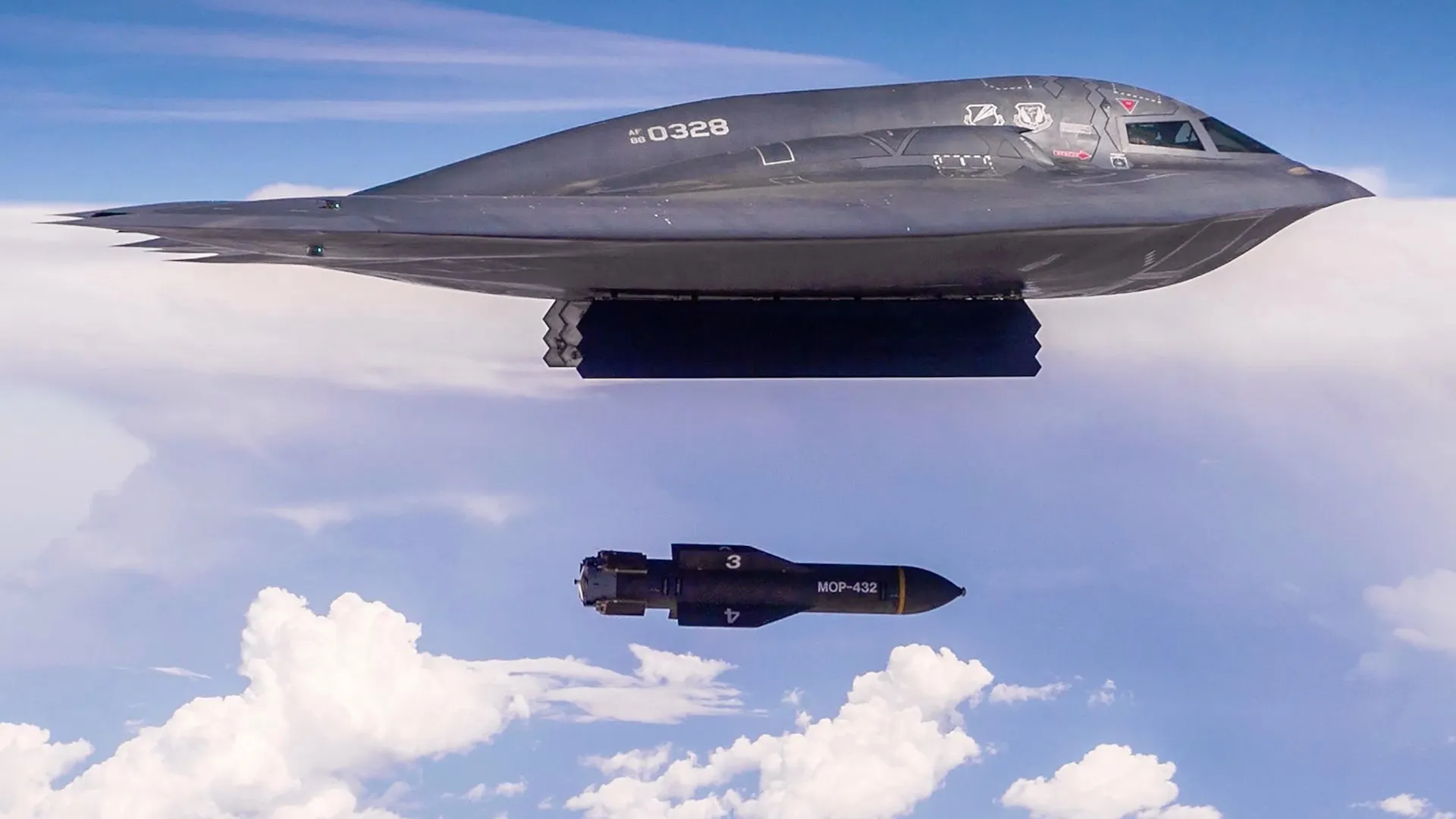
According to documents from the Air Force, the U.S. armed forces are in the process of replenishing their inventory of GBU-57 Massive Ordnance Penetrator bombs – munitions capable of destroying bunkers – which were deployed against Iran’s subterranean nuclear installations last June.
The Air Force is concluding an agreement with Boeing, exceeding $100 million in value, for the purpose of substituting the bombs employed to strike Iran’s Fordow and Natanz nuclear locations.
On February 12, partially censored documents made public on a government web portal indicated that the service deemed this procurement “vitally necessary to restore the stock of GBU-57s consumed during Operation Midnight Hammer.”
Furthermore, the service is proceeding with its contest for advanced weaponry designed to neutralize targets situated far underground.
On June 22, 2025, U.S. Air Force B-2 Spirit stealth bombers deployed 14 armaments at these locations during the mission. Every B-2 aircraft transported a pair of MOPs. Six of these explosives were aimed at Fordow, while two struck Natanz. Operation Midnight Hammer marked the initial instance these 30,000-pound bunker-penetrating bombs saw active deployment.
The censored files aim to furnish a rationale for refraining from issuing a completely competitive agreement for this uniquely developed ordnance.
“This measure is vital for reinstating operational preparedness … and for guaranteeing that Air Force Global Strike Command (AFGSC) holds the requisite resources to uphold strategic contingency war strategies for all Combatant Commands (COCOMs),” as stated in the document.
The records do not specify the quantity of MOPs the U.S. government intends to acquire in the upcoming transaction, which is anticipated to be the final batch of GBU-57s obtained by the U.S. military prior to transitioning to its novel Next-Generation Penetrator, or NGP.
Prior to the publication of these documents, indications suggested the Pentagon was reallocating finances to procure additional bombs. A request for fund reallocation, totaling $123 million, made last August, declared that capital was required to substitute the MOPs utilized during Operation Midnight Hammer.
The recently disclosed documents imply that the Air Force aims to acquire complete MOP weapon systems. The text specifies that the weapon’s tailkits are anticipated for delivery commencing January 10, 2028, in order “to substitute spent units.” Furthermore, constituent parts for complete rounds – the bombs themselves – are also being procured.
The precise count of MOPs being procured, alongside other distribution timelines, seems to fall within the censored sections of the report.
Operation Midnight Hammer encompassed 125 aircraft, such as F-35s, F-22s, F-16s, aerial refueling planes, and the bomb-deploying B-2s. Additionally, the U.S. targeted a third installation at Isfahan using over two dozen Tomahawk land-attack cruise missiles.
The MOP features a reinforced shell capable of penetrating strata of stone, concrete, and metal. Within the munition, sensors are configured to sense the region the bomb traverses prior to its detonation at a predetermined subterranean level.
“The armaments operated as intended; that is to say, they detonated,” Gen. Dan Caine, Chairman of the Joint Chiefs of Staff, informed journalists following the assaults.
Per Caine, the munitions descended ventilation conduits at the installations at speeds exceeding 1,000 feet per second.
“An explosive device generates three damaging consequences: an explosion, fragmentation, and excessive pressure,” he explained. “For this particular situation, the principal destructive means within the operational zone comprised a combination of excessive pressure and a blast tearing through the exposed tunnels, thereby demolishing essential equipment.”
The exact quantity of MOPs constructed in prior years, and precisely how many are still available, is not specified.
The MOP underwent its inaugural trials from a B-52. Nevertheless, its deployment was consistently envisioned for the B-2, given that the extensively fortified objectives this bomb aimed to strike were foreseen to be guarded by sophisticated air defense networks, which the stealth bomber possessed the ability to infiltrate. The armament attained its initial operational readiness in 2011.
The Air Force executed trial deployments from B-2s between 2014 and 2016, succeeded by additional evaluations in 2017 to confirm improvements. The latest advancement for the bomb is the Large Penetrator Smart Fuse alteration, which underwent trials in 2020 against a subterranean tunnel objective. A further three assessments transpired between 2021 and 2022. In 2024, two comprehensive tests were carried out to confirm its compatibility with the B-2.
The armed forces seem poised to transition to the MOP’s follow-up after this recent procurement.
“The manufacturing of the MOP program will cease once these acquisition endeavors are finalized,” the report declares.
Last September, the Air Force awarded a preliminary contract for the advancement of the NGP. This came after a March 2024 solicitation for data from the industrial sector concerning the weapon, requesting proposals for “a prototype penetrator warhead configuration adept at overcoming Hard and Deeply Buried Targets.”
The 2024 dossier specified that the blueprint ought not to surpass 22,000 pounds, which is approximately two-thirds the mass of the MOP.
The recently introduced B-21 Raider bomber is recognized for being more compact than the B-2, measuring approximately two-thirds its scale, and possessing a reduced cargo capability. It remains uncertain whether the MOP would be compatible with a B-21, a craft projected to become operational within the forthcoming few years.
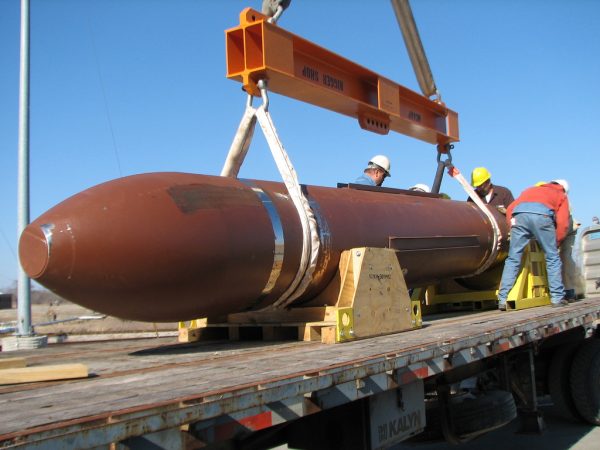
The Air Force publication characterizes the Next-Generation Penetrator as “an analogous MOP-style capacity” destined to feature “advanced technology.”
The administration seems to be adopting a more competitive methodology for the NGP compared to the GBU-57, considering Boeing maintains authority over a substantial portion of the weapon’s intellectual assets and programming.
Regarding the NGP, the Pentagon is soliciting agreements that permit “autonomous progress, alteration, and enhancement of all hardware, software algorithms, and logical connections pertaining to NGP and subsequent MOP weapon systems,” as detailed in the recently made public records. “This strategy will enable a varied pool of providers to contend based on inventiveness, efficacy, and expense, thereby fostering technological progress.”