
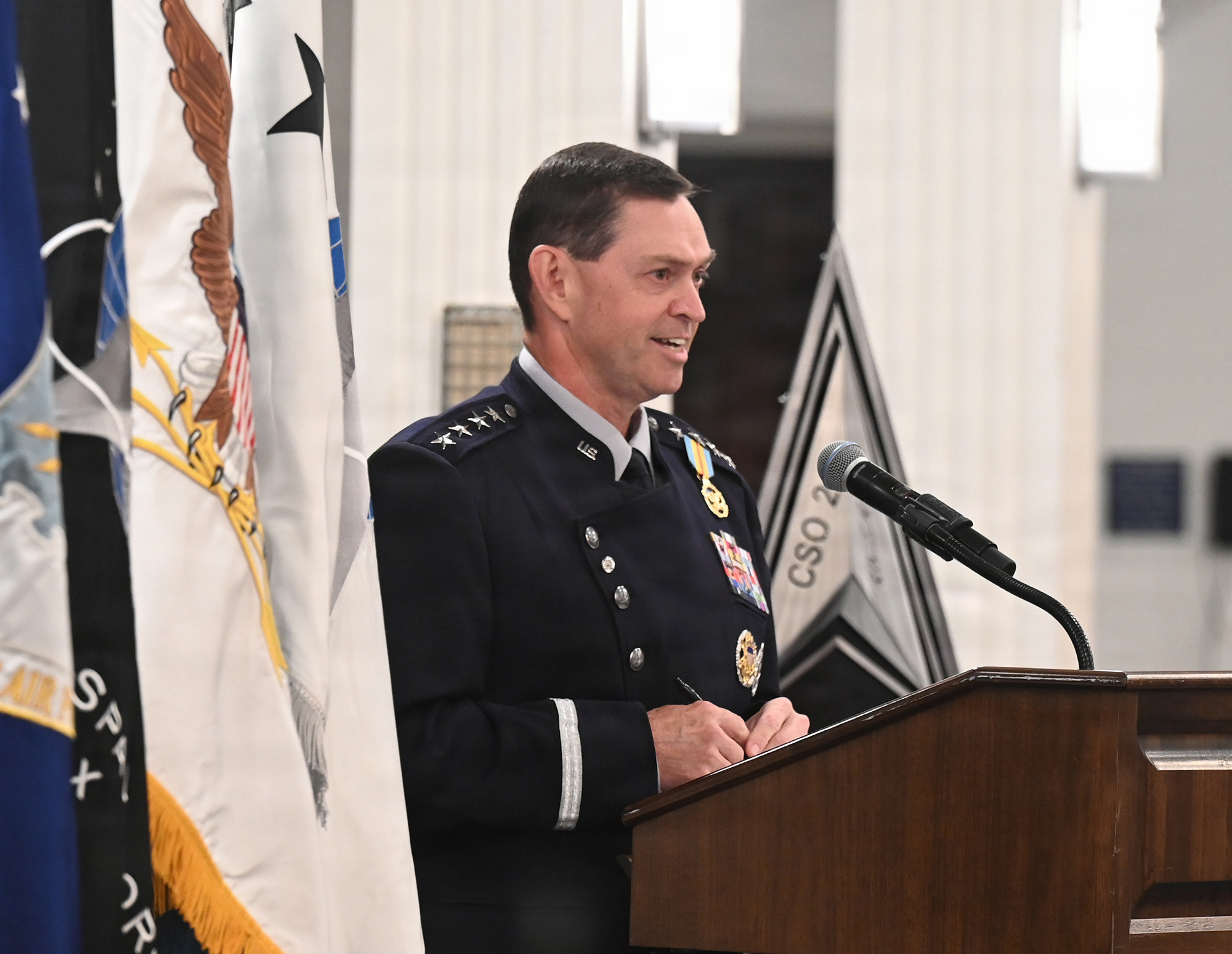
General B. Chance Saltzman, the second Chief of Space Operations (CSO) for the U.S. Space Force, was honored at his retirement ceremony on August 13 at Joint Base Anacostia-Bolling in Washington, D.C. The event featured tributes from Chairman of the Joint Chiefs of Staff Gen. Dan Caine, Air Force Secretary Troy Meink, and Chief Master Sergeant of the Space Force John F. Bentivegna, celebrating Gen. Saltzman’s 35-year military career and his pivotal role in shaping the nascent service.
Gen. Saltzman’s extensive career journey began as a junior missileer and culminated in his leadership as a senior space operator. While the retirement ceremony took place in mid-August, Gen. Saltzman is scheduled to formally step down at the end of the month. Lt. Gen. Douglas A. Schiess is slated to succeed him, with a formal change of command ceremony planned for September 3.
The retirement event highlighted significant milestones in the U.S. Space Force’s (USSF) development, many of which were directly influenced by Gen. Saltzman. Air Force Secretary Troy Meink underscored this legacy, stating, “there is nothing going in the Space Force today that Salty was not behind in one form or another,” using Saltzman’s widely known nickname.
Gen. Saltzman played a critical role in the Space Force even before assuming its top leadership position. He served as the service’s first deputy chief of space operations for operations under the inaugural CSO, Gen. John W. “Jay” Raymond. On November 2, 2022, Gen. Saltzman succeeded Gen. Raymond, taking the helm of a service that was less than three years old. At the time of his selection, he was considered the most junior among the candidates but ultimately secured the position after a competitive interview process.
Under Gen. Saltzman’s leadership over the subsequent four years, the Space Force experienced substantial growth and transformation. When he took office, the service comprised approximately 8,000 uniformed Guardians with a budget of $26.1 billion. Today, the force has expanded to more than 10,000 Guardians, with an stated objective to reach 20,000 personnel. Concurrently, the Space Force’s budget has grown to $36.1 billion, with projections indicating a near doubling in the coming fiscal year, reflecting increasing investment in space capabilities.
Beyond quantitative growth, Gen. Saltzman was instrumental in driving a significant cultural shift within the Space Force. He advocated for Guardians to perceive themselves as “warfighters” rather than merely enablers for other military branches. This push aimed to integrate space operations as a central and aggressive component in modern conflicts. Saltzman encouraged advanced adversarial thinking, promoted training for high-end conflicts, and challenged long-standing taboos surrounding discussions of offensive operations in space. He also instituted a new force generation model designed to rotate space operators between operational deployments and training cycles, thereby enhancing overall readiness and combat effectiveness.
General Caine lauded Saltzman’s strategic foresight, observing, “You’ve laid out a clear and unambiguous vision for what your service needs to look like in the future: its culture, its purpose, its doctrine. And you’ve empowered leaders along the way.”
Another key organizational achievement during Gen. Saltzman’s tenure was the establishment of eight different field components, integrated beneath unified commands. This strategic move ensured that the Space Force was represented and embedded within the operational plans of every geographic combatant command, thereby enhancing coordination and the integration of space capabilities across all domains. Secretary Meink acknowledged the complexity of this undertaking, noting, “Just getting the billets, getting them in place, the details, and making that happen are extremely challenging.”
Addressing the public, Gen. Saltzman consistently articulated the evolving nature of space, emphasizing that it is no longer a benign environment. He openly discussed the imperative of “space superiority” and the need for the Space Force to evolve into a more robust warfighting service. He introduced “space control” as a new USSF mission, defining it as the capacity “to contest and control the space domain, employing kinetic and non-kinetic means to affect adversary capabilities by disruptions and degradation—even destruction if necessary.”
These candid remarks by Gen. Saltzman served to liberate other Space Force and Pentagon leaders, enabling them to speak more openly about counter-space operations and the potential for waging war in, from, and to space. Historically, space operators often maintained a low profile, but under Saltzman’s leadership, there has been a growing emphasis on publicly detailing how access to space informs and enables the American way of war.
To illustrate the Space Force’s expanding role, the service began sharing details about how its missile warning capabilities could contribute to defense, citing examples such as the defense of Israel from Iranian attacks in 2024 and potential contributions to operations in Venezuela and Iran in 2026. These examples highlighted missions like electronic warfare, missile warning and tracking, and providing position, timing, and navigation services for U.S. forces. General Caine referenced these and other operations, underscoring how the Space Force has “secured the ultimate high ground, ensuring that we have options when the President or the nation needs them.”
Reflecting on the transformation, Gen. Saltzman expressed pride in the service’s progress, stating, “In a few short years, we have transformed the Space Force from an organization that essentially served as a provider of operational support to other branches of the military into a combat-credible, battle-tested military service in its own right.”
Looking back on his extensive military career, Gen. Saltzman offered a few key pieces of advice:
- Be ready for criticism.
- Be ready to adapt—not everything will go according to plan.
- Don’t stress over things you can’t control.
- Be nice.
In July, Air & Space Forces Magazine conducted an exclusive interview with Gen. Saltzman, covering his career, Space Force resourcing, doctrine development, and public perceptions. Readers interested in further details can access the interview through the provided link.
Why This Matters
The retirement of General B. Chance Saltzman and the transition in leadership of the U.S. Space Force carry significant implications for global security, technological advancement, and the future of military strategy. His tenure saw the Space Force evolve from a nascent entity primarily focused on support functions to a recognized combat-credible military service, emphasizing its direct role as a warfighting domain.
Firstly, the ongoing development and operationalization of the Space Force underscore the critical importance of space in modern geopolitical competition. Nations worldwide rely on space assets for communication, navigation, intelligence gathering, weather forecasting, and critical infrastructure. The U.S. posture in space, defined by leaders like Saltzman, directly influences the global balance of power and dictates the deterrence capabilities against potential adversaries. A robust and offensively-capable Space Force signals a commitment to protecting these vital assets and projecting power in a domain increasingly contested by peer and near-peer competitors.
Secondly, the cultural shift initiated by Saltzman, transforming Guardians into “warfighters,” reflects a fundamental change in military doctrine. It signifies that future conflicts will not be confined to land, sea, or air, but will inherently involve the space domain. This reorientation requires new training methodologies, technological innovations, and strategic thinking to ensure the U.S. maintains an advantage. The establishment of integrated field components across geographic combatant commands further embeds space operations into every aspect of military planning and execution, ensuring seamless coordination and leveraging space capabilities for tactical and strategic advantages.
Finally, the increased transparency regarding offensive space operations and “space control” challenges the historical perception of space as a purely benign realm. While promoting stability and responsible behavior in space remains a U.S. goal, openly discussing the capacity to “disrupt, degrade, or even destroy” adversary capabilities sends a clear message about the seriousness of protecting national interests in orbit. This stance, while potentially raising concerns about the weaponization of space, is presented by the Space Force as a necessary deterrent and a component of comprehensive national defense in an increasingly complex and contested environment. The trajectory set by Gen. Saltzman will profoundly influence how the U.S. and its allies navigate the strategic challenges and opportunities presented by the final frontier in the decades to come.