
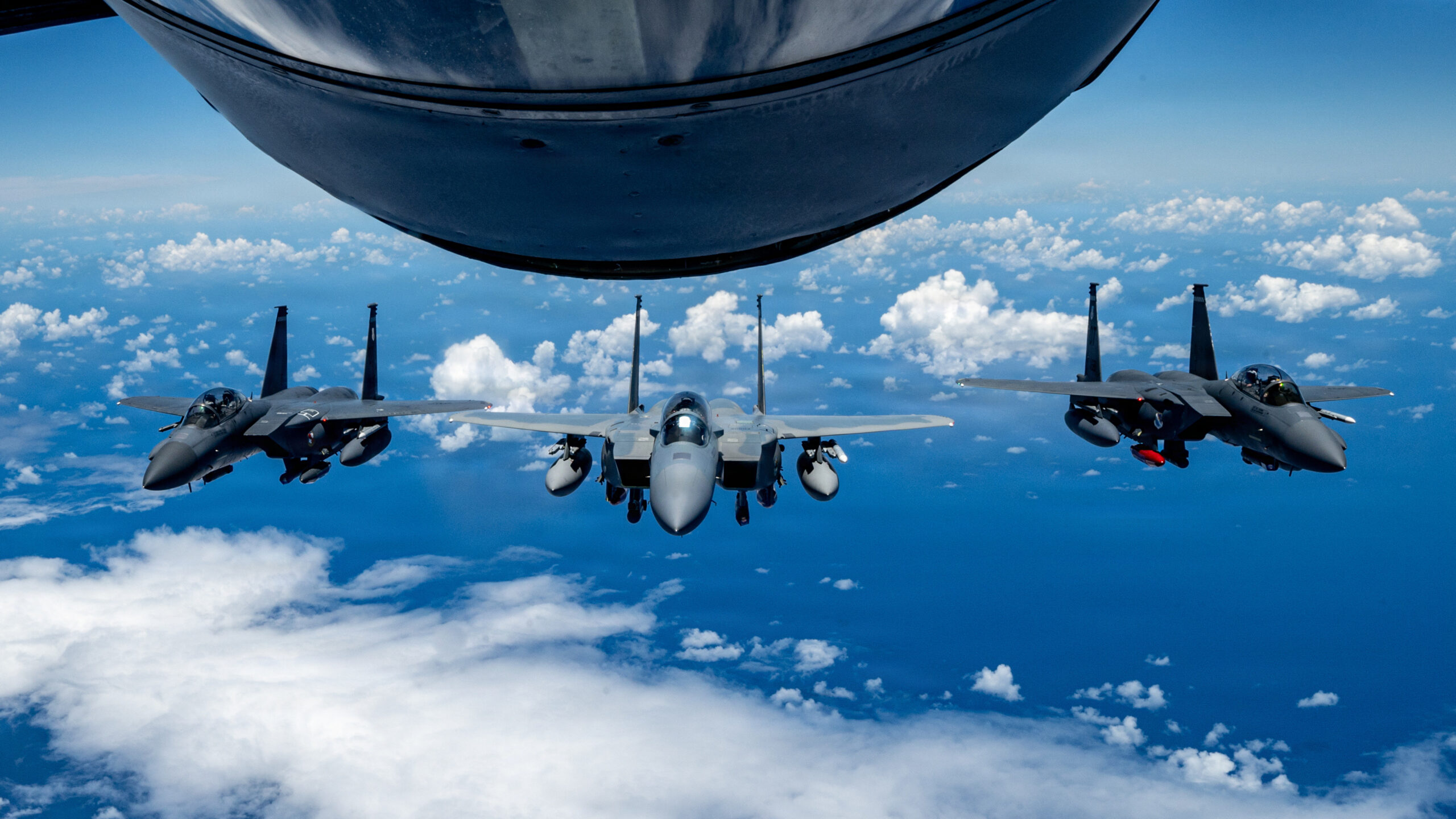
The United States Air Force has announced plans for a significant restructuring of its fighter jet fleet, specifically involving Seymour Johnson Air Force Base in Goldsboro, North Carolina, and Whiteman Air Force Base in Knob Noster, Missouri. Under the proposed strategy, Seymour Johnson AFB is slated to receive new F-15EX Eagle II fighter jets, which will replace its existing F-15E Strike Eagles. These F-15E aircraft will then be relocated to Whiteman AFB, where they are intended to replace the retiring A-10 Warthog ground-attack aircraft.
Air Force Secretary Troy Meink officially confirmed these basing intentions in a letter sent to Senator Ted Budd (R-N.C.), which the Senator released to the public on August 20. Secretary Meink’s letter indicated that the procurement of the F-15EX aircraft designated for Seymour Johnson AFB is projected to occur through the fiscal year 2027 budget. He cautioned, however, that the realization of this timeline and the acquisition of the jets are contingent upon congressional authorization and appropriation of the necessary funds.
A key commitment outlined by Secretary Meink is the assurance that the transfer of Seymour Johnson’s F-15Es will not take place until their F-15EX replacements have arrived and are ready for operational deployment at the base. This policy is designed to prevent any gap in the base’s critical fighter missions, ensuring continuous readiness and operational capability throughout the transition period.
“While Air Force fleetwide delivery schedules depend on aircraft production and congressional appropriations, the Air Force has no plans to reduce Seymour Johnson’s F-15 missions without replacement aircraft already in place,” Secretary Meink affirmed in his communication to Senator Budd. This statement underscores the Air Force’s priority on maintaining the base’s strategic importance and operational tempo.
Senator Budd welcomed Secretary Meink’s confirmation, stating that the decision to station the F-15EX at Seymour Johnson represents “an important step toward ensuring America maintains its air dominance.” The Senator’s remarks highlight the perceived strategic value of modernizing the U.S. fighter fleet in the context of national security and global power projection.
Seymour Johnson Air Force Base is home to the 4th Fighter Wing, a vital component of the U.S. Air Force’s combat and training infrastructure. The wing’s operational group encompasses six squadrons, including two active F-15E fighter squadrons and two F-15E formal training units, alongside an operations support squadron and an additional training squadron. This structure underscores the base’s dual mandate of deploying combat-ready forces and developing skilled fighter pilots.
Senator Budd further elaborated on the base’s significance, noting, “The 4th Fighter Wing has operated at a significantly high operational tempo, including deployments to the Middle East and the Pacific, demonstrating the critical role Seymour Johnson plays in defending our nation.” He also emphasized the base’s role as the primary training ground for Air Force F-15 pilots. At the time of the announcement, two of Seymour Johnson’s operational F-15E squadrons were reportedly deployed to undisclosed locations in Southwest Asia, actively participating in Operation Epic Fury.
The F-15EX Eagle II is an advanced derivative of the proven F-15 airframe, designed to serve as a formidable air superiority fighter and multi-role attack aircraft. It incorporates significant upgrades over earlier F-15 models, including a redesigned internal structure for extended service life, an advanced Electronic Warfare (EW) suite, a modern cockpit with large-area displays, and an open mission systems architecture for rapid software upgrades. Capable of carrying a larger and more diverse weapons payload than its predecessors, the F-15EX is intended to replace aging F-15C/D and F-15E variants, ensuring that the U.S. Air Force maintains a robust and technologically superior fighter force well into the future, particularly against peer and near-peer adversaries.
In parallel with the F-15EX deployment to Seymour Johnson, the Air Force has detailed plans to transfer 24 F-15E Strike Eagles from the North Carolina base to Whiteman Air Force Base. This transfer is part of a broader Air Force initiative to phase out the A-10 Thunderbolt II, commonly known as the Warthog, which is currently stationed at Whiteman. The A-10, renowned for its close air support capabilities, is an aging platform, and its retirement aligns with the Air Force’s strategy to modernize its fleet by divesting of single-mission aircraft in favor of more versatile, multi-role fighters capable of operating in contested environments.
Secretary Meink’s letter specified that the final decision regarding the permanent basing of the F-15Es at Whiteman’s 442nd Fighter Wing, a U.S. Air Force Reserve Command unit, is projected for the fall of 2028. This extended timeline reflects the detailed planning and coordination required for integrating a new aircraft platform and mission into a reserve unit’s operations.
Further clarity on the Whiteman transition was provided by an Air Force spokesperson last month, who informed Air & Space Forces Magazine that the service anticipates the new F-15E mission at Whiteman to achieve Initial Operational Capability (IOC) in 2032. Full Operational Capability (FOC) for the unit, signifying its complete combat readiness with the F-15E, is expected by 2034.
Secretary Meink reiterated the Air Force’s firm commitment to preserving Seymour Johnson’s vital F-15 missions, encompassing both operational deployments and advanced pilot training. The assurance that “Any future movement of aircraft would occur only after Seymour Johnson receives replacement F-15EX aircraft, ensuring there is no gap in its operational or training missions,” reflects the Air Force’s emphasis on maintaining continuity and readiness across its strategic assets and personnel. These comprehensive plans for aircraft movement and upgrades are integral to the Air Force’s ongoing efforts to modernize its fleet, adapt to evolving global security challenges, and ensure its combat effectiveness well into the future.
Why This Matters
The U.S. Air Force’s strategic decision to introduce F-15EX Eagle II fighters at Seymour Johnson Air Force Base and subsequently relocate F-15E Strike Eagles to Whiteman Air Force Base carries significant implications for national defense, military readiness, and geopolitical stability. These moves are not merely logistical shifts but represent foundational elements of America’s long-term air power strategy.
Firstly, this initiative is a direct manifestation of the U.S. commitment to **fleet modernization**. The F-15EX Eagle II is designed to integrate advanced capabilities derived from fifth-generation fighter technology into a proven airframe. By upgrading to the F-15EX, the Air Force ensures that its F-15 fleet remains highly capable and relevant in an era of increasing sophistication among potential adversaries. This modernization effort is crucial for maintaining “air dominance,” a cornerstone of U.S. military strategy that allows for freedom of action across domains and protects allied interests globally. Extending the operational life of the F-15 platform with cutting-edge technology secures vital combat capacity for decades to come.
Secondly, these basing decisions reflect a deliberate **optimization of force structure and readiness**. Seymour Johnson Air Force Base’s role as a primary training ground and a key operational hub for F-15 pilots is not just maintained but enhanced by receiving the advanced F-15EX. This ensures that future F-15 aviators are trained on the most current technology, directly impacting the proficiency and effectiveness of the entire F-15 fleet. The Air Force’s explicit “no gap” policy during the transition underscores a critical commitment to continuous combat readiness, preventing any temporary vulnerabilities that could arise from aircraft transfers. This ensures that the U.S. can consistently meet its global defense obligations, from the Pacific to the Middle East.
Thirdly, the retirement of the A-10 Warthog at Whiteman AFB and its replacement with F-15Es signifies a **strategic shift in Air Force doctrine and resource allocation**. While the A-10 has been an iconic and invaluable asset for close air support, its specialized mission and aging platform no longer align with the Air Force’s long-term vision for a more versatile, multi-role fighter fleet. This transition aims to streamline maintenance, pilot training, and logistical support, allowing for greater flexibility and efficiency in deployment. It marks a move towards a force more capable of operating across a spectrum of missions in contested environments, reinforcing the Air Force’s ability to adapt to evolving threats and operational requirements.
Finally, these plans carry **tangible economic and geopolitical implications**. For the communities surrounding Seymour Johnson and Whiteman Air Force Bases, these decisions provide assurances of continued military presence, which translates into stable employment and sustained economic activity, offering long-term stability for local economies. On a broader geopolitical scale, the modernization and strategic reallocation of the U.S. fighter fleet send a clear message to allies and potential adversaries alike. It demonstrates America’s unwavering commitment to projecting power, deterring aggression, and maintaining stability in critical regions around the world. The U.S. Air Force’s capacity to respond effectively to global contingencies is directly underpinned by such strategic investments in its aircraft and the highly trained personnel who operate them.