
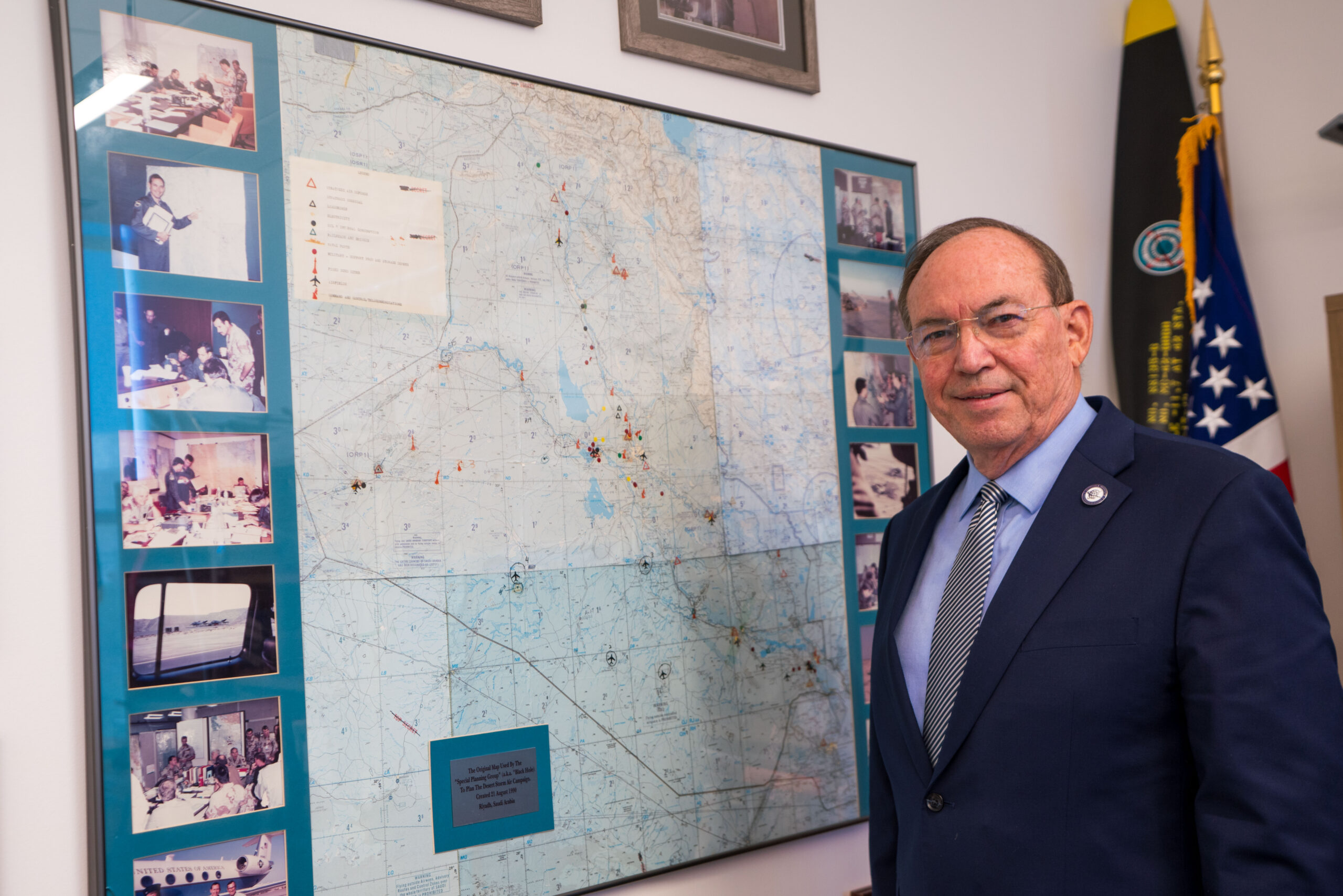
A pivotal artifact from the planning of Operation Desert Storm, a meticulously crafted map identifying strategic targets across Iraq in the fall of 1990, is slated for display in November at the Smithsonian’s National Air and Space Museum. This map, instrumental in shaping the coalition air campaign, will be a central feature of the museum’s forthcoming “Modern Military Aviation” gallery in Washington D.C. The exhibit aims to illustrate the transformative advancements in airpower, tracing its evolution from the Korean War to contemporary military operations.
The map is one of two original documents created by now-retired Lt. Gen. David Deptula, who served as the principal air attack planner for Operation Desert Storm. In this crucial role, Deptula was responsible for identifying key strategic targets across Iraq and developing the comprehensive blueprint for the coalition’s aerial offensive. These maps were integral to the planning process that ultimately defined the conduct of the Persian Gulf War.
Both original Gulf War maps remain in Deptula’s possession. One, depicting Baghdad, is on display in the Air & Space Forces Association’s (AFA) Heritage Hall in Arlington, Virginia. A larger map of Iraq hangs in Deptula’s office, surrounded by other mementos from his distinguished career. Due to the fragility and significant size of the original map intended for public display, a large-format graphic panel reproduction will be presented at the Smithsonian.
The inclusion of the map in the Smithsonian’s collection came about through a chance conversation. Dr. Michael Hankins, the Smithsonian’s Curator of U.S. Air Force, Navy, and Marine Corps post-World War II Aviation, learned about the existence of the maps during discussions with Doug Birkey, Executive Director of the Mitchell Institute for Aerospace Studies. Hankins, who was aware of the maps’ historical significance, had not known they were brought back from Saudi Arabia after the conflict.
Recognizing the powerful narrative the maps could convey, Hankins immediately saw them as an ideal bridge for the new exhibit. He believed they could effectively illustrate the evolution from conventional airpower tactics to the era of stealth and precision bombing—a shift that has profoundly influenced military strike operations ever since. The map visually represents a paradigm change in how air campaigns are conceived and executed.
“As we were planning the layouts for some of these different labels, we had an opportunity, particularly in that section, to have a large-scale photo as an introduction to the Desert Storm section of the gallery,” Hankins explained. He emphasized the map’s power as a visual aid: “What better visual image to use than this to speak to that? … [It shows] how the thought process of using military aviation was different in 1991 than it might have been in previous conflicts.” The gallery is scheduled to open on Veterans Day, November 11, 2026.
The Map, Deptula, and the Genesis of “Instant Thunder”
While the map serves as a tangible record of Operation Desert Storm, it also highlights a critical juncture in the career of Lt. Gen. Deptula, who meticulously led the planning of the operation. This arduous process unfolded over countless 20-hour days in a covert basement room in Riyadh, Saudi Arabia, a space that became famously known as “the Black Hole.” The urgency for such an operation arose on August 2, 1990, when Iraqi forces under dictator Saddam Hussein invaded and swiftly conquered neighboring Kuwait. In response, an international coalition, spearheaded by the United States, was formed with the express goal of expelling Saddam’s forces from Kuwait.
At the time, Deptula was a lieutenant colonel working in the Office of the Secretary of the Air Force. He was assigned to a Pentagon strategic planning cell known as “Checkmate,” led by Col. John Warden III. The Checkmate team had been developing a new strategic air doctrine for the post-Cold War era when it received the urgent task of devising an operational concept to counter Iraq’s invasion utilizing airpower. Their innovative plan was christened “Instant Thunder.” After briefing key military leaders, including Army Gen. Norman Schwarzkopf, who would command U.S. Central Command, and Gen. Colin Powell, then Chairman of the Joint Chiefs, Warden, Deptula, and a small team flew to Saudi Arabia to brief Gen. Chuck Horner, the senior air commander for the theater. Horner, while accepting the core concept of “Instant Thunder,” opted to send Warden back to Washington, retaining Deptula as the principal target planner for the entire campaign.
Based in the highly secure Royal Saudi Air Force headquarters basement, the “Black Hole” was characterized by its extreme secrecy and the politically sensitive nature of American forces planning offensive operations on Saudi soil. The demanding environment also imposed punishing hours on its occupants, with Deptula recalling that once “someone was allowed to come into it, they were never allowed to go out.” It was within this intense atmosphere that Deptula created his strategic map and the Master Air Attack Plan, which would ultimately orchestrate every single strike of the air campaign.
On the map, Deptula and his team meticulously pinpointed strategic targets, which were color-coded by category: air defense systems, leadership bunkers, military bases, Scud ballistic missile launchers, command and control systems, and critical electricity and telecommunications networks. This visual representation was far more than a mere collection of data points. It enabled planners to discern complex relationships between targets, coordinate force packages across multiple objectives simultaneously, and identify critical gaps in Iraqi defenses that a simple list of coordinates could not reveal. For instance, the map exposed a previously unrecognized gap in Iraqi border monitoring stations. This vital intelligence allowed Deptula to safely route F-15E attack aircraft to strike Scud launchers located in western Iraq before they could launch missiles toward Israel. Deptula emphasized, “It wasn’t just a pretty map that hung on the wall in our planning cell. That’s what the visualization of a map does that a bunch of target coordinates and names doesn’t.”
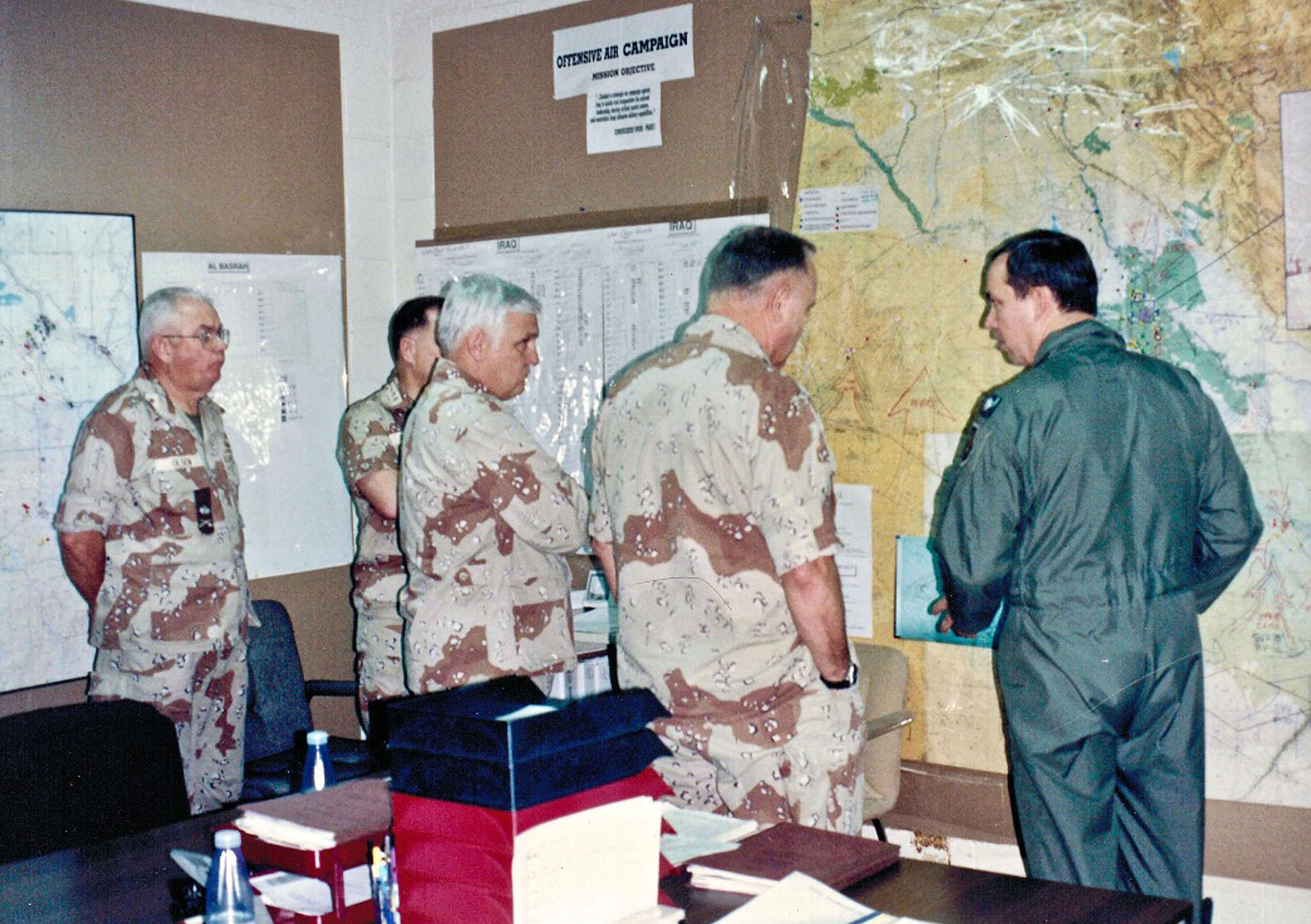
The “Instant Thunder” concept was predicated on the conviction that airpower, when applied systematically and strategically, could dismantle Iraq’s ability to wage war. Each target marked on the map was chosen with the specific intent of neutralizing a particular Iraqi capability, moving beyond the attrition-based strategies of previous conflicts. This approach represented a deliberate departure from what Deptula described as an “attritional, intelligence-based philosophy” that had characterized air campaigns such as the one in Vietnam, where success was often measured by cumulative damage rather than precise strategic disablement. The shift to precision targeting, enabled by technological advancements and meticulous planning, fundamentally altered the calculus of modern aerial warfare.
Why This Matters
The display of Lt. Gen. Deptula’s map at the Smithsonian’s National Air and Space Museum is significant for several key reasons, transcending its role as a mere historical artifact. It offers profound insights into the evolution of military strategy, the impact of technology on warfare, and the enduring importance of meticulous planning in complex geopolitical conflicts.
Firstly, the map symbolizes a pivotal moment in military history: Operation Desert Storm. This conflict marked a dramatic shift in how modern wars are fought, showcasing the unprecedented effectiveness of airpower when coupled with precision-guided munitions and stealth technology. The map is a direct link to the tactical and strategic decisions that shaped one of the most decisive military victories of the late 20th century. By illustrating the “Instant Thunder” concept, it educates the public on how military planners envisioned and executed a campaign designed to systematically dismantle an adversary’s capabilities rather than merely inflicting attrition.
Secondly, the artifact underscores the critical role of visualization and strategic thinking in military planning. In an era dominated by digital tools, Deptula’s hand-drawn, color-coded map demonstrates that fundamental principles of intelligence analysis, target prioritization, and operational coordination remain paramount. It highlights how understanding the interconnectedness of enemy assets through a visual medium can unlock strategic advantages that raw data alone cannot provide. This lesson remains relevant for military strategists today, emphasizing the human element in interpreting complex information.
Finally, the map’s inclusion in the “Modern Military Aviation” gallery at the Smithsonian serves a crucial educational purpose. It allows visitors to connect abstract concepts of warfare and technology with a tangible, human-created artifact. By presenting such a foundational document, the museum not only preserves a piece of history but also fosters a deeper understanding of the advancements that have shaped military aviation from the Korean War to the present day. It provides context for understanding current geopolitical realities and the ongoing development of airpower, ensuring that the lessons learned from past conflicts continue to inform future generations.
**Washington D.C. – A pivotal artifact from the 1991 Gulf War, a meticulously detailed target map used during the conflict’s groundbreaking air campaign, is set to become a centerpiece of the Smithsonian National Air and Space Museum’s new Modern Military Aviation gallery. This exhibit aims to illuminate a significant turning point in modern warfare, showcasing how the application of advanced technology and strategic planning fundamentally reshaped military operations.**
The massive map, measuring 12 feet by 5 feet, was a critical tool for planners in the Combined Air Operations Center (CAOC) during Operation Desert Storm. It visually represents the strategic blueprint for the initial phase of the air campaign, illustrating the shift from traditional attrition warfare to a more precise, “effects-based” approach. This change in doctrine, largely championed by then-Lieutenant Colonel David Deptula, a key architect of the air plan, sought to disable an adversary’s capabilities by targeting critical infrastructure and command nodes rather than simply destroying military assets indiscriminately.
The Gulf War air campaign, launched in January 1991 in response to Iraq’s invasion of Kuwait, marked a dramatic departure from previous conflicts. Prior military engagements often prioritized the destruction of enemy forces and matériel, measuring success by the sheer volume of damage inflicted. In contrast, Deptula and his team focused on achieving specific, debilitating effects on the Iraqi regime’s ability to wage war, recognizing that neutralizing key functions could achieve strategic objectives with greater efficiency and reduced collateral damage.
Central to this new strategy was the integration of cutting-edge military technology. The F-117 Nighthawk stealth fighter, making its combat debut, played a crucial role by penetrating heavily defended Iraqi airspace undetected. Its ability to bypass radar networks allowed coalition forces to strike high-value targets with precision-guided munitions (PGMs) in the opening hours of the conflict. This combination of stealth and precision was unprecedented and proved decisive in rapidly degrading Iraq’s war-making capacity.
Coalition air forces, led by the F-117s, almost instantly disabled Iraq’s command and control infrastructure. This swift neutralization of the enemy’s nervous system prevented effective coordination of Iraqi defenses and responses. Within weeks, other critical capabilities were systematically dismantled, all while planners aimed to greatly minimize overall infrastructure damage across the country – a deliberate departure from the carpet-bombing tactics of previous eras.
One illustrative example of this refined targeting strategy was the approach to Iraq’s electrical grid. Instead of striking entire power plants, which would entail extensive reconstruction efforts, planners focused on electrical transformer yards. By disabling these crucial distribution nodes, they could shut down the electrical grid, crippling various sectors of Iraqi society and military operations, while keeping the plants themselves largely intact and making post-conflict reconstruction more manageable. Deptula recounted instances where Iraqi power plant managers, recognizing the coalition’s targeted approach, preemptively switched off their facilities, leading the coalition to spare those sites from attack.
“By the third night of the war, there hadn’t been an electron flowing in the Iraqi power grid,” Deptula stated, underscoring the effectiveness of this precise objective. For Dr. James Hankins, a curator at the Smithsonian, the exhibit’s target map uniquely illustrates the evolution of airpower. “I think the map shows that in an interesting way, because you can see who’s targeting what, what kinds of things they are able to target, what kinds of things they were successful at. It’s different than something you would see in the sections on the Korean War or the Vietnam War,” Hankins explained, highlighting the detailed strategic thinking applied.
The map serves as the visual introduction to the gallery’s Desert Storm section, which extensively features the new technologies that defined the conflict. Complementing the map are items such as a scale model of an F-117 stealth fighter and an interactive display designed to explain the principles of stealth technology and its profound impact on the battlefield. Separately, the museum’s Steven F. Udvar-Hazy Center near Dulles Airport acquired an original F-117 in October, allowing visitors to experience the iconic aircraft up close.
Beyond its historical significance, the Desert Storm section is intended to serve as a vital bridge to understanding the conflicts of the Global War on Terror (GWOT) that have shaped the past three decades. This includes the evolution of remotely piloted aircraft, such as the Predator drone, which Deptula would later help pioneer as an armed platform. After the September 11 attacks, Deptula was directing the Combined Air Operations Center for the opening of the Afghanistan campaign when the United States launched a Hellfire missile from an RQ-1 Predator at al-Qaeda targets – marking the first combat use of an armed remotely piloted aircraft, a direct lineage from the precision-focused operations of Desert Storm.
For Deptula, the display of the map at the Smithsonian is more than just an exhibition; it represents a significant acknowledgment of a pivotal turning point in how America wages war and serves as a validation of the campaign’s innovative approach. “I think it’s recognition of the significance of the operation,” Deptula reflected. “It was the birth of how we conceive air operations.” Hankins emphasizes the map’s educational power, particularly for younger generations unfamiliar with the Gulf War. “It’s not just let’s launch a bunch of airplanes and go drop a bunch of weapons,” he said. “It’s much more careful than that. It takes a lot of people a lot of time.”
The Modern Military Aviation gallery, representing the culmination of the Smithsonian’s extensive eight-year renovation project, is scheduled to open its doors to the public on Veterans Day, November 11, 2026. This exhibit promises to offer a comprehensive and insightful look into the transformation of military aviation, with the Gulf War’s air campaign standing out as a foundational chapter.
***
**Why This Matters**
The exhibition of the 1991 Gulf War target map at the Smithsonian National Air and Space Museum is significant for several critical reasons, offering profound insights into the evolution of modern warfare and its lasting impact.
**1. Redefining Military Doctrine:** The Gulf War air campaign fundamentally shifted military thinking from “attrition-based” to “effects-based” warfare. This meant moving beyond simply destroying targets to strategically crippling an adversary’s ability to fight by targeting specific functions and systems. This intellectual leap continues to influence military planning and operations globally, emphasizing precision over brute force and strategic disruption over widespread destruction.
**2. Proving Ground for Advanced Technology:** The conflict served as the inaugural showcase for advanced military technologies like stealth aircraft (F-117 Nighthawk) and precision-guided munitions (PGMs). Their successful deployment demonstrated an unprecedented level of accuracy and minimized collateral damage, setting new benchmarks for military capabilities. This technological leap laid the groundwork for future defense investments and the development of subsequent generations of smart weaponry and platforms, including drones.
**3. Minimizing Collateral Damage (A New Ethic of Warfare):** The deliberate strategy of targeting specific points like transformer yards instead of entire power plants, or command centers over population centers, represented an attempt to achieve military objectives while concurrently limiting damage to civilian infrastructure. While war is inherently destructive, this approach marked a conscious effort to refine military ethics and strategic planning to reduce broader societal impact and facilitate post-conflict recovery.
**4. Influence on Future Conflicts:** The lessons learned from the Gulf War air campaign directly informed subsequent military engagements, particularly those of the Global War on Terror. The emphasis on precision, rapid disabling of enemy command structures, and the eventual integration of armed remotely piloted aircraft (drones) can be traced back to the strategies pioneered in 1991. Understanding this lineage is crucial for comprehending modern geopolitical conflicts and military interventions.
**5. Educational Value and Historical Memory:** For a new generation, the detailed target map and accompanying exhibits provide tangible evidence of complex strategic planning and technological application. It demystifies the notion of war as mere indiscriminate destruction, instead revealing the intricate logistics, intellectual rigor, and human decision-making involved in modern military operations. Preserving and interpreting these artifacts ensures that critical historical lessons about warfare, technology, and strategic foresight are not lost.