

CHARLESTON, S.C.—A significant military installation on the East Coast, formerly known as Joint Base Charleston, was officially renamed Joint Base Lindsey Graham on August 10, 2026. The renaming ceremony, held in Charleston, S.C., honored the late Senator Lindsey Graham of South Carolina, who passed away on July 11 at the age of 71 in Washington, D.C. The event was presided over by Secretary of Defense Pete Hegseth and Senator Darline Graham, the deceased senator’s sister and his successor in the Senate.
The new designation for the military base, which serves as a crucial logistics hub for the U.S. Air Force, reflects Senator Graham’s extensive background in military service and his decades-long career as a legislator. He was a prominent figure in Congress, particularly known for his involvement in national security and defense policy debates. The decision to rename the base in his honor recognizes his enduring contributions in both capacities.
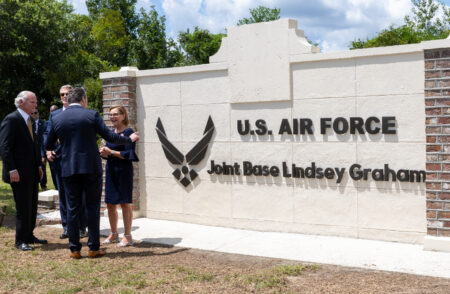
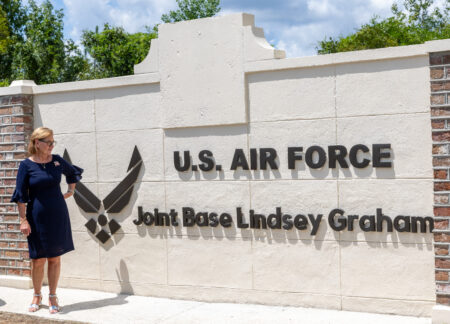
During the ceremony, Senator Darline Graham participated in the formal unveiling of the new base sign. She was accompanied by Secretary Hegseth, South Carolina Governor Henry McMaster (R), and Treasury Secretary Scott Bessent. The event brought together various public officials, military personnel, and local community leaders, underscoring the perceived importance of the occasion for both the state and the Department of Defense.
The renaming ceremony occurred at a politically sensitive time for Senator Darline Graham. Appointed by Governor McMaster to complete the remainder of her brother’s unexpired Senate term, she is currently campaigning for a full six-year term in the upcoming election. The ceremony took place on the eve of the Republican primary, in which she is a candidate, and she has received public endorsement from President Donald Trump. This timing positioned the high-profile event within the context of an active political campaign, adding a layer of political significance to the tribute.
Lindsey Graham’s career in the Air Force spanned 33 years, during which he served in several roles. He began his military service as a judge advocate general on Active-Duty from 1982 to 1988. Following this, he served in the South Carolina Air National Guard until 1995 and continued his commitment in the Air Force Reserve until his retirement in 2015, where he achieved the rank of colonel. His extensive military experience provided him with a deep understanding of defense matters, which subsequently informed his legislative work and made him a respected voice on military issues in Congress.
Secretary of Defense Pete Hegseth delivered a keynote address at the ceremony, where he commended Senator Graham’s dedication to public service and the armed forces. “Senator Lindsey Graham dedicated his life to serving this state and serving the armed forces of the United States. He served this nation both in uniform and in both houses of Congress,” Hegseth stated to the attendees, which included members of Congress, local dignitaries, and service members. He further emphasized Graham’s consistent focus on national defense, adding, “But in both capacities, it was always the same mission. He knew the timeless truth that to ensure peace, we must be prepared for war.”
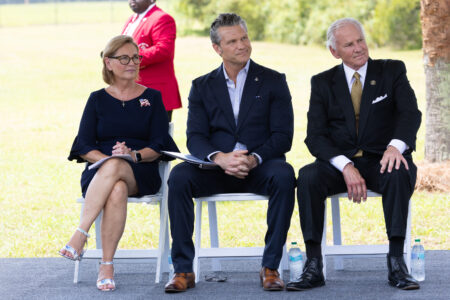
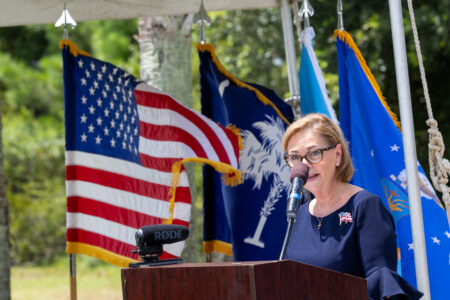
Senator Lindsey Graham’s political career commenced in 1994 when he was elected to the House of Representatives, serving four terms before successfully campaigning for a Senate seat. He was nearing the completion of his fourth six-year term in the Senate at the time of his death. A notable aspect of his political trajectory was his brief presidential campaign in 2016, during which he was a vocal critic of Donald Trump. However, following Trump’s election to the presidency, Graham’s relationship with Trump evolved, and he became one of the President’s closest allies in Congress, particularly on issues concerning national defense and judicial appointments.
The renamed installation, Joint Base Lindsey Graham, continues to hold immense strategic value for the U.S. military. Originally Charleston Air Force Base, it merged with nearby Navy facilities in 2009 to form Joint Base Charleston. It is currently recognized as the world’s largest base for the C-17 Globemaster III transport aircraft. This makes it an indispensable component of the U.S. military’s global airlift capabilities, facilitating the rapid movement of personnel and materiel across the globe. The C-17s based there prominently feature a blue tail flash incorporating South Carolina’s palmetto flag design. Officials at the ceremony announced that, moving forward, the name “Graham” will also be displayed on these aircraft, further commemorating the senator’s legacy.


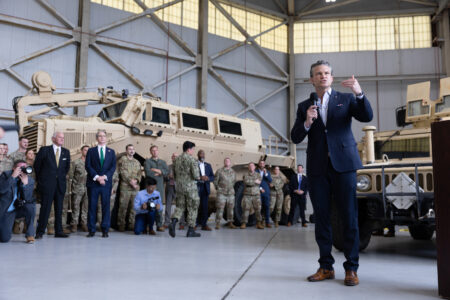
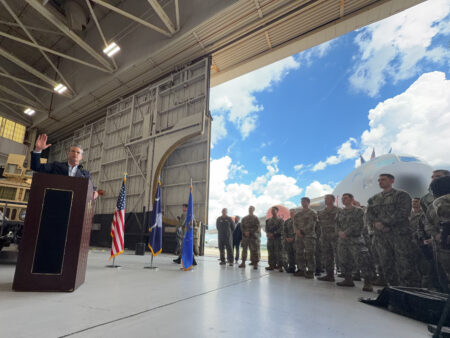
Secretary Hegseth concluded his remarks by reflecting on Senator Graham’s enduring influence. “I believe that he will continue here and around the world to inspire Airmen for generations to come,” he stated, indicating the perceived long-term impact of the senator’s legacy. The renaming of a major military installation is an infrequent honor, typically reserved for individuals with exceptionally distinguished records of service and profound contributions to national defense. This decision by the Department of Defense reflects the high esteem in which Senator Graham was held by military leadership and his political contemporaries.
The event served not only as a memorial to Senator Graham but also as a public affirmation of military and political continuity. The presence of high-ranking officials, including the Secretary of Defense, the Treasury Secretary, the state’s governor, and a sitting senator, underscored the strategic importance of the base and the perceived significance of Senator Graham’s contributions. The dedication ceremony combined elements of remembrance, political transition, and the reaffirmation of national security objectives for the United States.
Why This Matters
The renaming of Joint Base Charleston to Joint Base Lindsey Graham carries multifaceted significance, extending beyond a mere change of name. Firstly, it represents a substantial honor bestowed upon a deceased public servant and military veteran. Renaming a major military installation, particularly one as strategically critical as this base, is a rare tribute. It signifies official recognition by the Department of Defense and the U.S. government of Senator Graham’s 33 years of military service and his decades as a prominent voice in Congress on defense and foreign policy. This act serves as a public acknowledgment of his perceived contributions to national security and military preparedness.
Secondly, the event carries notable political implications, especially given its timing. The ceremony occurred just one day before a Republican primary election in which Senator Darline Graham, the sister and successor of Lindsey Graham, was a candidate. Her appointment to fill her brother’s seat and her current campaign, supported by President Donald Trump, positioned her at the center of this high-profile event. The presence of senior administration officials, including the Secretary of Defense and Treasury Secretary, alongside the state’s governor, provided a significant platform for her campaign, potentially influencing public perception and voter sentiment. This highlights the intersection of ceremonial acts, political campaigns, and the deployment of government resources.
Thirdly, the renaming impacts the identity and legacy of a key military asset. Joint Base Lindsey Graham remains the largest C-17 Globemaster III base globally, crucial for the rapid deployment of personnel and materiel worldwide. The decision to affix “Graham” to the base’s name, and potentially to the aircraft, means that his name will become synonymous with a strategic node of American power projection. This can serve as a morale booster for service members, connecting their mission to a figure revered within military and political circles. Conversely, such renamings can sometimes spark debate, particularly if the honoree’s public record includes controversial stances or political shifts, though such discussions were not prominently reported at this event.
Finally, the event reflects broader themes of political remembrance and the interplay between military and civilian leadership. The selection of a politically prominent figure for such an honor, particularly one who evolved from a strong critic to a staunch ally of a sitting President, illustrates the complexities of political alliances and legacy-building within contemporary American politics. It also underscores the executive branch’s prerogative in shaping public memory and recognition through ceremonial acts. The renaming solidifies Senator Graham’s place in the history of U.S. military infrastructure and public service, while also serving as a tangible symbol of his enduring influence in the state of South Carolina and national defense policy.
Charleston, S.C. –A significant U.S. military installation in South Carolina, formerly known as Joint Base Charleston, was officially renamed Joint Base Lindsey Graham on August 10, 2026, in honor of the late former U.S. Senator and Air Force Colonel. The renaming ceremony drew prominent national officials, including Secretary of Defense Pete Hegseth and Treasury Secretary Scott Bessent, who highlighted Colonel Graham’s extensive military and political career and his unwavering commitment to national security and defense spending.
During the ceremony, Secretary Hegseth underscored the symbolic weight of the base’s new designation. “Those gray tails that say ‘Charleston,’ now, when they land in far-flung places, will say ‘Graham.’ The world will remember that name,” Hegseth stated. He drew parallels to other South Carolina military facilities named after distinguished individuals, including:
- Shaw Air Force Base, named for Lt. Irwin David Shaw, a pilot who died in World War I.
- McEntire Joint National Guard Base, named for Brig. Gen. Bernie McEntire, the first commander of the South Carolina Air National Guard, who perished in an F-104 crash in Pennsylvania while ensuring it avoided populated areas.
- The 169th Fighter Wing of the S.C. Guard, nicknamed the Swamp Foxes, in homage to Francis Marion, a revered Revolutionary War commander.
Hegseth’s address primarily focused on advocating for increased military appropriations. He urged Congress to approve the Trump administration’s proposed $1.5 trillion budget for fiscal year 2027, linking the request directly to Graham’s legacy and his strong belief in a well-equipped military. Hegseth recounted a conversation with Graham before his death, suggesting that Graham desired an even greater defense budget than the administration’s $1.15 trillion base request combined with a $350 billion reconciliation package. “He looked at me and said, ‘How’s $355 billion sound to you?'” Hegseth recalled. “He wanted to give even more than $350 [billion]. He wanted to ensure our military was as equipped as humanly possible, because he was thinking of places like this one right here. This department pays tribute to Lindsey Graham in the naming of this space. But there could be no greater tribute than Congress could give than to invest in our warriors for the full $1.5 trillion. … Fully funding our warriors would be one last great accomplishment for Colonel Lindsey Graham and a major part of his legacy.” Hegseth added, “He believed in mission success. He believed in the troops. He believed in giving the troops everything they needed.”
Treasury Secretary Scott Bessent, a native of South Carolina, also spoke at the event. While not directly addressing the budget debate, Bessent affirmed Graham’s conviction that “the first obligation of the federal government is to keep its people safe.” Bessent highlighted the operational importance of the newly renamed base, stating that “Joint Base Graham is the backbone of our Air Force’s C-17 fleet,” and drew a parallel between the base’s vital role and Senator Graham’s reputation as “America’s workhorse.”
During his visit, Secretary Hegseth took the opportunity to recognize the service members stationed at the base, particularly those from the 437th Airlift Wing. He lauded their actions during “Operation Epic Fury” against Iran, where Airmen reportedly took cover from missiles on numerous occasions and successfully evacuated aircraft from more vulnerable locations such as Al Udeid Air Base in Qatar. Hegseth praised their adaptability and logistical expertise, stating, “I’ve been watching. I read the reports of how you iterate, do things faster, in congested logistics. It’s incredible, the backbone of what you have enabled in the theater. The secret sauce of any successful mission—whether it’s Epic Fury, Southern Spear, Midnight Hammer, Absolute Resolve, Hawkeye Strike, you name it—are the logistics behind it. All of it is enabled by all of you.”
Graham’s Story
Lindsey Graham’s career was marked by over three decades of military service and a prominent role in national politics. Before his death, Graham served as chairman of the Senate Budget Committee and was a vocal proponent of the Trump administration’s proposed $1.5 trillion budget for fiscal 2027. The Pentagon’s budget remains a subject of ongoing debate in Congress, with the prospect of the proposed funding, even within a Republican-controlled legislature, described as uncertain.
Throughout his political tenure, Graham was known as a foreign policy hawk, consistently advocating for firm U.S. policies toward Iran and Russia. He was also a staunch supporter of Ukraine in its conflict with Russia, and at the time of his death, he was actively championing a sweeping sanctions bill against Russia, which the Senate subsequently passed in his honor.
Graham was the last surviving member of a bipartisan group informally known as the “Three Amigos,” which included the late Senator John McCain (R-Ariz.) and former Senator Joe Lieberman (I-Conn.). This trio was notable for their consistent support for the invasions of Iraq, the continued presence of U.S. troops there, and the 2007 troop surge.
Born into a working-class family, Graham’s parents operated a pool hall. Both died while he was pursuing an ROTC scholarship. To remain close to home, Graham attended the University of South Carolina for both his undergraduate and law degrees. He joined the Air Force Judge Advocate General Corps, which led to deployments in Iraq and Afghanistan. Throughout his congressional career, he frequently traveled on official delegations to war zones and other international locations. Secretary Hegseth recalled meeting Graham approximately 20 years ago as a first lieutenant in the Army National Guard, and later as a captain while they were deployed to Afghanistan. “That man had a schedule like nobody else,” Hegseth said. “But he was there to hear from us because he wanted his ear to the ground from the troops on what was actually happening in the war in Afghanistan.”
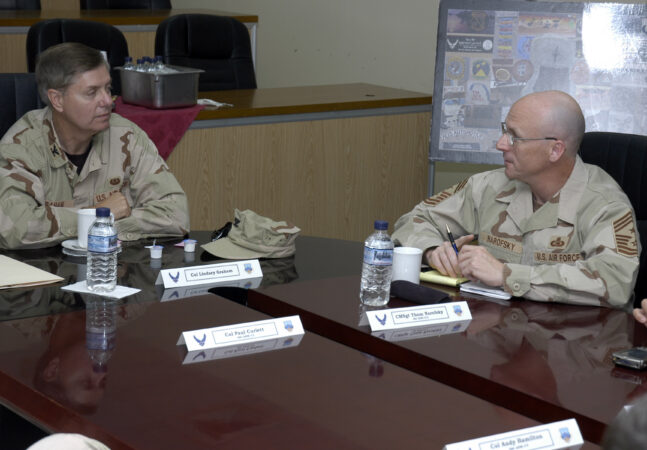
Graham’s military career first gained national attention in the mid-1980s when his exposé of errors in the Air Force’s drug testing protocols led to an appearance on CBS’s “60 Minutes.” He left active duty in 1989, subsequently joining the South Carolina Air National Guard and being activated to support Operation Desert Storm. As his national political career advanced, Graham joined the Air Force Reserve and deployed during America’s conflicts in the Middle East. He was promoted to colonel in 2004 before retiring in 2015, concluding 33 years of service to the Air Force.
Darline Graham, who became her brother’s legal dependent after their parents’ deaths, spoke movingly about his dedication. “Lindsey loved the Air Force,” she said. “He loved its mission. He loved wearing the uniform of his country. His interest in foreign affairs and national security started with his service in the Air Force.” She added, “It was sometimes hard to tell if Lindsey was a senator who happened to serve in the Air Force or an Air Force lawyer who happened to serve in the Senate. Such was his love for both. That’s the man this base is named after—a man who loved his country, loved his state and loved the United States Air Force. I could not be more honored or humbled for him to be recognized in such a fashion for his lifetime of service.”
Why This Matters
The renaming of a significant U.S. military installation to Joint Base Lindsey Graham carries substantial implications that extend beyond a simple honorific, reflecting broader themes in U.S. national security, political discourse, and military strategy.
Firstly, the event underscores the enduring importance of national defense spending in American political discussions. Secretary Hegseth’s use of the ceremony to advocate for a $1.5 trillion defense budget directly ties Graham’s legacy to the ongoing congressional debate over military appropriations. This highlights the persistent tension between fiscal constraints and perceived national security requirements. For proponents of a robust military, Graham’s name is now invoked as a standard-bearer for increased investment in defense capabilities, which could influence future budget negotiations and public opinion as the Pentagon’s budget remains in limbo.
Secondly, the renaming solidifies Lindsey Graham’s place in both military history and public memory. By associating his name with a strategic base that serves as the “backbone of our Air Force’s C-17 fleet,” his legacy is directly linked to operational readiness and global logistical power projection. This public recognition reinforces the narrative of a dedicated public servant deeply committed to military strength, particularly in an era where the U.S. military faces evolving geopolitical challenges, as evidenced by references to “Operation Epic Fury” against Iran. It also serves as a visible symbol of recognition for military service, potentially inspiring future generations of service members and reaffirming the value placed on such contributions.
Thirdly, the act of naming a military base after a political figure, especially one known for a hawkish foreign policy, signals a continued commitment to certain geopolitical stances. Graham’s consistent advocacy for assertive U.S. intervention and strong positions against adversaries like Iran and Russia reflects a particular school of thought in foreign policy. The base renaming can be seen as an institutional endorsement of these principles, potentially influencing military doctrine, strategic planning, and international relations. For allies and adversaries alike, such namings communicate a nation’s resolve and the values it seeks to uphold in a complex global environment.
Finally, for the state of South Carolina, the renaming provides a local connection to national defense. Like Shaw Air Force Base and McEntire Joint National Guard Base, Joint Base Lindsey Graham becomes a point of regional pride and a reminder of the state’s contributions to national security through its native sons and daughters. It reinforces the symbiotic relationship between military installations and their surrounding communities, creating a tangible link between local identity and global military operations. The event also serves as a poignant reminder of Graham’s personal journey from humble beginnings in South Carolina to a career of national and international influence, offering inspiration and a sense of continuity for future generations.