
**South Carolina Senate Halts Effort to Redraw Congressional Map Amid Primary Voting**
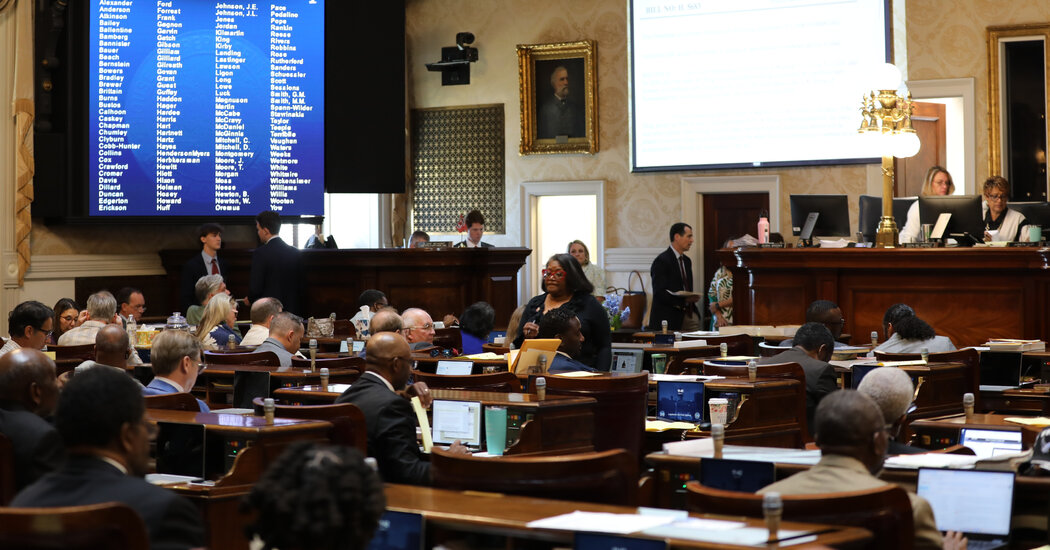
The South Carolina Senate concluded its session on Tuesday without taking action on a proposed new congressional map, effectively ensuring that the state’s existing district lines will remain in place for the upcoming June 9 primary election. The decision means that for now, South Carolina’s 6th Congressional District, the state’s sole majority-Black district, will not be eliminated, defying calls from some national conservative figures and former President Donald Trump to redraw boundaries ahead of the November general elections.
The Senate’s failure to advance the new map came as early voting for the primary was already underway, with nearly 45,000 ballots cast by Tuesday afternoon. The logistical complexities and potential disruption of discarding votes already submitted emerged as a significant factor preventing enough Republican senators from supporting the proposed changes.
The proposed map, which had passed the State House on May 20, aimed to eliminate the 6th Congressional District. This district has consistently elected a Black Democrat, Representative James E. Clyburn, who at 85 years old is seeking his 18th term in Congress and remains a prominent national political figure. The redrawing effort was part of a broader strategy by some Republicans to solidify their party’s control over the state’s congressional delegation, potentially leading to an entirely Republican representation in Washington.
This outcome distinguishes South Carolina from several other Republican-led states in the South, which have moved to redraw their congressional maps following recent interpretations by the U.S. Supreme Court concerning the Voting Rights Act. These efforts in other states have often resulted in the dilution of districts where Black voters constitute a majority, a trend aimed at diminishing the electoral power of demographic groups that predominantly vote for Democratic candidates.
However, in South Carolina, concerns about disenfranchising voters who had already participated in early voting proved paramount for many senators. Republican State Senator Richard Cash from northwestern South Carolina articulated this sentiment, stating on Tuesday, “Neither my conscience nor my common sense will allow me to stop an election that is already underway.” He acknowledged the frustration among some proponents of the map but emphasized the need to accept the current reality.
The debate over redistricting intensified following a Supreme Court ruling last month that some interpreted as weakening protections for minority voting rights. This increased pressure on South Carolina lawmakers to align with other states by redrawing districts to enhance Republican advantages. However, reservations persisted among some senators regarding the potential impact on incumbent politicians and the legal durability of a hastily enacted map. There were also strategic fears that the proposed changes might inadvertently strengthen Democratic electoral prospects in certain areas or boost Black voter turnout, potentially harming other Republican candidates down-ballot.
Democratic Minority Leader State Senator Brad Hutto indicated that Democrats had actively encouraged early voting to send a clear message. “The people in South Carolina were sending us a message that their vote mattered,” Mr. Hutto said in an interview. “It was important, and they didn’t want us to cancel their vote.”
The State House, whose members are up for re-election this year, had shown greater willingness to adopt the new map. Conversely, many Republican state senators, who are not up for re-election until 2028, expressed more skepticism. This difference in electoral timelines likely contributed to their differing approaches to a potentially contentious and legally risky redistricting effort.
Supporters of the map, such as State Senator Larry Grooms, a Republican, argued that it was crucial for solidifying GOP control in a narrowly divided U.S. Congress. “I like the map — I would like to see it become law,” Senator Grooms stated on Tuesday, adding his belief that it represented the “last and best chance to pass this map.” He later attributed some of the delay to Governor Henry McMaster, suggesting the governor’s call for a special session came too late for effective action.
However, some Republican senators raised significant concerns about the process and the map’s details. Majority Leader Shane Massey delivered a notable speech earlier in the month, contributing to the derailment of an initial attempt to reconsider district lines. Concerns were voiced about the map’s accuracy, with some lawmakers, including Senator Tom Davis, a Republican from Beaufort County, claiming it referenced non-existent voting precincts. Senator Davis criticized the expedited timeline, writing in an email to constituents, “Two weeks did not, because two weeks is not due diligence. It is a rubber stamp.”
Adam Kincaid, executive director of the National Republican Redistricting Trust, countered these claims, stating that the bill referred to 2020 census geography, which remains constant, rather than voting precincts, which can change frequently. He dismissed the senators’ concerns about map inaccuracies as “mistaken.”
Furthermore, some Republicans in the Senate expressed discomfort with what they perceived as national interference, particularly noting that the map had been generated by a consultant based in Washington. Doubts were also voiced about whether the new map would actually achieve its stated goal of unseating Representative Clyburn, given his strong incumbency and ability to attract resources to South Carolina. There were worries that redistributing his liberal voter base could create more competitive districts elsewhere, potentially leading to unintended consequences for other Republican candidates.
Representative Clyburn himself strongly condemned the proposed map, telling reporters on Tuesday morning after casting his early primary vote, “This is probably the most egregious map I’ve seen since the 1890s.”
Despite the Senate’s adjournment, the issue of redistricting in South Carolina is unlikely to be permanently settled. State Attorney General Alan Wilson, a Republican, expressed disappointment but vowed to continue the effort. “I have said all along that our state has both the authority and the responsibility to fix it. This fight is not over,” Wilson stated. Leaders in other states, such as Georgia and Mississippi, where primaries have already concluded, have also indicated intentions to redraw their district lines for future election cycles, suggesting that South Carolina may revisit this contentious issue before the 2028 elections.
Why This Matters
The South Carolina Senate’s decision to halt efforts to redraw its congressional map holds significant implications for electoral politics, voter representation, and the ongoing national debate over redistricting:
**Impact on Minority Representation:** The 6th Congressional District is South Carolina’s only majority-Black district, a product of historical efforts to ensure Black voters have the opportunity to elect representatives of their choice. The attempt to eliminate this district reflects a broader national trend in some states to dismantle such districts, often following judicial interpretations that have weakened sections of the Voting Rights Act. Maintaining this district, for now, preserves a critical avenue for minority political representation in the state and nationally.
**Precedent for Election Integrity and Voter Confidence:** The primary reason cited by many senators for not proceeding with the new map was the fact that early voting was already underway. This highlights a commitment to protecting the integrity of ballots already cast and avoiding voter confusion or disenfranchisement. It sets a precedent that the timing of redistricting changes must respect ongoing electoral processes, which can bolster voter confidence in the stability and fairness of elections.
**National Political Landscape and Partisan Control:** Redistricting is a powerful tool for shaping political outcomes, directly impacting the partisan balance of power in the U.S. House of Representatives. By attempting to eliminate a reliably Democratic district, proponents sought to cement an all-Republican delegation from South Carolina, contributing to their party’s national strength. The failure of this effort means the current partisan composition of South Carolina’s federal delegation remains unchanged for the upcoming election, a significant point given the narrow margins in Congress.
**State Sovereignty vs. National Pressure:** The debate also underscores the tension between state legislative autonomy and pressure from national political figures and organizations. Former President Trump and national conservative groups advocated for the map change, but local concerns about legality, practicality, and potential unintended consequences ultimately swayed a significant portion of the state Senate. This demonstrates that while national narratives can influence state politics, local realities and political calculations often play a decisive role.
**Future of Redistricting Battles:** While the immediate attempt to redraw the map failed, the commitment from state officials like Attorney General Alan Wilson to “continue the fight” indicates that this issue is likely to resurface. The broader trend of states reviewing and revising their maps in the wake of Supreme Court decisions suggests that redistricting will remain a contentious and recurring battleground for political power in the lead-up to future election cycles, particularly before the 2028 elections, when state senators are next up for re-election.