
U.S. Air Force Conducts Readiness Exercise at Kadena Amidst Fighter Jet Transition and Delays
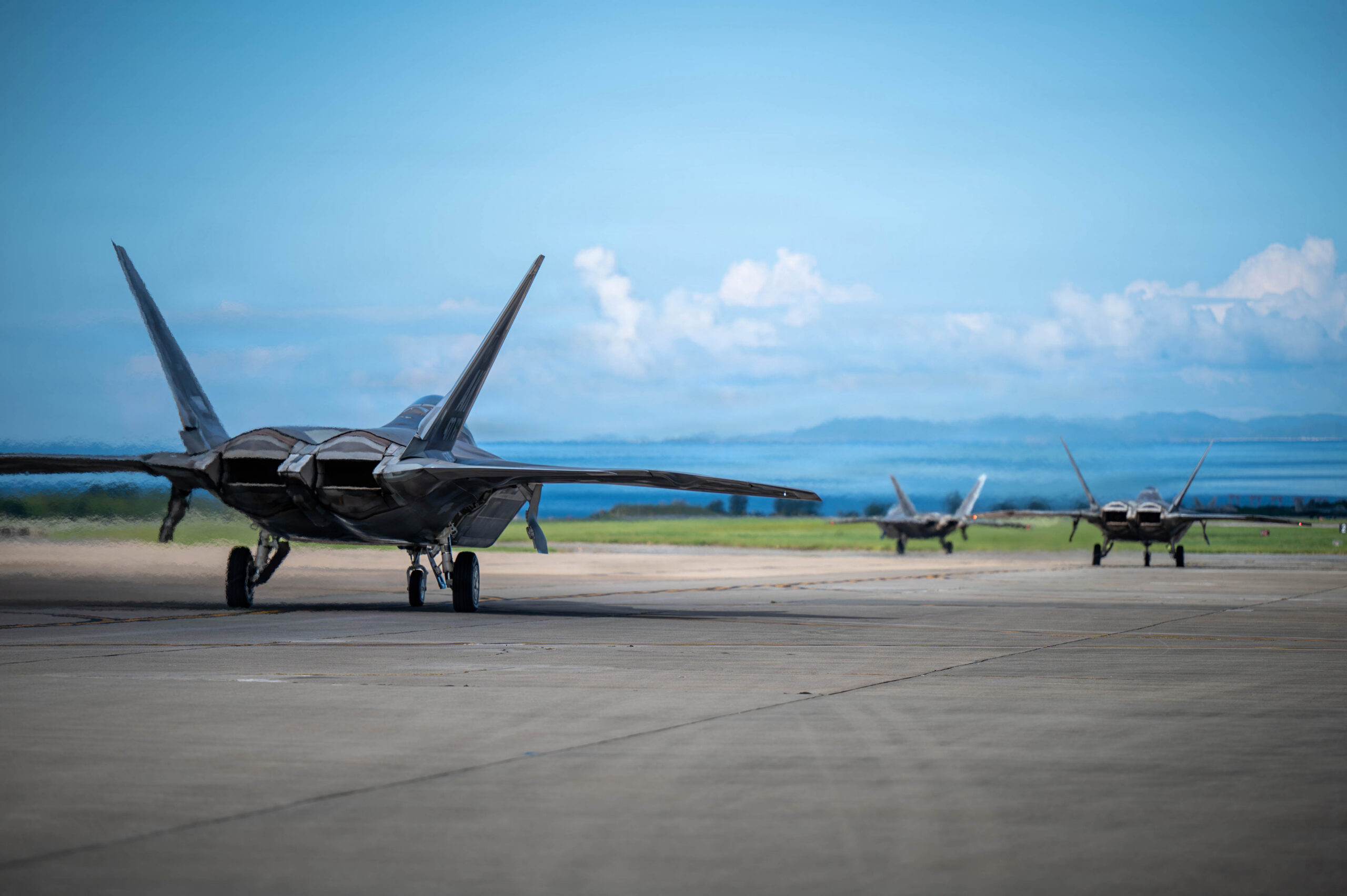
Kadena Air Base in Okinawa, Japan, is currently hosting a significant readiness exercise, “Beverly Beach 26-1,” involving two rotational fifth-generation F-22 Raptor fighter squadrons. This exercise underscores the U.S. Air Force’s commitment to maintaining combat readiness in the Indo-Pacific region as the base continues to await the delayed arrival of its permanent F-15EX Eagle II fighter jets. The 18th Wing, stationed at Kadena, initiated the exercise on August 3rd, coinciding with preparations for typhoon operations.
The “Beverly Beach 26-1” exercise aims to “rapidly generate combat airpower through agile combat employment principles,” as stated in a release from the 18th Wing. Participating units include F-22 Raptors from the 27th and 90th Expeditionary Fighter Squadrons, which arrived in Okinawa in May for a six-month deployment scheduled to conclude in November. These units are typically based at Joint Base Langley-Eustis, Virginia, and Joint Base Elmendorf-Richardson, Alaska, respectively.
Lt. Col. Brenden Torphy, director of operations for the 27th Expeditionary Fighter Squadron, emphasized the value of the ongoing operations: “We’re getting a lot of local flying to build our combat readiness. Exercises like this allow us to train under realistic conditions and ensure we’re ready to defend Kadena, our allies and our partners whenever we’re called upon.” This training is critical for honing tactical skills and ensuring interoperability in a strategically vital area.
Kadena Air Base, a pivotal U.S. Air Force installation in the Western Pacific, concluded the permanent stationing of its F-15C/D Eagle fighter jets in December 2022, marking the end of an era for the 18th Wing’s 48 Eagles that had patrolled the skies around Okinawa and the South China Sea for years. Since then, the Air Force has adopted a rotational deployment strategy to maintain fighter presence at Kadena. While new F-15EX Eagle II jets were initially expected to begin arriving at the base sooner, deliveries have faced delays.
In February, an Air Force spokesperson confirmed these delays to *Air & Space Forces Magazine*. Secretary of the Air Force Frank Kendall indicated that the initial permanent F-15EXs are now projected to arrive at Kadena in 2027, with a full complement not expected until 2028. This extended timeline necessitates continued reliance on rotational deployments of advanced fighter aircraft to fill the gap. A single F-15EX from the 85th Test and Evaluation Squadron at Eglin Air Force Base, Florida, did make a visit to Kadena in June, offering a glimpse of the future aircraft.
Kadena Air Base’s location in Okinawa, Japan, places it approximately 450 miles from Taiwan, making it the closest major U.S. Air Force operating location to the island. This proximity underscores its critical role in regional security, particularly concerning potential contingencies in the Taiwan Strait and the broader South China Sea, areas of increasing geopolitical tension. The base serves as a cornerstone of the U.S.-Japan alliance and a vital hub for projecting airpower across the Indo-Pacific.
The F-15EX Eagle II represents a significant upgrade from the F-15C/D, featuring enhanced processing power, advanced avionics, and a powerful electronic warfare suite for self-protection. These advancements lead some to categorize it as a “4.5-generation” fighter. However, a key distinction lies in its lack of inherent stealth capabilities, which are fundamental to fifth-generation fighters like the F-22 Raptor and F-35 Lightning II.
Retired Col. J.V. Venable, a senior resident fellow at the Mitchell Institute for Aerospace Studies and a former F-16 pilot, highlighted this crucial difference. “There is no substitute for a fifth-generation fighter,” Venable stated, emphasizing that these aircraft offer “a complete package of collection, computation power and the ability to disseminate that and then employ in a way that no other fighter in the world can do.” He explained that while fourth-generation fighters like the F-15EX can carry substantial firepower, they are expected to operate “riding on the skirts of fifth generation,” leveraging the superior situational awareness and stealth capabilities of their 5th-gen counterparts. The Air Force already fields F-35As at Misawa Air Base in Japan, co-located with approximately 40 F-35As from the Japanese Air Self-Defense Force, demonstrating a mixed-fleet approach in the region.
The reliance on rotational deployments, while necessary, introduces operational challenges. The Airmen currently participating in the Kadena exercise, particularly those from the 27th Expeditionary Fighter Squadron, deployed earlier this year for Operation Epic Fury before rotating to Okinawa. Such back-to-back deployments can be demanding on personnel. Col. Venable described six-month deployments as “bone crushers, particularly if you just came off of another deployment,” noting the cumulative strain on service members.
Furthermore, squadron sizes have generally decreased over the decades. While fighter squadrons historically deployed with 24 aircraft, the current standard is often around 12. This reduction means that a squadron commander might only be able to deploy six or eight combat-ready jets at a given time, potentially impacting the sustained combat airpower available for a given mission or exercise. The anticipated F-15EXs are expected to boast higher mission capable rates than the aging F-22s, which could mitigate some of these challenges once fully integrated. The 123rd Fighter Squadron at Portland Air National Guard Base, Oregon, is the first USAF unit to receive the F-15EX, though it has only received nine of its planned 12 aircraft to date.
The future of F-15EX production and delivery is a critical factor in Kadena’s long-term fighter presence. The Senate Armed Services Committee’s version of the 2027 National Defense Authorization Act includes provisions that would allow the Air Force to negotiate multi-year procurement contracts for the F-15EX. This legislative measure could potentially accelerate the rate of production and, over time, reduce per-unit costs. However, its implementation is contingent on manufacturer Boeing’s ability to consistently meet delivery schedules, an issue that has contributed to the current delays. As of August 3rd, Boeing had deferred questions regarding production to the Air Force, and Air Force public affairs did not provide a comment by press time.
Why This Matters
The ongoing situation at Kadena Air Base, marked by readiness exercises, fighter jet transitions, and deployment delays, carries significant implications across several dimensions:
1. **Regional Stability and Deterrence:** Kadena Air Base is a cornerstone of U.S. military presence in the Indo-Pacific, a region experiencing heightened geopolitical competition and potential flashpoints, particularly concerning Taiwan and the South China Sea. Maintaining a robust and capable airpower presence at Kadena is crucial for deterring aggression and reassuring allies. Delays in permanent aircraft stationing necessitate reliance on rotational deployments, which, while effective in the short term, can introduce complexities in sustained readiness and operational consistency. The mix of 4th and 5th generation fighters, with 5th-gen aircraft providing critical stealth and situational awareness, is key to maintaining a credible deterrent posture against advanced adversaries.
2. **U.S. Military Readiness and Modernization:** The transition from aging F-15C/D models to the F-15EX Eagle II is part of a broader U.S. Air Force modernization effort aimed at ensuring its forces remain technologically superior and capable in future conflicts. The F-15EX, with its advanced avionics and electronic warfare systems, represents a significant upgrade. However, delays in its delivery directly impact the pace of this modernization and the full spectrum of capabilities available at a forward-deployed base like Kadena. The exercise with F-22s highlights the Air Force’s adaptive strategies to bridge capability gaps and ensure personnel remain proficient.
3. **Alliance Commitments and Interoperability:** Japan is a vital U.S. ally, and Kadena Air Base serves as a symbol of this enduring partnership. A strong U.S. air presence reinforces alliance commitments and facilitates joint training and interoperability with the Japan Air Self-Defense Force. The F-22 exercises not only bolster U.S. readiness but also enhance the collective defense capabilities of the alliance in a critical region. The sustained presence of advanced U.S. airpower is essential for demonstrating commitment to regional security.
4. **Impact on Personnel and Resources:** The reliance on frequent, demanding rotational deployments for fighter squadrons places a considerable strain on Air Force personnel and resources. “Bone crusher” deployments, especially when back-to-back, can impact morale, retention, and combat effectiveness. Furthermore, the operational logistics and maintenance required for rotating squadrons, rather than managing a permanently stationed fleet, introduce additional complexities and potentially higher costs in the long run. Ensuring adequate support and sustainable deployment rhythms is vital for the well-being and long-term effectiveness of the force.
5. **Industrial Base and Procurement Challenges:** The delays in F-15EX deliveries underscore broader challenges within the defense industrial base and procurement processes. Issues with manufacturing capacity, supply chains, or contractual agreements can have cascading effects on military readiness and strategic timelines. The Senate’s consideration of multi-year procurement contracts for the F-15EX signals an effort to stabilize production and improve cost-efficiency, but it also highlights the ongoing need for robust oversight and collaboration between the military and defense contractors to ensure timely delivery of essential capabilities. The ability of manufacturers like Boeing to meet commitments directly influences national security objectives.