
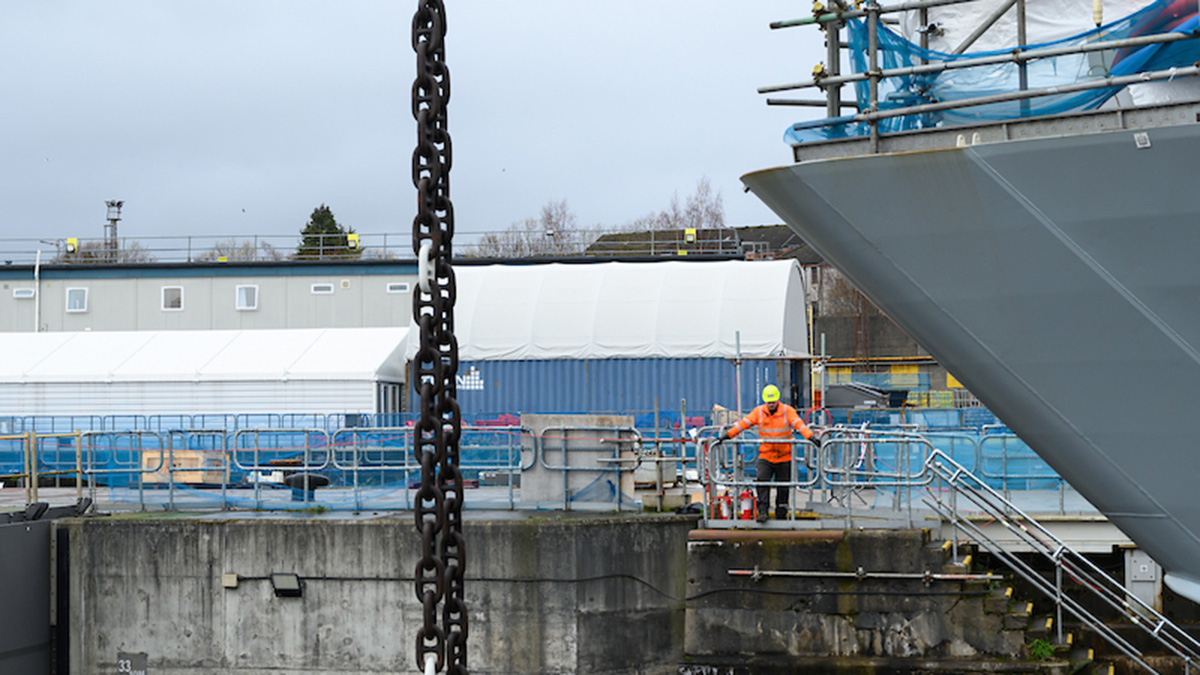
BAE Systems reports that HMSCardiff, the Royal Navy’s subsequent Type 26 frigate, has attained a further building landmark with the securing of its mooring cables.
The firm indicated that groups drawn from its operational divisions, naval construction, activation, and technical departments collaborated to make ready the vessel’s chain compartments. This crucial action was undertaken prior to attaching the heavy links, ensuring the mechanism can securely hold the ship’s mooring devices.
With the mooring cables now secured, attention will shift to strength verification of the anchor hoist mechanism, which is responsible for hoisting and deploying the anchors. This system requires validation prior to the vessel proceeding into subsequent phases of equipping. This achievement signifies ongoing advancement in the assembly of HMSCardiff, which is presently undergoing outfitting at BAE Systems’ Scotstoun facility on the River Clyde, subsequent to its unveiling in September 2024.
Positioned as the second among eight Type 26 frigates, HMSCardiffis under construction for the Royal Navy, destined to succeed the obsolescent Type 23 fleet. This initiative commenced with HMSGlasgow, and additionally, HMSBelfastis slated to be next as the third vessel in this series.
Momentum is building as HMS Cardiff is looking ship shape ⚓
The successful installation of the Type 26’s anchor chains is a huge win for our Operations, Shipwrights, Commissioning, and Engineering teams. Working side-by-side, they prepared both chain lockers, a critical safety…pic.twitter.com/qpcXt7I7FU— BAE Systems Maritime (@BAES_Maritime)March 26, 2026
Conceived principally for sub-surface combat, the Type 26 class will additionally perform aerial protection and versatile operations, constituting a fundamental component of the Royal Navy’s impending naval surface contingent. These vessels will be furnished with the Sea Ceptor air defence system and a 24-cell Mk 41 vertical launch system able to launch diverse armaments, as well as sophisticated underwater detection mechanisms, which comprise the Type 2087 towed array.
Intended for worldwide missions and prolonged assignments, these vessels boast a full-load weight surpassing 8,000 metric tons and an operational reach beyond 7,000 nautical miles. This capability is facilitated by a spacious operational deck and accommodations for rotary-wing aircraft and unmanned craft.
BAE Systems affirmed that the headway made onCardiffdemonstrates sustained impetus within the initiative, while the United Kingdom persists in revitalizing its sophisticated naval vessel construction prowess in the Clyde region.