
The convergence of modern social dynamics and culinary innovation is increasingly evident in informal celebratory gatherings, such as “Friendsgiving.” This contemporary tradition, which emphasizes camaraderie over conventional family structures, often highlights practical and efficient cooking methods to accommodate diverse group sizes and busy lifestyles. A prominent trend facilitating such events is “sheet-pan cooking,” a technique celebrated for its simplicity, reduced cleanup, and ability to produce varied dishes with minimal fuss.
Credit…Ryan Liebe for The New York Times.
The concept of Friendsgiving has emerged as a significant cultural phenomenon, particularly among younger demographics in Western societies. It represents a shift towards chosen families and a more relaxed approach to holiday celebrations, often occurring parallel to or as an alternative to traditional Thanksgiving gatherings. This informal context encourages culinary approaches that prioritize ease of preparation and communal enjoyment, making methods like sheet-pan cooking particularly appealing.
Sheet-pan cooking, which involves preparing multiple ingredients or an entire meal on a single baking sheet, aligns well with these modern demands. It streamlines the cooking process, maximizes oven space, and critically, minimizes post-meal cleanup. This efficiency is especially valued in urban environments or among individuals with limited kitchen resources or time constraints, allowing hosts to focus more on social interaction rather than complex culinary logistics.

Credit…Armando Rafael for The New York Times.
Examples of how this technique is applied across various dish categories illustrate its versatility. For instance, traditional potato gratins, often prepared in deep baking dishes, are adapted for sheet pans by arranging potato slices in a shingled pattern. This technique enhances surface area exposure, leading to increased browning and crispiness. Flavor profiles typically remain classic, incorporating ingredients such as Gruyère cheese, sage, garlic, and nutmeg.

Credit…Christopher Testani for The New York Times.
Vegetable preparations also benefit from the sheet-pan approach. A notable adaptation involves transforming classic salad concepts, such as Caesar, into roasted vegetable sides. Roasted Brussels sprouts, for example, can be prepared on a sheet pan, with elements like croutons often baked concurrently to further reduce dish count. Dressings may feature contemporary substitutions, such as tahini replacing traditional anchovy-based components.

Credit…Christopher Testani for The New York Times.
For main courses, poultry preparation on a sheet pan offers significant advantages. The “spatchcocking” technique, which involves removing the bird’s backbone to flatten it, is increasingly applied to turkeys. This method facilitates faster, more even cooking at higher temperatures, significantly reducing the overall preparation time for large birds, making them more manageable for informal gatherings.

Credit…Kerri Brewer for The New York Times.
Simple side dishes, such as roasted green beans, are frequently prepared using this method. By roasting vegetables and protein components, such as diced pancetta, at high temperatures with minimal seasoning like olive oil, salt, and pepper, a dish can be completed rapidly, often garnished with fresh lemon juice for brightness. This emphasizes speed and minimal ingredient lists.

Credit…David Malosh for The New York Times.
The concept extends to comprehensive one-pan meals, where protein, starch, and vegetables are cooked together on a single sheet. Dishes combining elements such as gnocchi with sausage and broccoli exemplify this efficiency, providing a complete meal with simplified preparation and cleanup, a primary driver of its popularity among home cooks seeking convenience.

Credit…Julia Gartland for The New York Times.
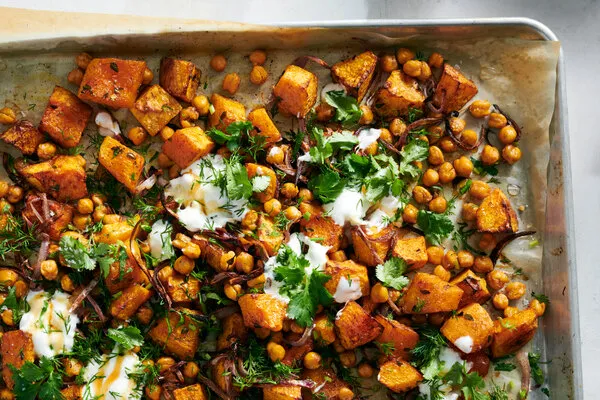
Root vegetables and legumes are also frequently featured in sheet-pan preparations. Roasted honey nut squash and chickpeas, for instance, demonstrate how various textures and flavors can be harmonized on a single pan, often complemented by sweet and savory accents like hot honey and yogurt. Such dishes typically require minimal hands-on time, focusing on oven roasting.

Credit…Bryan Gardner for The New York Times.
Even traditional holiday components like stuffing are adapted for sheet-pan cooking. By baking stuffing on a flat sheet rather than in a deep casserole, a greater proportion of the dish achieves a desirable toasted and crispy texture. Standard ingredients such as celery, onion, apple, herbs, and broth are maintained, while the cooking method optimizes textural outcomes.

Credit…Con Poulos for The New York Times.
The versatility of sheet pans extends beyond savory dishes to desserts. The “Texas Sheet Cake,” a flat, chocolate-based cake, exemplifies a popular dessert that leverages the sheet-pan format. Characterized by its moist texture and often topped with a warm cocoa frosting and pecans, it offers an efficient method for producing a dessert suitable for sharing at communal gatherings.
Finally, for those seeking alternative main courses beyond traditional turkey, sheet-pan preparations offer appealing options. Roasted chicken thighs with autumnal ingredients like apples, fennel, and onions, seasoned with toasted fennel seeds and rosemary, provide a flavorful and festive alternative. These dishes are designed for readiness in under an hour, making them suitable for informal company.
Why This Matters
The widespread adoption of “Friendsgiving” and sheet-pan cooking techniques reflects significant societal and cultural shifts. Firstly, the rise of Friendsgiving underscores an evolving understanding of family and community, particularly among younger generations who prioritize chosen relationships and less formal social structures. This movement challenges traditional holiday norms and highlights a desire for celebrations that are adaptable, inclusive, and less burdened by historical expectations.
Secondly, the popularity of sheet-pan cooking speaks to a broader global trend towards convenience and efficiency in daily life, including culinary practices. In an increasingly fast-paced world, individuals and households seek methods that reduce preparation time, simplify cooking processes, and minimize post-meal cleanup. This is particularly relevant for busy professionals, urban dwellers with limited kitchen space, and anyone navigating demanding schedules. The accessibility of this cooking method—requiring minimal specialized equipment—democratizes home cooking, making it approachable for a wider demographic, regardless of culinary skill level.
Moreover, these trends intersect with considerations of sustainability and resource management. Simplified cooking often translates to less energy consumption and potentially less food waste, as portion control and ingredient utilization can be more easily managed. The emphasis on practical, adaptable meals contributes to greater food security by promoting efficient use of ingredients and reducing barriers to preparing nutritious food at home. Understanding these culinary and social adaptations offers insights into contemporary lifestyles, consumer preferences, and the ongoing evolution of communal dining experiences worldwide.
Global Culinary Trends Highlight Efficiency and Flavor in Home Cooking
In an era characterized by demanding schedules and a renewed focus on convenience, a significant shift is observable in global culinary practices. Home cooks are increasingly seeking simplified yet flavorful recipes, a trend prominently amplified by leading food publications. This movement emphasizes minimalist preparation techniques, such as sheet-pan and one-pot methods, which promise reduced cooking time and minimal cleanup without compromising taste or nutritional value. This approach caters to a diverse audience, from busy professionals and parents to those new to cooking, democratizing access to diverse and satisfying meals.

Credit…Bobbi Lin for The New York Times. Food Stylist: Simon Andrews.
The popularity of dishes that can be prepared with minimal fuss is evidenced by widespread positive reception. For instance, a 20-minute broccoli recipe, developed by Yasmin Fahr, which incorporates miso butter and lime juice directly on a sheet-pan after roasting, has garnered significant acclaim from users. Its ease and flavor profile exemplify the current demand for efficient cooking. Such recipes often feature readily available ingredients and straightforward instructions, making them accessible to a broad demographic looking to integrate healthier, home-cooked meals into their routines.
Recipe Highlight:Miso-Butter Roasted Broccoli– This recipe underscores the utility of a single cooking vessel for both preparation and flavor infusion, minimizing post-meal chores.

Credit…Christopher Testani for The New York Times. Food Stylist: Simon Andrews.
Another staple benefiting from this culinary simplification is the roasted potato. Lidey Heuck’s recipe, designed to achieve both creamy interiors and crispy exteriors, utilizes baby potatoes or larger varieties cut into uniform pieces for even cooking. The enduring appeal of potatoes, combined with an optimized roasting method, reflects a desire for comfort food that aligns with modern efficiency requirements. This approach ensures a reliable outcome with minimal effort, a key factor in its broad adoption across households.
Recipe Highlight:Roasted Potatoes– Emphasizes fundamental techniques to elevate a common ingredient, showcasing how basic cooking can yield sophisticated results.

Credit…Yossy Arefi for The New York Times (Photography and Styling)
The trend extends beyond everyday meals to traditionally complex holiday feasts. Melissa Clark’s streamlined Thanksgiving menu, for instance, proposes preparing an entire holiday dinner—including turkey, stuffing, Brussels sprouts, sweet potatoes, cranberry sauce, and gravy—using only one sheet pan, one medium pot, and one bowl. This innovative approach addresses the perennial challenge of holiday cooking, aiming to reduce both preparation time and the subsequent volume of dishwashing. Such solutions demonstrate a proactive response to the demands of modern festive gatherings, offering a practical alternative to elaborate multi-dish preparations.
Recipe Highlight:One-Pan, One-Pot Thanksgiving Dinner– A comprehensive example of how complex culinary events can be adapted for greater efficiency without sacrificing traditional elements.

Credit…Armando Rafael for The New York Times. Food Stylist: Cyd Raftus McDowell.
Vegetables that were once considered humble or difficult to prepare are also being revitalized through simplified, flavor-forward recipes. Hetty Lui McKinnon’s six-ingredient roasted green cabbage recipe, featuring a garlic-lemon-caper oil, highlights how basic ingredients can be transformed into compelling dishes. This focus on elevating often-overlooked vegetables aligns with growing consumer interest in plant-based diets and sustainable eating practices. The emphasis on robust flavor profiles generated from minimal ingredients reflects both culinary ingenuity and a pragmatic approach to daily cooking.
Recipe Highlight:Roasted Cabbage With Capers and Garlic– Illustrates the potential for simple preparations to unlock rich flavors from readily available produce.

Credit…Julia Gartland for The New York Times. Food Stylist: Samantha Seneviratne.
Even the realm of baking is adapting to these streamlined methodologies. Genevieve Ko’s easy carrot cake, baked in a half-sheet pan and then cut into layers, eliminates the need for specialized cake rounds, simplifying what can often be a daunting process for home bakers. The use of sour cream in the cream cheese frosting for an “extra tang” further demonstrates an innovative approach to traditional recipes, balancing ease of preparation with enhanced flavor. This adaptation makes home baking more approachable, encouraging more individuals to engage in culinary activities typically perceived as time-intensive.
Recipe Highlight:Easy Carrot Cake With Cream Cheese Frosting– Shows the application of efficiency principles to baking, making complex desserts more accessible.

Credit…Bobbi Lin for The New York Times. Food Stylist: Simon Andrews.
Further illustrating the reinvention of traditional side dishes, Hetty Lui McKinnon’s harissa-roasted sweet potato wedges with red onion offer a modern alternative to saccharine preparations. By incorporating ingredients like harissa, feta, cilantro, mint, and lemon, the recipe introduces complex savory, smoky, creamy, and tangy notes. This diversification of flavor profiles in common dishes reflects a broader trend of culinary exploration and the integration of international ingredients into everyday cooking, moving away from overly sweet, conventional accompaniments.
Recipe Highlight:Harissa-Roasted Sweet Potatoes and Red Onion– Exemplifies the introduction of global flavors and savory alternatives to traditional sweet dishes.

Credit…Linda Xiao for The New York Times. Food Stylist: Judy Kim.
The integration of global flavors into simplified recipes is further highlighted by Zainab Shah’s roasted cauliflower, which features Vietnamese nước chấm sauce. This pungent sauce, characterized by fish sauce, garlic, rice vinegar, sugar, and chili, transforms a subtly sweet vegetable into a dish noted for its “awesome amount of flavor” by readers. The positive feedback from users underscores the success of combining approachable cooking methods with sophisticated, internationally inspired condiments. This fusion represents a democratization of global cuisine, making complex flavors achievable for the home cook with minimal effort.
Recipe Highlight:Roasted Cauliflower With Nước Chấm Sauce– Demonstrates the effectiveness of pairing simple roasted vegetables with bold, authentic international sauces.
The collective output from prominent food writers and stylists, frequently credited in these culinary features, indicates a deliberate editorial strategy to meet evolving consumer demands. Publications are investing in high-quality photography and detailed stylistic direction to present these simplified recipes in an appealing and aspirational manner. This not only enhances the visual appeal but also reinforces the perception that efficient cooking does not necessitate a compromise on aesthetic quality or culinary experience.
Why This Matters
The global shift towards streamlined, efficient home cooking holds significant implications across societal, economic, and cultural spheres. From a societal perspective, these accessible recipes empower individuals and families to prepare nutritious meals at home, potentially mitigating the reliance on less healthy, processed foods or expensive takeout options. This can contribute to improved public health outcomes and foster a greater sense of culinary confidence among home cooks, regardless of their experience level or time constraints. The reduction in active cooking and cleanup time directly addresses the “time poverty” increasingly faced by modern households, allowing more time for other personal or family activities.
Economically, encouraging home cooking through simplified methods can lead to considerable cost savings for consumers, as ingredients are generally less expensive than pre-prepared meals. This trend could also influence food retail markets, potentially increasing demand for basic, versatile ingredients and specialized kitchen tools designed for efficiency. Culturally, the integration of diverse, international flavors into these easy-to-follow recipes broadens culinary horizons for home cooks globally. It promotes cross-cultural understanding through food, making exotic tastes approachable and encouraging experimentation with a wider range of ingredients and spices. This phenomenon reflects a broader democratization of culinary knowledge and an ongoing evolution of global food culture, driven by both practicality and a desire for flavor innovation.
Furthermore, the emphasis on single-pan or single-pot preparations may offer environmental benefits, such as reduced water consumption for dishwashing and potentially lower energy usage compared to multiple stove-top burners and oven racks. By making home cooking more manageable and less intimidating, this culinary trend plays a crucial role in shaping contemporary eating habits, promoting sustainability, and enhancing overall well-being in an increasingly fast-paced world.