
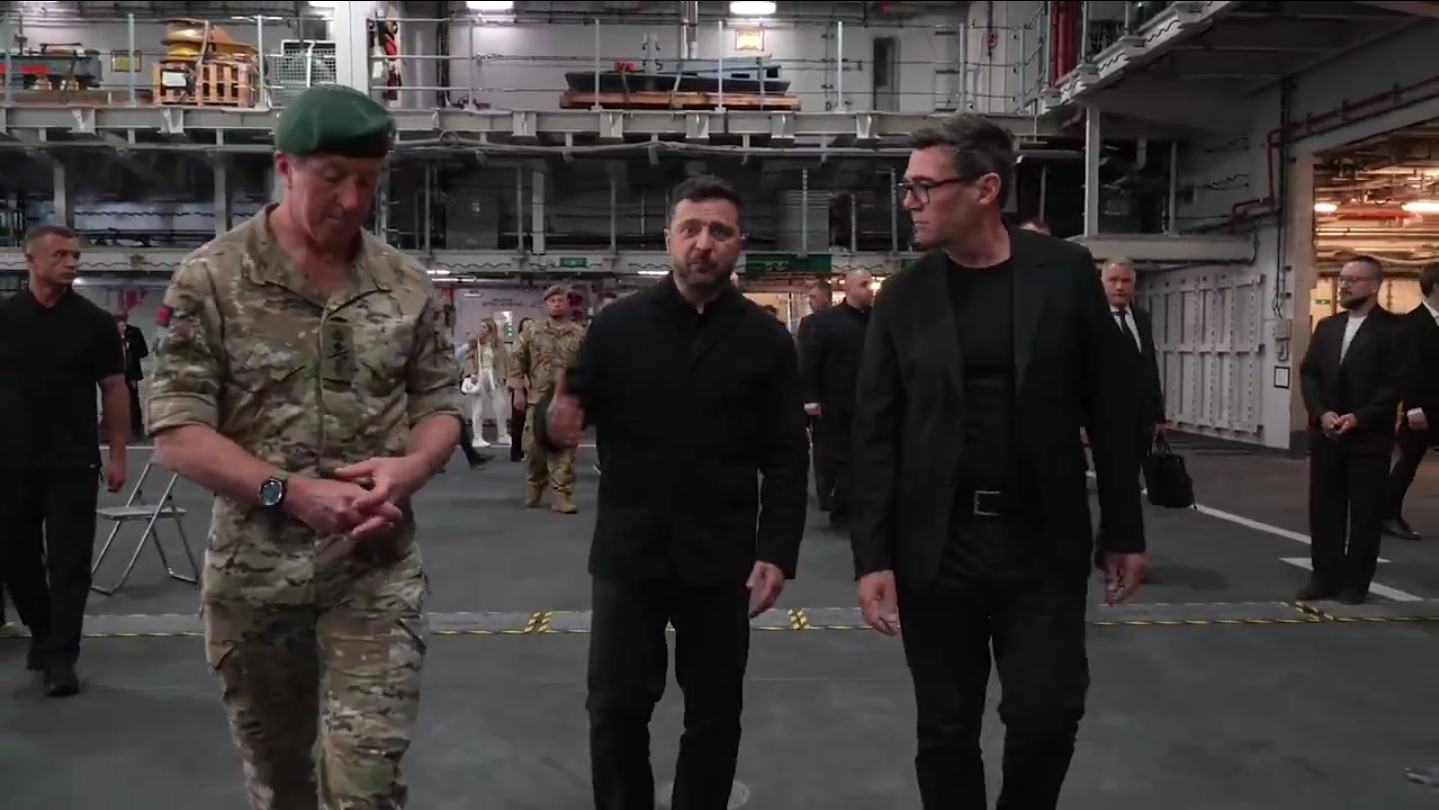
UK Prime Minister Hosts Ukrainian President in First International Visit
Prime Minister Andy Burnham hosted Ukrainian President Volodymyr Zelensky in the United Kingdom, marking the Prime Minister’s first international visitor since taking office. The meeting, confirmed by the Prime Minister’s Office, underscored the UK’s commitment to Ukraine amidst the ongoing conflict.
The two leaders convened at Portsmouth Naval Base on the south coast of England. According to President Zelensky, their initial discussions took place aboard the aircraft carrier HMS Queen Elizabeth. This high-profile visit occurred just a week after Prime Minister Burnham assumed office. He had engaged with President Zelensky in one of his initial calls as Prime Minister, extending an invitation for an early visit. Downing Street stated that the purpose of the visit was for Prime Minister Burnham to reaffirm the UK’s unwavering support for Ukraine, both during the current war and into the future.
During the visit, Prime Minister Burnham was quoted stating: “Britain stands with Ukraine, shoulder to shoulder, and our support remains unwavering. Russia should be in no doubt of our resolve, and we will not back down until we achieve long lasting and just peace for Ukraine. Stone Cloak is the best of homegrown British innovation and proven on the frontline, and it will be vital to protecting our security in both our countries.” This statement highlighted the UK’s steadfast dedication to Ukraine’s sovereignty and its resolve to achieve a just peace.
A central element of the visit was the announcement of a significant defence technology transfer. The UK will share the intellectual property rights for a British capability known as “Stone Cloak.” Government sources describe Stone Cloak as an electronic jammer, approximately the size of a tablet computer. Its function is to impede Russian air defence systems from effectively tracking and targeting the drones to which it is affixed. By transferring the intellectual property, the government explained, Ukraine gains the ability to mass-produce Stone Cloak domestically, thereby substantially reinforcing its front-line defences and increasing the survivability of its drone operations.
The government confirmed that thousands of these jammers have already been supplied to Ukraine by the Ministry of Defence, contributing to the Ukrainian armed forces’ ability to sustain their extensive drone operations. This device was presented as a prime example of the rapid innovation and collaborative development fostered between the two countries under the framework of the “100 Year Partnership” agreement, which was signed earlier in the year to solidify long-term defence and security cooperation.
Looking ahead, Stone Cloak is also slated for integration into the next generation of UK deep-strike capabilities, following its initial deployment and proven effectiveness in Ukraine. This includes its planned incorporation into Project Brakestop, the government’s initiative focused on developing a new generation of low-cost cruise missiles. This arrangement represents an unusually direct instance of battlefield lessons and operational experience feeding back into domestic British weapons development and procurement, potentially accelerating the refinement of new military technologies for the UK itself.
The development and deployment of electronic warfare protection for strike drones directly addresses one of the most critical challenges of the current conflict. Both Ukrainian and Russian forces rely heavily on uncrewed aerial vehicles (UAVs) but experience high rates of loss due to sophisticated jamming techniques and air defence systems. A device like Stone Cloak, which degrades an air defence system’s capacity to track a drone, significantly extends the operational range and survivability of these crucial aircraft. The objective behind sharing its design with Ukrainian industry is to achieve this capability at a low cost and in a format suitable for large-scale production, enabling widespread deployment across the front lines.
President Zelensky provided his perspective on the meeting through a post on the social media platform X, which was subsequently reposted by the UK Ministry of Defence. He indicated that discussions with Prime Minister Burnham covered Ukraine’s urgent need for sufficient capabilities to protect lives both in the air and at sea, alongside the strategic development of joint defence production. “I am grateful to the United Kingdom for today’s decision to provide Ukraine with electronic warfare technologies to protect Ukrainian drones,” Zelensky wrote, further noting that he had extended an invitation for Prime Minister Burnham to visit Ukraine.
Beyond the high-level discussions, the leaders also engaged with more than 200 Ukrainian military personnel and sailors. These service members had recently completed three weeks of training in the UK as part of Exercise Sea Breeze, a multinational maritime security and counter-mine exercise designed to prepare them for future missions, particularly within the Black Sea region. This interaction underscored the practical, hands-on training support the UK provides to Ukrainian forces.
The government reiterated the extensive support the UK offers to Ukraine, which includes a commitment of £3 billion annually for as long as it takes. Since Russia’s full-scale invasion commenced, the total UK support for Ukraine has reached approximately £25 billion. This includes an estimated £16 billion in military assistance and an additional £5.6 billion in non-military, humanitarian, and economic aid, demonstrating a comprehensive and sustained commitment to Ukraine’s defence and recovery.
Why This Matters
This visit by President Zelensky, occurring as Prime Minister Burnham’s first international engagement, carries significant strategic weight. It immediately signals continuity and steadfastness in the UK’s foreign policy regarding Ukraine, reinforcing the message that the new leadership is unwavering in its support against Russian aggression. For Ukraine, it demonstrates sustained high-level international backing, crucial for morale and continued military effort.
The announcement regarding Stone Cloak and the sharing of its intellectual property represents a potentially transformative moment in military aid. Moving beyond simply supplying finished equipment, this initiative empowers Ukraine to bolster its own defence industrial base, enabling the domestic mass production of a critical capability. This shift towards technological transfer and co-production could significantly enhance Ukraine’s long-term self-sufficiency and resilience, setting a new precedent for how Western allies might support the country’s defence needs.
Operationally, Stone Cloak addresses a critical vulnerability in modern warfare: the high attrition rate of drones due to advanced electronic warfare and air defence systems. By improving drone survivability and operational range at low cost and high scale, it could provide a tangible advantage on the battlefield, particularly in contested airspace. This directly impacts Ukraine’s ability to conduct reconnaissance, targeting, and strike operations more effectively, potentially reducing casualties and increasing the precision of its forces.
Furthermore, the integration of Stone Cloak into future UK defence projects like Project Brakestop highlights a practical and expedited feedback loop between active conflict zones and domestic defence innovation. This direct application of battlefield lessons to future weapons development could accelerate the UK’s own military modernization, ensuring that new capabilities are designed with real-world effectiveness in mind. It underscores the concept of “innovation through necessity” and the strategic value of learning from contemporary conflicts.
Finally, the “100 Year Partnership” and the ongoing military exercises like Sea Breeze underline a deeper, long-term commitment beyond immediate conflict support. This foundational cooperation aims to build Ukraine’s capabilities for lasting security and stability, integrating it more closely with Western defence standards and alliances. This visit, therefore, is not merely about immediate aid but about forging enduring strategic partnerships and shaping the future security architecture of Europe.