
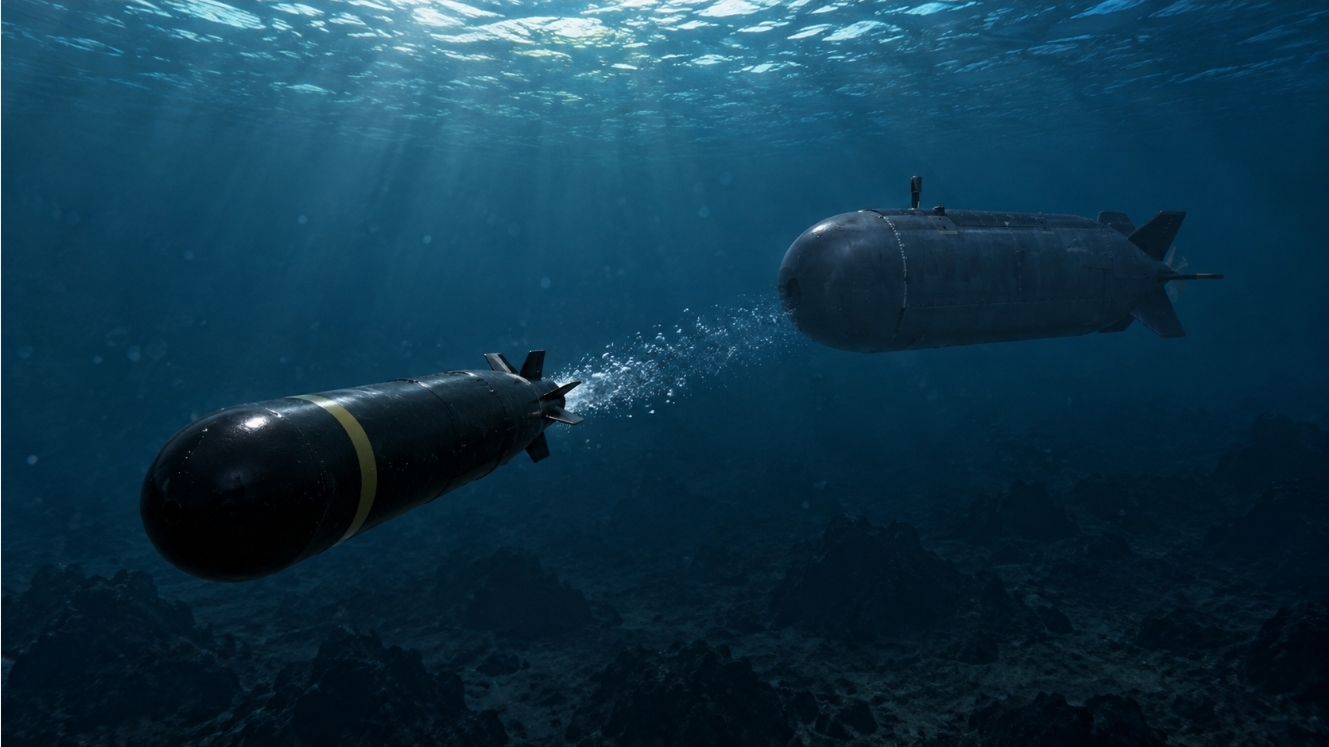
On September 13, a significant milestone in allied undersea warfare was achieved at the British Underwater Test & Evaluation Centre (BUTEC) in Scotland. The Royal Navy’s 12-meter XV EXCALIBUR autonomous underwater vehicle (AUV) successfully launched an exercise Mk 48 torpedo, marking a historic first for both the United Kingdom and the United States.
This event, described by the British Government as the first live firing of a heavyweight torpedo from an uncrewed underwater vessel by either the UK or US, represents a departure from traditional submarine-launched deployments. The trial was conducted under Project Broadsword and Trial Iron, as part of the broader AUKUS Pillar 2 initiative, which focuses on advanced capabilities and interoperability among Australia, the UK, and the US.
The primary objective of Project Broadsword was to validate the complex mechanical, electrical, and software integration necessary to deploy an American-designed weapon from a British autonomous platform. Engineers successfully demonstrated the seamless interface between the Mk 48 torpedo, the standard heavyweight submarine-launched torpedo of the US Navy, and the XV EXCALIBUR vehicle.
US Chief of Naval Operations Admiral Daryl Caudle underscored the importance of this achievement, stating, “This successful test marks a historic first for allied undersea warfare. Proving that we can seamlessly launch a U.S. heavyweight torpedo from a Royal Navy autonomous underwater vehicle validates our shared vision for true interchangeability.” He further elaborated on the strategic implications, adding, “By integrating weapons, payloads, and mission architectures across allied platforms, we are increasing the flexibility, scale, and combat power of our combined forces and ensuring they are ready to meet the strategic demands of tomorrow.” It was confirmed that the weapon used in the trial was an exercise torpedo, with the focus solely on testing the launch mechanisms and interfaces.
The UK Government highlighted that this firing signifies a major advancement in developing autonomous undersea strike capabilities. This work is expected to contribute directly to wider collaborative efforts within the AUKUS security pact. UK Prime Minister Andy Burnham commented on the broader implications, stating, “Our work together already shows what can be achieved when our two countries combine our expertise and innovation.”
Prime Minister Burnham connected the trial to an overarching UK-US initiative on artificial intelligence (AI) and autonomy. He noted, “That ambition is underlined in our new defence partnership with the United States on AI and autonomy, bringing together the brightest minds to strengthen the protection of critical infrastructure, deter those who threaten our security, and use the enormous potential of AI to our advantage.” This proposed partnership aims to integrate the UK’s Rapid AI Delivery Taskforce with the US Department of War’s Chief Digital and Artificial Intelligence Office, with a shared goal of developing interoperable AI and autonomous capabilities for tasks such as safeguarding sea lanes and airspace.
Vice Admiral Robert Gaucher, Director of Submarine Programs, characterized the torpedo firing as a foundational step towards equipping autonomous underwater systems with offensive capabilities. He stated, “Demonstrating the launch of a US torpedo from a UK extra-large unmanned underwater vehicle (XLUUV) is an important early step in developing lethality in our undersea autonomous systems.”
Project Broadsword itself has demonstrated rapid development, having been approved by the US Department of the Navy Rapid Capabilities Office in February 2026 (based on the original text’s timeframe) and reaching the live-firing stage in less than seven months. The project involved a collaborative effort between the Royal Navy, US Navy, Defense Innovation Unit, Naval Undersea Warfare Center Keyport, and various industry partners.
Vice Admiral Seiko Okano, director of the Rapid Capabilities Office, emphasized the innovative approach taken: “We are not waiting 10 years for a single bespoke platform; we are pioneering a modular, software-defined, open-systems approach that integrates allied hardware with commercial innovation to rapidly scale distributed lethality.”
Following this successful demonstration, future work will transition into Project CUTLASS, which will utilize Anduril’s Dive-XL extra-large uncrewed underwater vehicle. This subsequent phase will delve deeper into payload integration, advanced command-and-control architectures, and tactical employment strategies, as the three AUKUS nations continue to evolve their autonomous undersea systems in parallel with their crewed submarine fleets.
Why This Matters
This successful test firing of a heavyweight torpedo from an uncrewed underwater vehicle (UUV) by the UK and US carries profound implications for global security, naval strategy, and the future of military alliances. It represents a tangible shift towards a new era of autonomous warfare, particularly in the undersea domain.
Firstly, the demonstration significantly advances the concept of **interoperability** between allied forces. The ability to seamlessly integrate an American weapon system with a British autonomous platform means that the navies of the UK, US, and potentially Australia (under AUKUS) can operate more cohesively and efficiently. This reduces logistical complexities and enhances the flexibility and responsiveness of combined forces in contested environments, making them a more formidable deterrent.
Secondly, it marks a critical step in developing **autonomous strike capabilities**. Historically, heavyweight torpedoes have been launched exclusively from crewed submarines, placing human lives at risk and limiting operational endurance. By proving the viability of UUVs for such missions, this development paves the way for deploying offensive power in high-threat areas without endangering personnel. This could revolutionize naval tactics, enabling persistent presence, intelligence gathering, and strike missions in adversary-controlled waters with a reduced risk profile. It also suggests a future where naval forces can project power through distributed, networked autonomous systems rather than relying solely on large, crewed platforms.
Thirdly, the project underscores the strategic importance of the **AUKUS security pact**, particularly Pillar 2. Beyond the high-profile provision of nuclear-powered submarines to Australia, Pillar 2 focuses on accelerating the development and sharing of advanced capabilities, including AI, quantum technologies, and undersea warfare. This test demonstrates AUKUS’s commitment to delivering on these promises and its potential to foster rapid technological innovation among its members, solidifying the alliance’s relevance in countering emerging threats, particularly in the Indo-Pacific region.
Finally, the rapid development timeline and the “modular, software-defined, open-systems approach” highlighted by Vice Admiral Okano signify a paradigm shift in **military procurement and innovation**. Instead of lengthy, bespoke development cycles for single platforms, there’s a clear move towards agile, adaptable systems that can quickly integrate commercial technologies and allied hardware. This approach is crucial for maintaining a technological edge in an era of rapid technological change, allowing for faster deployment of capabilities and more effective responses to evolving strategic demands, especially as AI and advanced autonomy become central to modern defense strategies.