
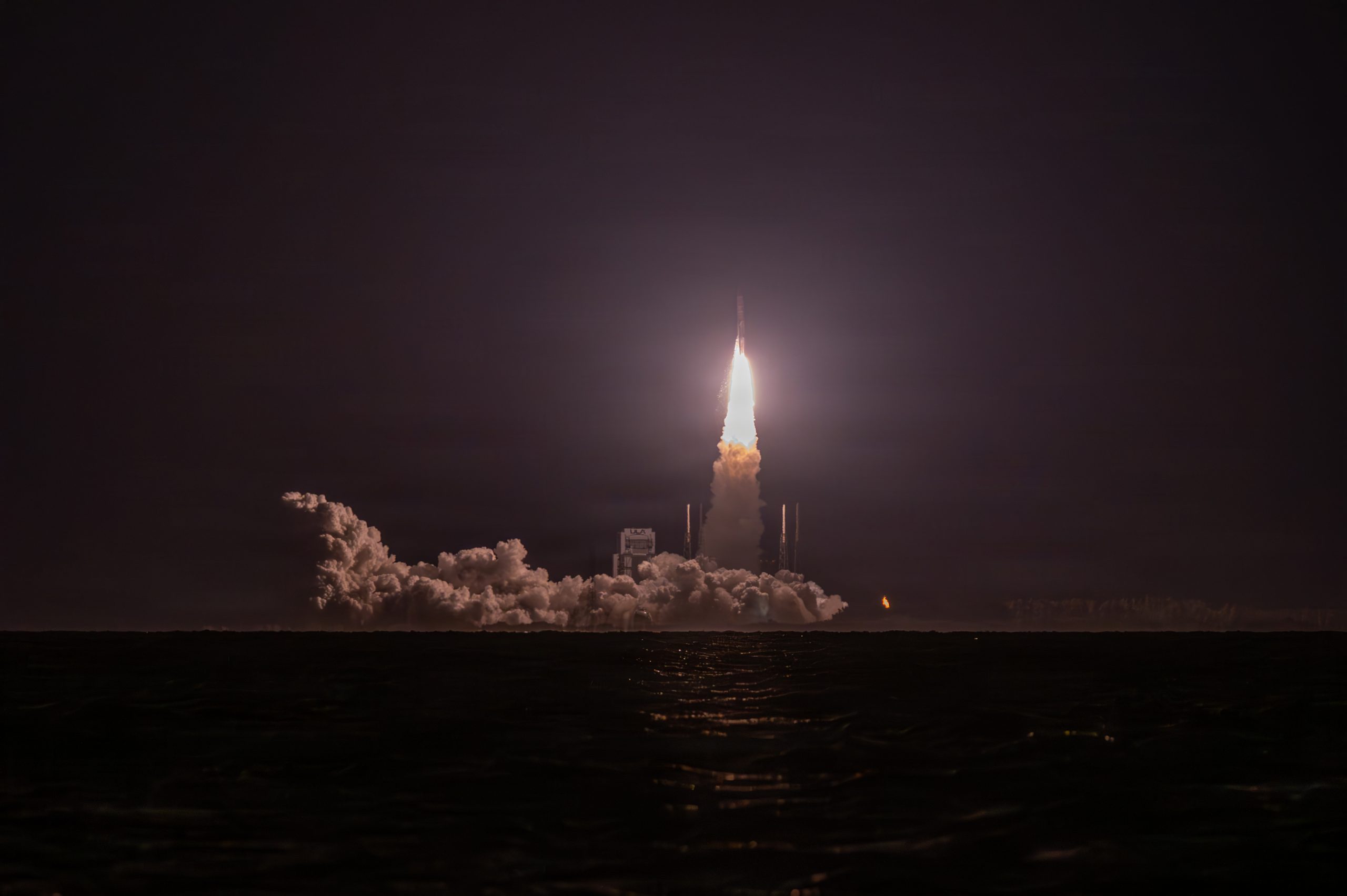
The Vulcan rocket, built by United Launch Alliance, undertook its second Space Force assignment on February 12th, transporting numerous Space Force cargo items into geosynchronous orbit subsequent to detecting an operational problem involving one of its solid propellant boosters during the initial phase of its journey.
Designated USSF-87, the endeavor launched from Florida’s Cape Canaveral Space Force Station a little past 4 o’clock in the morning, embarking on a ten-hour voyage conveying cargo for the Space Force’s Geosynchronous Space Situational Awareness Program in addition to an unrevealed trial and research operation.
Though the liftoff succeeded, subsequent to its departure, ULA verified it had noted a predicament concerning one of the craft’s four solid propellant engines. In a subsequent declaration, Gary Wentz, the firm’s Vice President overseeing Atlas and Vulcan Programs, described the occurrence as a “notable operational irregularity.”
“Notwithstanding the reported event, the Vulcan booster and Centaur operated as expected and transported the space vehicle straight to geosynchronous orbit,” the corporation stated. “The combined U.S. government and contractor group is scrutinizing the technical information, accessible visuals, and forming a salvage crew to gather any remnants. We intend to carry out an exhaustive inquiry, pinpoint the underlying reason, and enact any requisite remedial measures prior to the subsequent Vulcan undertaking.”
It remains uncertain at this moment how this recent irregularity could affect the firm’s forthcoming launch timetable. ULA has plans to deploy the tenth GPS III satellite for the Space Force in March, a Next-Generation Overhead Persistent Infrared satellite during May, as well as space vehicles for the Space Development Agency’s Tranche 1 Tracking Layer in June.
In a declaration, Space Systems Command indicated that its System Delta 80, responsible for supervising the launch sector, “shall collaborate intimately with ULA in accordance with our mission assurance space flight readiness protocol prior to the subsequent Vulcan national security space endeavor.”
ULA and SpaceX stand as the sole two launch service providers whose rockets are authorized to conduct the Defense Department’s most critical assignments, even though Blue Origin’s New Glenn, having completed its second flight last November, is advancing towards authorization. ULA had intended to dispatch ten Vulcan rockets in the previous year, yet eventually only deployed the craft a single time attributable to an inquiry concerning an irregularity in its second-stage booster.
It remains uncertain whether any connection exists between earlier difficulties with the Vulcan and the rocket’s February 12th malfunction.
Executives from the firm stated this week that the company is “intensely focused” on elevating its launch frequency and aims to execute as many as eighteen missions by 2026.
“We possess a stock of pre-fabricated rockets which will enable us to reach that pace throughout the current year,” interim CEO John Elbon informed journalists on February 10th, preceding the launch. “Our imperative is to conduct our launch operations at the Cape and Vandenberg, and such is highly attainable for us.”
Throughout that same press conference, Wentz mentioned that USSF-87 represented Vulcan’s most extended flight yet, and embodies the type of deployment the rocket was engineered to perform.
“This constitutes the sort of operation for which the team specifically conceived this launch craft,” he conveyed to reporters on February 10th, ahead of the launch. “It involves substantial cargo for highly intricate orbits, multi-manifested, national security space objectives, directly to GEO. This perfectly suits that assignment; it is the rationale for Vulcan’s establishment.”
The USSF-87 mission included an unrevealed quantity of payloads intended for the Space Force’s GSSAP program, a program frequently termed the service’s “neighborhood surveillance” constellation, monitoring operations within geosynchronous orbit. The Space Force had deployed its initial six GSSAP satellites in groupings of two and had suggested USSF-87 would replicate that arrangement, yet refrained from disclosing the precise number of satellites carried on this particular mission.
“Information gathered from the GSSAP shall singularly assist in prompt and precise orbital forecasts, thereby augmenting our comprehension of the GEO surroundings and additionally facilitating space flight security, encompassing satellite impact prevention,” Space Systems Command declared in an official statement.
Apart from GSSAP, the launch conveyed additional research, development, and instructional systems. As per SSC, Guardians shall utilize the space vehicle to “perfect strategies, methods, and protocols for accurate in-orbit movements” and that these would “strengthen and confirm resilience and safeguarding” within GEO. The command chose not to corroborate additional specifics regarding their undertaking.