
British Army EOD Specialists Conduct Urban Warfare Training at Catterick Garrison
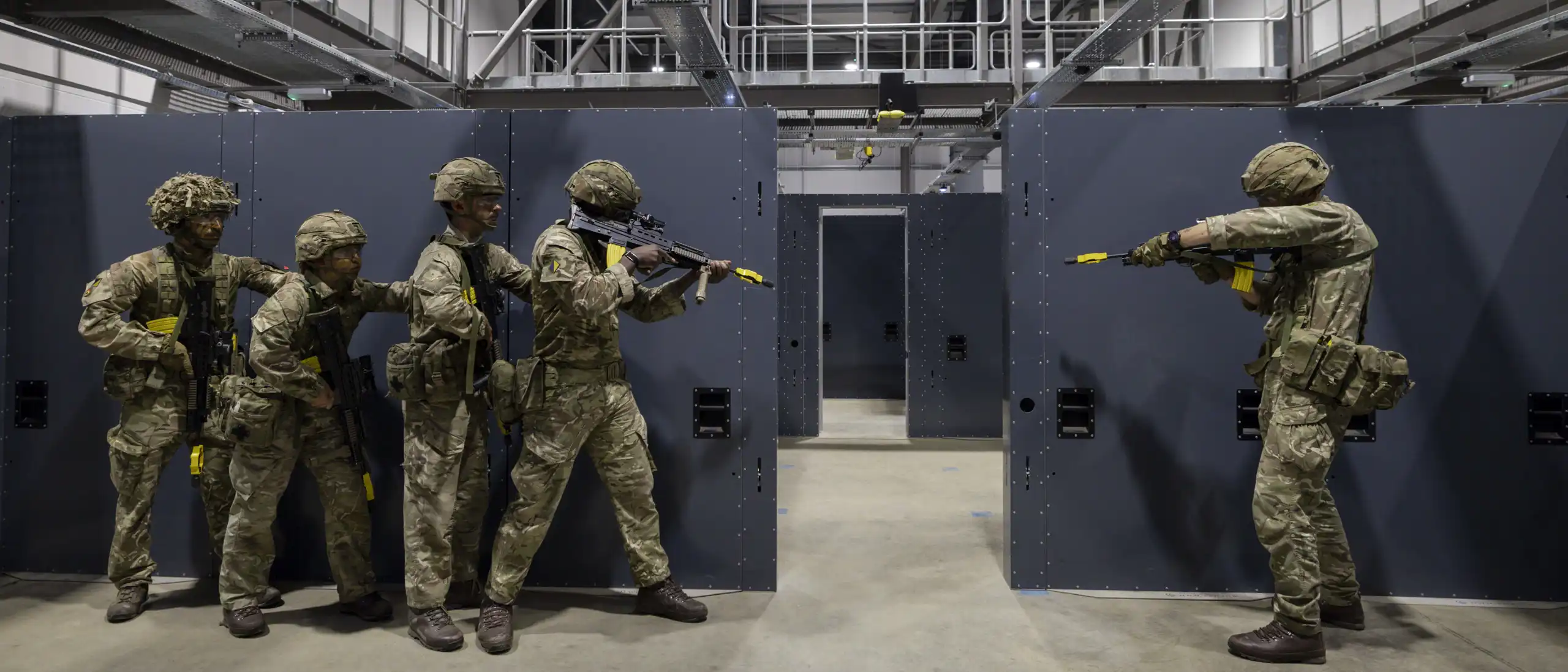
Personnel from the British Army’s specialist explosive ordnance disposal (EOD) units recently undertook intensive urban warfare training at Catterick Garrison. The exercise, conducted by 521 EOD Squadron, which is part of the 11 Explosive Ordnance Disposal and Search Regiment Royal Logistic Corps, focused on refining fundamental soldiering skills crucial for operations in built-up areas, while simultaneously maintaining their advanced bomb disposal and search proficiencies.
The training regimen incorporated a comprehensive series of activities designed to prepare troops for the complexities of modern urban combat. These included blank firing exercises, intricate building clearance procedures, and advanced platoon-level urban tactics. The primary objective was to ensure that all personnel are fully equipped and proficient for deployment in densely populated environments, which are increasingly common settings for military operations globally.
Structured as a Squadron-level Individual Training Requirement (ITR) exercise, the activity served as a vital platform to evaluate individual competence across diverse specialist roles. It also tested the seamless integration of various teams and refined critical command and control protocols under simulated operational pressure. The exercise brought together soldiers from different specialisms within the regiment, highlighting the multi-disciplinary nature of contemporary military operations.
Major Matthew Coleman, Officer Commanding 521 EOD Squadron, emphasized the foundational importance of the training. He was quoted stating, “Today is bringing us back to basics from our normal day job.” This statement underscores the principle that even highly specialized military units must consistently maintain core combat capabilities to operate effectively and safely in any operational theatre.
Major Coleman further elaborated on the collaborative and preparatory aspects of the exercise, adding, “Today is hugely important, the junior and senior members of the team are all working together and preparing themselves for what they would need to do in a real-life urban warfare situation.” This highlights the regiment’s commitment to developing all ranks, from new recruits to seasoned leaders, in readiness for a wide spectrum of potential real-world scenarios.
The 11 EOD and Search Regiment, while predominantly known for its crucial work in explosive ordnance disposal and specialist search operations, operates under the doctrine that its personnel must also retain the ability to function as conventional soldiers. This dual capability is considered indispensable, as their highly technical and often hazardous EOD tasks may frequently need to be executed concurrently with, or within the immediate vicinity of, conventional combat activity. This integrated approach ensures that specialists can protect themselves and their teams while performing their primary missions.
Comprising approximately 650 personnel, the regiment draws its expertise from various branches of the British Army. Its diverse workforce includes Royal Logistic Corps ammunition technicians, Royal Signals specialists who manage communications and electronic warfare, Royal Engineers dedicated search teams, and intelligence personnel. The Catterick exercise specifically challenged these varied elements to operate cohesively and effectively as a unified force under simulated time constraints, practicing the precise tactical procedures required for movement through, and the securing of, urban terrain. This inter-specialism cooperation is a hallmark of modern military effectiveness.
Lance Corporal James Tunstall, an Electronic Warfare and Signals Intelligence systems operator within the squadron, gained significant experience during the exercise, particularly in a new instructional capacity. He provided insight into the exercise’s direct impact on individual soldiers, stating, “Today is about training the troop in urban tactics, making sure we’re all fully trained and everyone has an awareness of what urban training is.”
Having recently qualified as an instructor, Tunstall reflected on the distinct challenges associated with teaching military drills compared to executing them personally. He observed, “Learning it is very different to teaching it… personally instructing is a lot more difficult.” The experience proved invaluable for his professional development, as he further explained, “Today has given me the knowledge that I need to learn the drills better in order to know how to instruct them better.” This demonstrates a commitment to continuous improvement not just in execution, but also in the methodologies of military instruction.
The training also deliberately placed personnel in situations that necessitated close collaboration with colleagues from across different specialisms, reinforcing the importance of integrated operations. Lance Corporal Tunstall affirmed the comprehensive benefits of this approach, stating, “It benefits the whole team to try and work together in close proximity, it’s definitely beneficial to the whole team and individually too.” This emphasis on interoperability is considered crucial for successful modern military operations, where complex tasks frequently demand the seamless integration of diverse technical and combat skills.
Exercises such as this one at Catterick Garrison, a significant training area for the British Army, are fundamental to cultivating and sustaining a versatile, adaptable, and resilient military force. They ensure that highly specialized units, while experts in their particular domains, maintain proficiency in the core soldiering skills essential for operating safely and effectively in any operational theatre, particularly the increasingly prevalent urban landscape. This holistic approach to training rigorously prepares personnel for the unpredictable and multi-faceted nature of contemporary conflicts, ensuring the British Army remains ready to meet future challenges.
Why This Matters
The urban warfare training undertaken by the British Army’s EOD specialists is significant for several reasons, reflecting the evolving nature of global security and military operations.
- Adaptability in Modern Warfare:Urban environments, characterized by dense populations and complex infrastructure, are increasingly common settings for military engagements. For EOD specialists, whose primary role involves neutralizing explosive threats, possessing robust urban combat skills ensures they can operate effectively and secure their own positions within these challenging landscapes, rather than relying solely on conventional infantry for protection. This adaptability is crucial for mission success in diverse operational contexts, from counter-terrorism to stability operations.
- Enhanced Force Protection:EOD operations are inherently dangerous and often conducted in high-threat environments. Proficiency in basic combat skills, such as building clearance, tactical movement, and defensive postures, directly contributes to the safety and survivability of EOD teams. This training provides essential force protection, enabling specialists to mitigate risks and perform their vital tasks more effectively under hostile conditions.
- Interoperability and Combined Arms Integration:Modern military conflicts rarely involve single-specialty units operating in isolation. This exercise underscores the critical importance of interoperability, bringing together diverse capabilities—EOD, signals intelligence, engineering, and general infantry tactics—into a cohesive fighting force. Seamless cooperation between different specialisms reduces operational friction, enhances situational awareness, and ultimately improves overall mission effectiveness, reflecting a ‘whole force’ approach to military challenges.
- Readiness for Diverse Threats:The global security landscape is characterized by a wide spectrum of threats, from state-sponsored aggression to non-state actors employing asymmetric tactics. Training that blends highly specialized EOD skills with general soldiering ensures the British Army maintains a versatile response capability, capable of addressing both conventional and unconventional adversaries. This comprehensive readiness is vital for the UK’s national defence and its contributions to international security alliances.
- Maintaining Core Competencies:Even elite specialists can experience a decline in proficiency in fundamental military skills without regular practice. The ‘back to basics’ approach highlighted in this training ensures that essential combat capabilities are consistently maintained and refreshed across all ranks and roles within the regiment. This prevents skill fade and ensures a consistently high standard of operational readiness throughout the force.
- Strategic Deterrence and Response Capability:A well-trained, adaptable, and resilient military force enhances a nation’s ability to deter potential adversaries and respond decisively to crises anywhere in the world. Exercises like this contribute directly to strengthening the UK’s defence posture, demonstrating its commitment to maintaining a capable armed forces ready to protect national interests and support international stability.
- Professional Development of Personnel:Beyond immediate operational readiness, such training significantly contributes to the professional development of individual soldiers. It fosters leadership skills, as demonstrated by Lance Corporal Tunstall transitioning into an instructor role, reinforces teamwork, and deepens understanding of military doctrine and tactics. This investment in human capital results in a more skilled, confident, and resilient fighting force.