
Recent events in the South China Sea have highlighted long-standing territorial disputes between China and the Philippines, culminating in a significant clash at the Second Thomas Shoal. This incident, described by officials as the most severe in years, underscores the escalating tensions in a region vital to global trade and security.
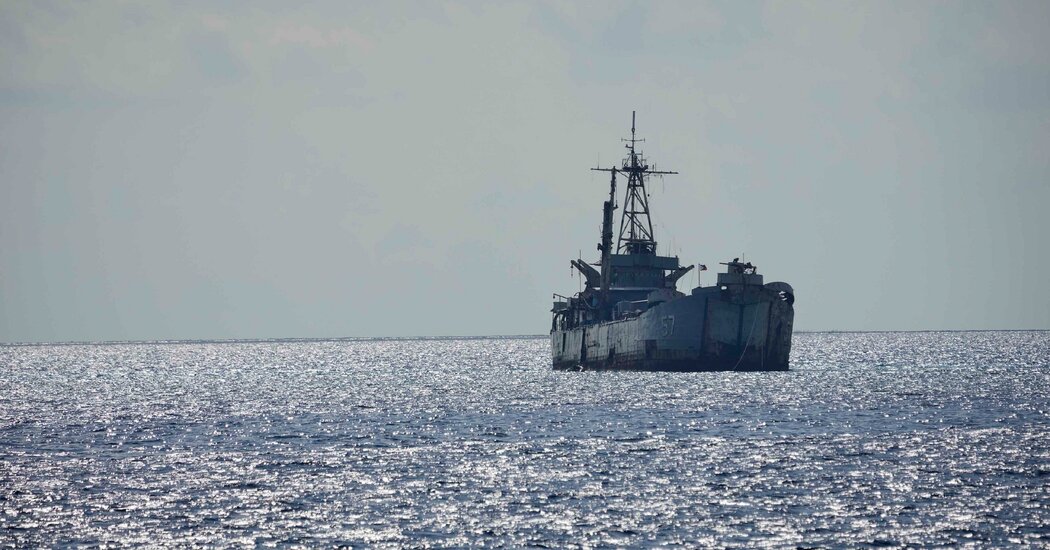
The Second Thomas Shoal, a submerged reef located within the Philippines’ exclusive economic zone, has been a point of contention for decades. The Philippines asserts its control over the territory through the continuous presence of a small contingent of Marines stationed aboard the BRP Sierra Madre, a World War II-era naval vessel intentionally grounded on the shoal in 1999. This act serves as a physical manifestation of Manila’s sovereign claim. An international arbitral tribunal ruling in 2016 largely affirmed the Philippines’ claims, rejecting China’s expansive assertions over much of the South China Sea. However, Beijing has consistently rejected this ruling.
Last month, a Chinese Coast Guard vessel was observed circling the BRP Sierra Madre, initiating what Philippine and U.S. officials describe as a series of aggressive maneuvers. The incident escalated when Chinese Coast Guard personnel reportedly used small boats to intercept Filipino service members attempting to resupply the outpost. During this confrontation, one Filipino service member allegedly sustained head injuries after being struck with a wooden baton. Chinese authorities, however, presented a contrasting account, asserting that the Philippines provoked the clash through their actions.
In response to the incident, the American ambassador expressed strong condemnation and reaffirmed the United States’ unwavering support for the Philippines, its oldest treaty ally in Southeast Asia. This diplomatic backing, however, has been met with growing skepticism among some Asian nations regarding the long-term commitment and capabilities of the United States to effectively deter China’s assertive activities in the region.
Observers in Asia point to several factors contributing to these doubts. Foremost among them is the perceived strain on U.S. military resources and attention due to escalating tensions in the Middle East, particularly those involving Iran and its proxies, which have drawn significant U.S. military assets. Concerns have also been raised about the United States’ inventory of critical weapons, including air defense interceptors, following the expenditure of munitions in various global operations. Reports of Iranian missile and drone attacks forcing U.S. troops to relocate or damaging bases in the Middle East have been interpreted by some as an indicator of the potential challenges the more powerful Chinese military could pose in a future conflict in Asia.
Meanwhile, China continues to demonstrate its growing military might. In early July, China conducted a rare test firing of a nuclear-capable intercontinental ballistic missile (ICBM) from a nuclear-powered submarine. The missile, carrying a dummy warhead, was launched into the Pacific Ocean, showcasing one of the most powerful elements in China’s expanding arsenal and signaling its strategic reach.
Amidst these demonstrations of Chinese strength, reports emerged from congressional officials briefed on the decision that the Trump administration’s State Department was in the process of closing consulates in Japan and Indonesia. This move drew criticism from U.S. lawmakers. Representative Gregory W. Meeks of New York, then the top Democrat on the House Foreign Affairs Committee, stated that the administration’s approach “has been a colossal failure for U.S. interests in the Asia region.” He added, “This strategy, if you can call it one, is a gift to China that is undermining U.S. credibility and harming our national security.”
Officials within the Trump administration, however, countered claims of ceding ground in Asia. Elbridge Colby, then the under secretary of defense for policy, delivered a speech in Manila on August 10, outlining the administration’s aim to “maintain a posture of deterrence by denial along the first island chain.” This strategy, he explained, involved committing military resources to dissuade China from invading or attacking key islands, including Taiwan, and those belonging to the Philippines and Japan. Colby also emphasized that allies needed to increase their defense spending and integrate their militaries more closely with that of the United States, urging them “not vainly and futilely seek to exclude or supplant us.”
Beyond military and diplomatic considerations, the Trump administration’s global trade policies, which included tariffs targeting Southeast Asian nations, also created a perception among allies and partners that the United States could be a commercial adversary. For years, the U.S. government had been perceived as lacking a coherent economic vision for Southeast Asia, particularly after both Democratic and Republican politicians retreated from the Trans-Pacific Partnership (TPP), a comprehensive Pacific Rim trade pact championed by the Obama administration. This perceived economic disengagement has led countries in Southeast Asia to question the United States’ commitment to maintaining a robust presence that could effectively balance against China’s growing economic influence.
Mira Rapp-Hooper, who served on the National Security Council during the Biden administration and is now a visiting fellow at the Brookings Institution, highlighted this regional sentiment. She noted that while Southeast Asian countries generally prefer to avoid being entangled in a direct great-power confrontation between the United States and China, “they still want to feel the United States is a healthy counterweight to the P.R.C.,” using the initials for the People’s Republic of China.
Rapp-Hooper further elaborated that “the perception that the United States is drifting as an alternative has also left a real impression on many of these partners.” This impression was exacerbated by former President Trump’s evolving approach to China. While he often publicly characterized China as an economic rival, he also expressed admiration for Chinese President Xi Jinping during a summit in Beijing in May and later prepared to host President Xi for a state visit in Washington in late September. This shift towards fostering what Trump termed a “G2” – or Group of Two – relationship with China contrasted sharply with a growing bipartisan consensus in Washington over the preceding decade that advocated for a more confrontational stance towards China as a strategic rival. As the perceived bonhomie between Trump and Xi developed, some Asian countries reported feeling overlooked, leading them to increasingly align with China.
This inclination is particularly strong given China’s status as the largest trading partner for many of these nations, coupled with the absence of compelling economic alternatives from the United States. Richard Heydarian, a political scientist from the Philippines, articulated the difficult position faced by his country: “We’re in a very difficult position because you know we want to have that maximal relationship with both sides. And then for countries like the Philippines, it’s even more impossible because the U.S. is a military ally. We need the U.S. when it comes to the China threat, but the U.S. is not giving us much love on anything beyond the military aspect.”
Despite these concerns, recent U.S. administrations have attempted to bolster economic engagement. The Biden administration, for instance, agreed to collaborate with the Philippines on expanding the Luzon Economic Corridor, an initiative aimed at better integrating the country into global supply chains.
Similarly, the Trump administration sought to include the Philippines in its “Pax Silica” initiative, a concept designed to integrate the country into semiconductor manufacturing and artificial intelligence development in a manner beneficial to U.S. interests.
Why This Matters
The recent clash at Second Thomas Shoal is more than an isolated incident; it represents a significant flashpoint in the broader contest for influence and control in the South China Sea. This body of water is a critical global artery, through which an estimated one-third of global shipping passes annually, making it indispensable for international trade and economic stability. Ongoing disputes and escalating confrontations directly threaten freedom of navigation and overflight, vital principles of international law.
For the Philippines, the preservation of its claims in the South China Sea is a matter of national sovereignty and economic security, particularly concerning fishing rights and potential resource exploitation. The assertive actions by China, despite an international tribunal ruling, challenge the rules-based international order and set a precedent for how powerful nations interact with smaller neighbors. The risk of miscalculation or accidental escalation in such encounters remains high, potentially drawing in external powers and triggering wider regional instability.
The perceived wavering of U.S. commitment in the Indo-Pacific, whether due to resource constraints from other global conflicts, shifting political priorities, or a lack of comprehensive economic engagement, has profound implications. It forces Southeast Asian nations to re-evaluate their alliances and strategic alignments. If the United States is seen as an unreliable security guarantor or an inconsistent economic partner, countries like the Philippines may find themselves compelled to accommodate China’s growing influence, potentially altering the regional balance of power. This shift could have long-term consequences for democratic values, human rights, and the geopolitical landscape of one of the world’s most dynamic regions.
Ultimately, the events in the South China Sea highlight the complex interplay of military might, economic leverage, and diplomatic maneuvering. The outcome of these disputes will not only determine the future of international law and maritime freedom in Asia but also significantly shape the trajectory of U.S.-China relations and the global order for decades to come.
The United States and the Philippines are significantly enhancing their military cooperation amidst escalating regional tensions, particularly concerning China’s assertive actions in the South China Sea and the Taiwan Strait. This deepening partnership builds upon a long-standing historical alliance, with both nations emphasizing mutual defense and regional stability as cornerstones of their strategic engagement.
The relationship between the United States and the Philippines dates back to the late 19th century when the U.S. gained control of the archipelago from Spain following the Spanish-American War, establishing its first significant colonial foothold in Asia. This historical bond evolved into a robust security alliance, formally solidified by the 1951 Mutual Defense Treaty (MDT). This treaty legally obligates both countries to come to each other’s defense in the event of an armed attack, making the Philippines the only Southeast Asian nation with such a formal alliance with the United States. While the ties have experienced periods of adjustment, including the closure of major U.S. military bases in the early 1990s, recent geopolitical shifts in the Indo-Pacific have reinvigorated the alliance’s importance and scope.
In recent years, China’s expansive territorial claims and increasing military presence in the South China Sea have become a primary catalyst for renewed strategic cooperation. Actions such as the construction of artificial islands, militarization of disputed features, and persistent harassment of Philippine vessels and fishermen in waters claimed by Manila have prompted a strategic re-evaluation in both Washington and Manila, underscoring the renewed urgency for stronger security collaboration.
During a recent annual forum of Southeast Asian nations in Manila, Secretary of State Marco Rubio reiterated the U.S. commitment to countering China’s expansionist efforts. “We’re never going to accept that international waterways are somehow under the control of other countries,” Rubio stated. “We’ll continue to sail through international waterways and freedom of navigation efforts of that kind, and we’ll continue to live up to our commitments — for example, with the Philippines and other countries — in terms of the treaty commitments that we have.” This declaration underscored the U.S. resolve to uphold international law, ensure freedom of navigation, and support its allies in the face of regional challenges.
Under the Biden administration, the U.S. government adopted a proactive approach to strengthening alliances and forging new partnerships across Asia. A key development was the expansion of the Enhanced Defense Cooperation Agreement (EDCA) with the Philippines, granting American troops expanded access to nine strategic military bases. These sites, located on islands near the South China Sea and the Taiwan Strait, are crucial for enhancing joint training, pre-positioning equipment, and improving rapid response capabilities in the event of regional contingencies. The strategic positioning of these bases significantly bolsters the U.S. and Philippine ability to monitor and respond to developments in the disputed waters and around Taiwan, serving as a critical component of deterrence.
Further illustrating this commitment, Vice President Kamala Harris traveled to the island of Palawan in November 2022. Her visit to a Philippine Coast Guard site on the island, which directly faces the South China Sea, was widely interpreted as a clear signal of U.S. support for Philippine sovereignty and a deterrent message to China regarding its aggressive actions in the disputed maritime zones. Such high-level engagements underscore the strategic importance placed on the alliance.
Military cooperation has continued to intensify through various joint exercises and equipment deployments. In May, the U.S. and Philippine militaries conducted a significant test of a Typhon missile launcher at one of the newly accessible EDCA sites. This public demonstration involved a medium-range, land-based missile system, showcasing capabilities that could be deployed to deter or respond to potential aggression, particularly in a hypothetical scenario involving a cross-strait invasion of Taiwan. This test highlighted the growing interoperability and advanced defensive posture of the allied forces, sending a clear message about their combined readiness.
The Philippines, while deepening its alliance with the United States, is also actively diversifying its security partnerships. In a historic move in June, the Philippines invited Japan to participate in multinational military exercises, marking the first time since World War II that Japanese troops had been active on Philippine soil. This initiative is a continuation of broader security coalition-building efforts seen under the Biden administration, which aimed to bring key regional partners like Japan into closer security alignment with the Philippines. For Manila, broadening its partnerships beyond the United States represents a strategic hedge, allowing it to enhance its defense capabilities and diplomatic leverage by engaging with multiple regional powers that share similar security interests, such as Australia, South Korea, and European allies.
This concerted effort to bolster military ties and forge new alliances reflects a calculated strategy by both the United States and the Philippines to strengthen collective security in the Indo-Pacific, deter potential adversaries, and uphold the rules-based international order in a rapidly evolving geopolitical landscape.
Why This Matters
The increased military cooperation between the U.S. and the Philippines, alongside Manila’s efforts to diversify its alliances, carries profound implications for regional and global security. Firstly, it directly impacts the geopolitical balance of power in the Indo-Pacific. By strengthening its alliances, the U.S. aims to counter China’s burgeoning military influence and assertive territorial claims in the South China Sea, a critical waterway for global trade. The enhanced access to Philippine bases and the potential deployment of advanced weapon systems like the Typhon missile launcher serve as significant deterrents against potential military aggression, particularly in scenarios involving the Taiwan Strait.
Secondly, this collaboration reinforces the credibility of U.S. alliance commitments. In an era of heightened global uncertainty, demonstrating unwavering support for treaty allies like the Philippines signals U.S. resolve to maintain the rules-based international order and stand by its partners. This is crucial for reassuring other allies in the region, such as Japan, South Korea, and Australia, that the U.S. remains a reliable security guarantor and that its security pledges are robust and actionable. Such demonstrations can stabilize regional expectations and reduce miscalculation.
Thirdly, for the Philippines, these partnerships are vital for bolstering its sovereign defense capabilities and protecting its maritime interests. Facing persistent challenges from China in its exclusive economic zone, the Philippines benefits significantly from advanced military training, equipment, and intelligence sharing that enable it to better defend its territory and resources. The diversification of alliances, bringing in countries like Japan, also provides Manila with multiple layers of security and diplomatic support, reducing over-reliance on a single power and enhancing its strategic autonomy in regional affairs.
Finally, the unfolding dynamics have broader economic consequences. Stability and freedom of navigation in the South China Sea are paramount for global shipping and trade, as a significant portion of the world’s commerce passes through these waters. Any escalation of tensions or disruption of navigation could have severe repercussions for international supply chains and economies worldwide, affecting energy, food, and goods transport. This evolving security architecture in the Indo-Pacific, therefore, is not merely a military concern but a critical factor shaping global prosperity and the future of international relations, particularly in maintaining a predictable and rules-based environment for global commerce.
Eric Schmitt contributed reporting from Washington.