
The fantasy basketball postseason is rapidly approaching, and circumstance holds greater weight than inherent skill. Annually, team leaders face disappointment by prioritizing star power over current circumstances. Teams intentionally losing often shift their focus to younger players, while championship hopefuls carefully regulate player exertion, leading to the unexpected unavailability of a season-long key performer precisely when their contribution is most crucial.
During this phase, the frequency of games, team’s drive, and player resilience take precedence over established renown. A greater number of contests translates to increased opportunities to amass statistical totals, and squads vying for playoff positions are considerably more inclined to rely significantly on their principal athletes compared to those merely finishing their season.
The difficulty of upcoming fixtures introduces an additional factor. Easier adversaries often facilitate a quicker game tempo and enhanced effectiveness, generating inconspicuous yet significant statistical benefits across a three-week contest. Such advantages rapidly multiply, particularly in direct competition setups. The immediate objective is not to assemble the most glamorous lineup, but rather the most dependable. Emphasize athletes with assured positions, driven squads, and a low likelihood of being rested. Presence and participation are keys to championship success.
With player rotations becoming more concentrated and team incentives evolving throughout the league, the following athletes and patterns merit attention going ahead.
GG Jackson’s progression near the basket is driving a significant late-season fantasy uptick
Jackson has transformed into an effective scorer for the Memphis Grizzlies, leveraging his physical stature and agility to score close to the basket rather than opting for outside attempts. This alteration is evident in his shooting patterns, demonstrating higher two-point shot frequency and enhanced effectiveness in the restricted area, indicating improved physical power, more judicious shot choices, and a more deliberate drive towards the hoop.
Consequently, he has experienced a standout period, registering an average of 18.8 points per game across his previous seven matches. Observing his gameplay, his progress is evident: he’s driving aggressively, completing plays despite physical contention, and converting possessions in the lane into prime scoring chances, instead of opting for challenged jump shots.
This progression has directly enhanced his fantasy utility. Across his recent 10 appearances, Jackson has accumulated an average of 32.1 fantasy points in 25.9 minutes per outing. Furthermore, his increased participation does not seem to be merely a fleeting boost. Given that the Grizzlies currently rank 11th in the Western Conference (and remain contention-minded), there are no pressing worries about him being sidelined to restrict his playing time. Jackson has evolved from an inconsistent scorer to a dependable contributor across multiple statistical categories, and with a mere 23.1% rostered rate in ESPN leagues, fantasy strategists looking for late-season potential ought to be monitoring him keenly.
The reason Moussa Diabate is an essential acquisition as the Hornets experience a rise in performance
Diabate has reaffirmed his suitability as the primary center for the Hornets. Following his comeback from a four-game ban, he has recorded a minimum of 34 fantasy points in three consecutive games. His output is particularly compelling due to its broad utility — Diabate represents one of the few big men who contributes in almost every statistical metric. Even with such a comprehensive skill set, he is owned in only 36.6% of ESPN leagues.
Charlotte’s recent improved performance further supports his claim. Across their previous 20 matches, the Hornets have demonstrated enhancements on both offense and defense, accumulating victories, and their initial quintet of LaMelo Ball, Kon Knueppel, Brandon Miller, Miles Bridges, and Diabate has proven formidable. This unit approaches Tuesday’s schedule boasting an 18-2 win-loss record (from a minimum of 15 games), marking the finest performance of any five-player combination this season. When playing together, they have surpassed opponents by a cumulative 179 points, equating to a +6.2 point differential per game, which also positions them at the top of the league among eligible lineups.
Perhaps it’s time to part ways with Nikola Vucevic and Coby White
Vucevic’s transfer to the Boston Celtics and White’s relocation to the Charlotte Hornets seemed promising superficially at the trade deadline. However, concerning fantasy implications, both players have experienced a notable decrease in their output. With the Chicago Bulls, Vucevic posted averages of 16.9 points and 9.0 rebounds per game over 30.8 minutes across 48 contests. Subsequent to his move to Boston, these statistics have fallen to 11.8 points and 8.2 rebounds per game in 24.1 minutes. Neemias Queta has absorbed playing time, and as Jayson Tatum nears his comeback, Vucevic’s prospects for the remainder of the season seem progressively precarious. Even though he is included in 97.3% of ESPN league rosters, he is no longer an unequivocal essential retention, presenting team owners with a challenging choice.
White is in an analogous predicament in Charlotte. While starting for Chicago, he recorded averages of 18.6 points, 3.7 rebounds, and 4.7 assists per game in 29.1 minutes. Upon joining the Hornets, he has transitioned into a reserve player capacity, and considering the strong performance of the current starting lineup, it is improbable that the coaching staff will disturb their cohesion. His statistics per game across these vital metrics have decreased following his transfer. White is not an indispensable retention at this point, and team owners seeking different choices can consult Andre Snellings’ most recent waiver wire article for prospective substitutes before the fantasy postseason.
How Jonathan Kuminga might become a pivotal late-season fantasy asset
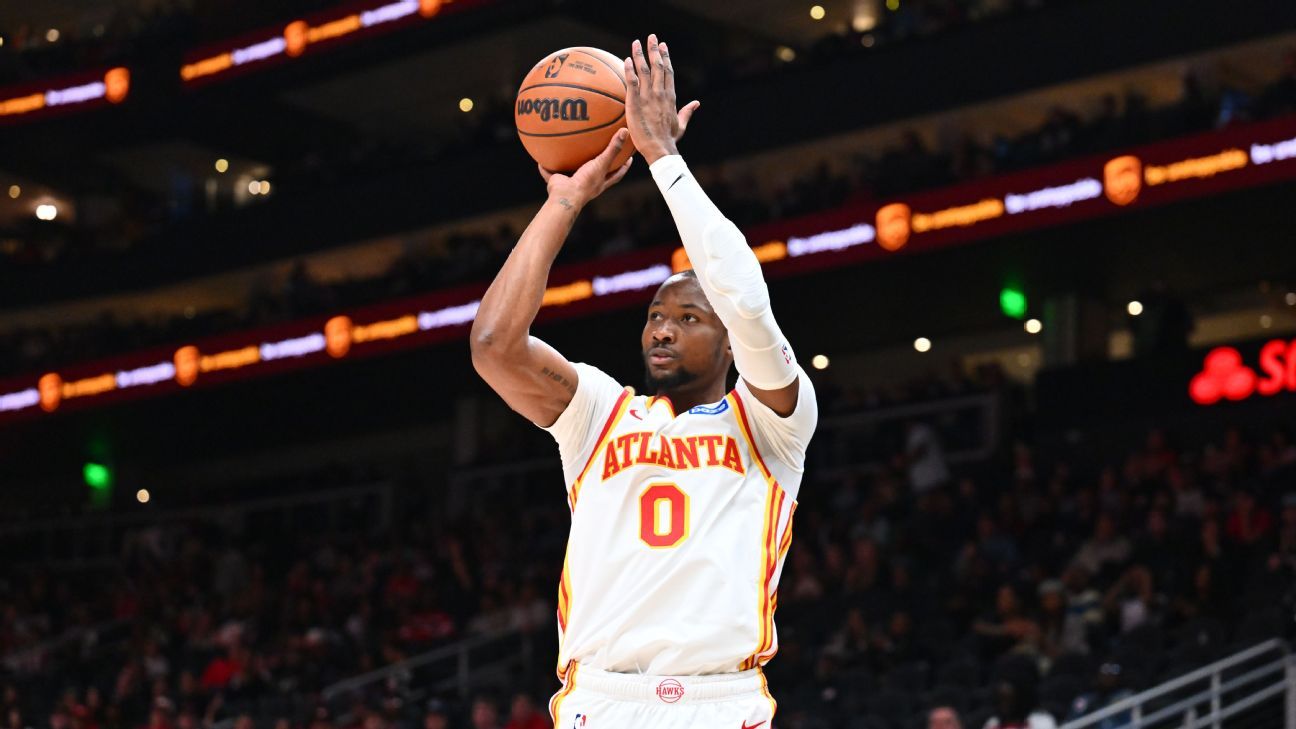
Kuminga has generated an instant effect since his relocation to Atlanta, providing the Hawks with a boost of offensive prowess and adaptable skills upon his joining. Over his initial three contests, he has put up averages of 21.3 points and 7.7 rebounds per game in 26.7 minutes, aggressively driving to the basket without pause and achieving a personal high frequency of free throw attempts.
Under Quin Snyder’s guidance, Kuminga has been authorized to operate aggressively towards the basket in open areas, and the outcomes have surpassed mere point accumulation. He is exhibiting enhanced rebounding numbers, heightened defensive participation, and superior ball distribution, achieving a personal best average of 3.3 assists while performing with markedly amplified self-assurance.
This new beginning seems to have unveiled a more comprehensive iteration of Kuminga’s skill set. As Atlanta capitalizes on fast-break chances and one-on-one advantages, Kuminga’s physical prowess is directly yielding output for a Hawks squad positioned third in game tempo. For fantasy strategists, this broadened involvement is crucial. Kuminga’s point totals, boards, foul shot frequency, and defensive efforts afford him multi-category potential. Should his playing time stay consistent, Kuminga embodies the characteristics of a late-season game-changer. He remains obtainable in 43% of ESPN leagues.
A pair of broadly accessible players who might influence your fantasy postseason
With the regular season nearing its conclusion, the fantasy postseason is imminent. Clubs with unfavorable standings frequently redirect their attention to upcoming seasons and are less inclined to hastily reintroduce sidelined athletes to play. Among these teams are the Utah Jazz and Sacramento Kings, both possessing players who are broadly obtainable and merit consideration.
Within Utah, Ace Bailey distinguishes himself. Lauri Markkanen is scheduled for a re-assessment in two weeks concerning a hip ailment, thereby generating extra chances for Bailey, who was already integrated into the playing rotation. Across his recent 11 outings, Bailey has posted an average of 28.6 fantasy points in 33.1 minutes per game, concurrently contributing in various statistical areas. Given the minimal motivation for the Jazz to hasten Markkanen’s comeback, Bailey is expected to maintain substantial playing time. He is owned in only 33.3% of ESPN leagues.
Sacramento’s forward and center positions have been severely impacted by various ailments, chiefly Keegan Murray, who is out due to an ankle problem—the identical ankle that kept him off the court for 20 successive games earlier in this campaign. This circumstance creates an opportunity for Precious Achiuwa to assume a more prominent position. Across his previous six matches, he has averaged 38.8 fantasy points, while providing contributions in scoring, retrieving boards, pilfering the ball, and blocking shots. Achiuwa is on rosters in merely 23.8% of leagues.