
INDIANAPOLIS — The 2026 iteration of the men’s Final Four competition will showcase several of the most formidable squads from the current season.
Arizona maintained the top position in the AP poll for nine consecutive weeks, commencing the season with an unprecedented 23-0 run. The Wildcats are scheduled to compete against Michigan, the squad that supplanted them from the No. 1 spot. Michigan is currently averaging 95.3 points per game throughout the NCAA tournament, a higher figure than any team reaching the semifinals since Kentucky achieved 97.0 in 1993.
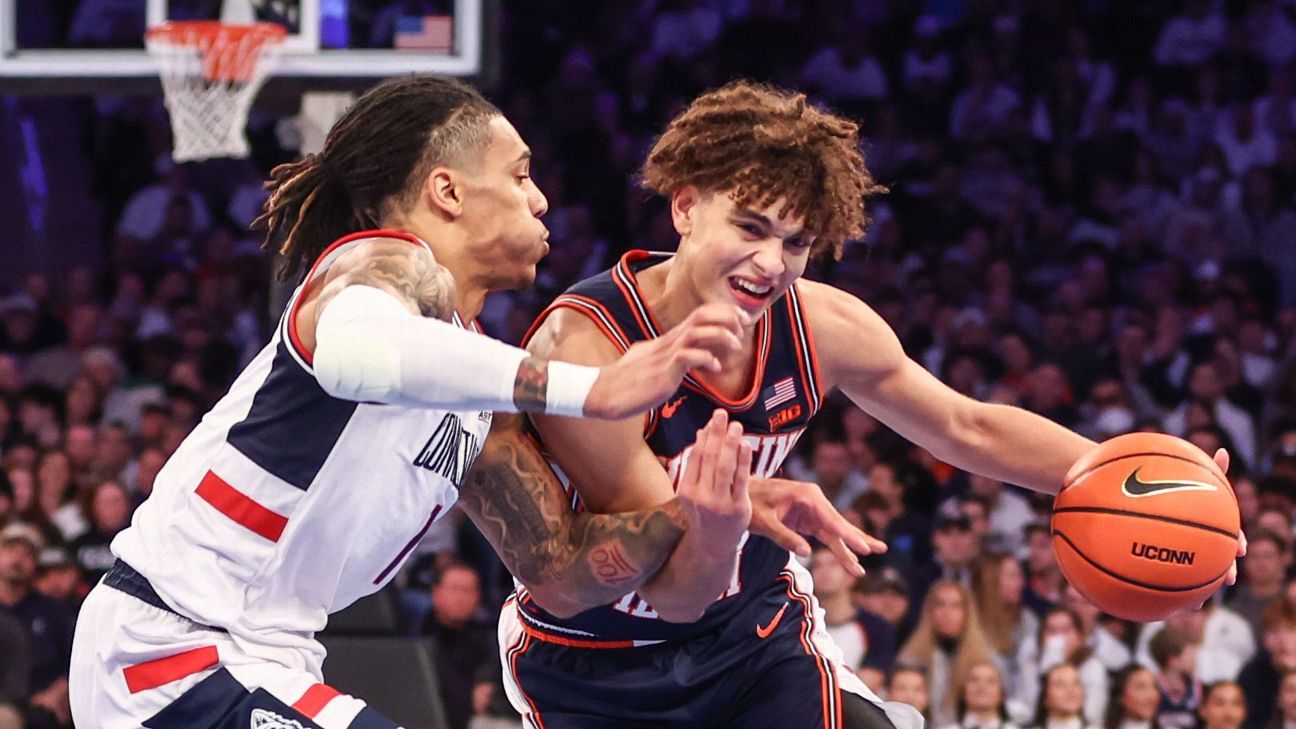
These two teams, alongside Illinois, have advanced to the Final Four by securing victories in every NCAA tournament contest by double-digit margins. This marks the first occasion since 1973 that three teams have accomplished such a feat, according to ESPN Research. The Fighting Illini will commence Saturday’s events by facing UConn, a team vying for its third national title within four seasons. The Huskies have prevailed in their most recent two encounters with the Illini: during the Elite Eight of their 2024 championship campaign and in a nonconference match held at Madison Square Garden in November.
Which teams will progress to Monday’s national championship game? ESPN college basketball reporters Jeff Borzello and Myron Medcalf meticulously analyze the factors — and specific player performances — that could determine the outcomes of both matchups.
Who stands out as the most crucial player on the court this Saturday?
Borzello:Tarris Reed Jr.
UConn has been fundamentally altered by Reed’s emergence as a contemporary Wilt Chamberlain during the NCAA tournament. He has been the preeminent player in the competition over the past fortnight, with his stellar play bracketed by a 31-point, 27-rebound showing against Furman in the initial round and his superior performance over AP Player of the Year Cameron Boozer in the Elite Eight against Duke. Reed’s tournament averages currently stand at 21.8 points, 13.5 rebounds, 3.0 assists, and 2.3 blocks, all while maintaining a 60% shooting accuracy from the floor.
Reed will be tasked with dominating the paint, both offensively and defensively, when facing Illinois. The Fighting Illini intend to curb his interior scoring with 7-foot-1 Tomislav Ivisic and 7-2 Zvonimir Ivisic — the capability of both players to stretch the court and sink 3-pointers might compel Reed to move away from the basket defensively. In the initial encounter between these teams, he participated for only 15 minutes due to an ankle injury, failing to score (0-for-3 from the field) and accumulating four fouls.
UConn cannot afford a repetition of that scenario.
Medcalf:Koa Peat
Standing at 6-8 and weighing 235 pounds, Arizona requires the freshman’s blend of stature, aptitude, and expertise to overcome Michigan. The encouraging news for the Wildcats is that Peat is delivering some of his finest displays as the season concludes, with averages of 14.8 points and a 53% success rate on shots within the arc across his last 10 contests. This game pits two outstanding teams against each other, collectively featuring six athletes projected as first-round NBA draft selections.
Peat will need to serve as a defensive lynchpin against one of college basketball’s most imposing frontcourtsandgenerate the necessary interior scoring for the Wildcats to match an opponent renowned for its prolific paint production.
It is arduous to envision Michigan securing a victory if All-American Yaxel Lendeborg does not perform exceptionally well. A similar argument could be made for Arizona regarding Peat, who amassed a mere eight points across the team’s two defeats.
What pivotal aspects will shape the outcome of UConn-Illinois?
Borzello:Success from beyond the arc.
Illinois has consistently been among the nation’s most enthusiastic 3-point shooting teams throughout the season, though the Illini grew less reliant on perimeter attempts as the final games approached. They nevertheless remain within the national top 15 for 3-pointers made per game and 3-point attempt frequency. However, after achieving double-digit 3-pointers in 18 of their preceding 22 games, they have managed this only once since March 3 — notably going 3-for-17 from long range against Iowa in the Elite Eight.
For UConn, the emphasis is less on shot volume and more on shot conversion. In theory, Solo Ball, Braylon Mullins, and Alex Karaban form as formidable a shooting trio as can be found in college basketball. Yet, in recent actuality, Ball has converted merely 14.3% of his 3-point attempts over his last six games, Mullins stands at 18.5% from 3 in his past eight contests, and Karaban managed only 1-for-6 from downtown against Duke.
UConn is not obligated to outshoot Illinois given their anticipated interior advantage, but consistent shot-making provides a significant boost to UConn’s offensive efficiency.
Medcalf:Illinois’ capability to restrain Reed.
Mullins sank the decisive 3-pointer against Duke, and UConn’s second-half defensive intensity and offensive execution fueled their comeback, but the Huskies’ triumph would not have been conceivable without Reed’s substantial contributions: 26 points, nine rebounds, and four blocks.
Illinois possesses an imposing presence around the basket that few teams can rival. Nevertheless, if Reed performs with the same dominance he has displayed throughout the NCAA tournament, it will generate increased opportunities for Mullins, Karaban, and their backcourt teammates to influence the game offensively — but the Huskies also require Reed to be a defensive linchpin in the paint. Opposing players have converted a mere 25% of their attempts near the rim when defended by Reed during the NCAA tournament.
What will be the defining elements of Arizona-Michigan?
Borzello:Scoring within the lane.
As collegiate basketball increasingly gravitates towards larger formations and interior dominance, Arizona and Michigan are leading this movement. Both squads possess substantial size, exhibit physical play, and aim to assert themselves offensively through sheer forcefulness. Arizona ranks fifth nationally in points scored in the paint per game, second in 2-point attempts per game, third in free throw attempts per game, and is within the top 10 for offensive rebound percentage. Michigan holds the second position in 2-point field goal percentage, third in 2-point percentage defense, and is among the top 20 for both paint points per game and second-chance points per game.
In their Sweet 16 matchup against Arkansas, Arizona amassed 60 points in the paint and 30 from the free throw line. Subsequently, the Wildcats outscored Purdue by a combined 28 points in these specific areas during the Elite Eight. Conversely, Michigan showcased an exemplary transition offense against Tennessee, a feat not typically expected from a team of the Wolverines’ stature.
Can either team firmly establish control around the basket? That will prove to be the critical factor.
Medcalf:Perimeter pressure.
The efficacy of both teams’ interior offensive strategies will hinge on what transpires on the perimeter.
Jaden Bradley and Brayden Burries are most effective when they drive towards the basket, drawing additional defensive attention and creating uncontested shots for their teammates. Consequently, Michigan’s efforts to impede an Arizona team proficient around the rim must commence with disrupting the Wildcats’ offensive orchestrators.
Conversely, Arizona will be unable to commit more defensive support to alleviate Michigan’s paint threats if the Wolverines pose a danger from beyond the arc: Elliot Cadeau, Trey McKenney, Nimari Burnett, and Yaxel Lendeborg have each converted at least 37% of their 3-point attempts. However, if the Wolverines’ shooting falters — as they connected on just 28% of their 3-point attempts in their three losses this season — the Wildcats’ defensive assignment will become less demanding.

Final Four Forecasts
UConn-Illinois
Borzello:UConn, 74-72
Medcalf:UConn, 77-73
Arizona-Michigan
Borzello:Arizona, 82-80
Medcalf:Michigan, 78-76