
Dan Graziano
Close
Dan Graziano
senior NFL national reporter
- Dan Graziano, an ESPN senior NFL national reporter, covers the whole league and breaking news. Dan also provides contributions to Get Up, NFL Live, SportsCenter, ESPN Radio, Sunday NFL Countdown, and Fantasy Football Now. A New Jersey native, he became part of ESPN in 2011 and is also the author of two published novels.
Tim McManus
CloseTim McManus
ESPN Staff Writer
- Tim McManus covers the Philadelphia Eagles for ESPN. He joined ESPN in 2016 after previously covering the Eagles for Philadelphia Magazine’s Birds 24/7, a site he helped establish, since 2010.
Ben Solak
CloseBen Solak
ESPN
- Ben Solak became part of ESPN in 2024 as a national NFL analyst. He previously provided coverage of the NFL at The Ringer, Bleeding Green Nation, and The Draft Network.
Seth Walder
CloseSeth Walder
ESPN Analytics
- Seth Walder works as an analytics writer at ESPN, specializing in quantitative analysis. He is also a regular participant on “ESPN Bet Live” and assists in covering sports betting. Seth has been with ESPN since 2017. Previously, he worked at the New York Daily News, covering the Jets and Giants. You can follow Seth on X via @SethWalder.


Multiple Authors
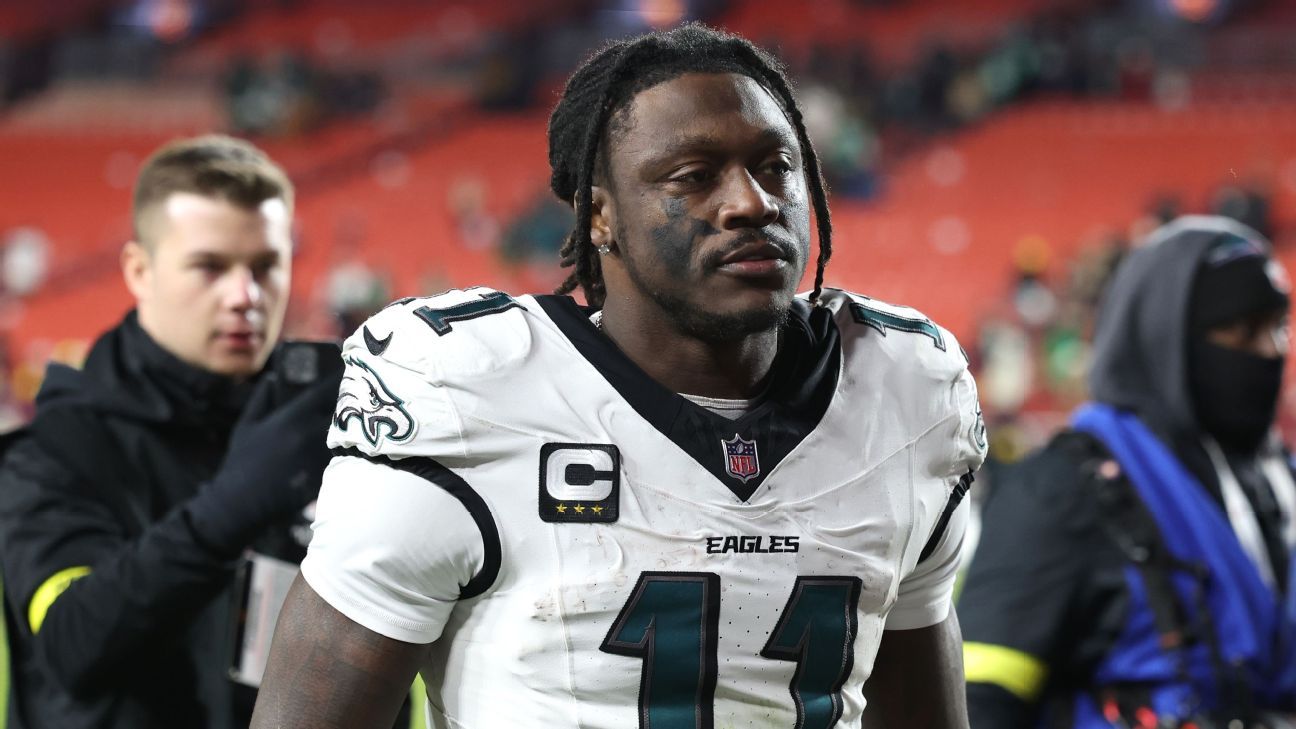
NFL franchises are unable to *formally* complete player exchanges until the fresh league season commences on March 11; nevertheless, preliminary discussions and accord on conditions can be initiated prior to that date. And one prominent athlete, Eagles wide receiver A.J. Brown, is at the core of discussions regarding a potential transfer. Philadelphia’s general manager, Howie Roseman, downplayed any trade discussions in January, but what if Brown genuinely becomes accessible?
We requested NFL analysts Jeremy Fowler, Dan Graziano, Ben Solak, and Seth Walder to assume the role of general manager for four distinct organizations and formulate realistic transfer proposals for Brown. Subsequently, Eagles correspondent Tim McManus was tasked with making a determination based on potential actions by Roseman and the club this offseason.
Here’s an overview of how our market simulation transpired, beginning with some background on Brown’s circumstances and concluding with a judgment on a possible new destination.
Navigate to:
Current status
Four proposals | The conclusion


The latest updates on a possible A.J. Brown player exchange
Brown has arguably been the most outstanding receiver in Eagles history, achieving two seasons with over 1,400 yards and contributing to the team’s two Super Bowl appearances over four years. He also recorded 78 receptions for 1,003 yards and seven touchdowns last season. However, his discontent with the passing game’s deficiencies escalated in 2025 and appeared to influence his performance.
A video emerged in November showing Brown describing his situation as a “s— show,” and he frequently expressed his displeasure before eventually consenting to CEO Jeffrey Lurie’s request to moderate his public statements. The front office recognizes Brown’s crucial role in the Eagles’ prosperity, but they must ascertain whether he will commit to the team’s operations and maintain harmony with quarterback Jalen Hurts moving forward.
Should they become convinced that such alignment is improbable, a transfer might be necessary. The Eagles would incur a dead-cap charge exceeding $40 million if they deal him before June 1, in contrast to less than $20 million in dead cap if a trade is finalized after that date.
Any transaction would initially cause financial strain but would free up capital in the long run. This freed-up money could be utilized to secure new contracts for some of their ascending talents, such as Jalen Carter, Quinyon Mitchell, and Cooper DeJean, who are due for second deals. The organization acquiring Brown would be responsible for his $29 million compensation in 2026 and roughly $4 million in guaranteed funds in 2027, according to the Roster Management System.— Tim McManus, Eagles correspondent
Four hypothetical exchange proposals for Brown

Jeremy Fowler’s proposal:
Why this arrangement is logical:They possess two first-round draft selections (numbers 6 and 24) following the Travis Hunter trade last April. They could utilize the No. 6 pick on an offensive lineman and forward the No. 24 pick to the Eagles in return for Brown. This action would instantly bolster new head coach Todd Monken’s offense, providing the passing game with a legitimate chance to succeed alongside an already formidable defense. Cleveland’s wide receiver corps collectively recorded only 1,467 receiving yards in 2025, the lowest total in the NFL.
Browns general manager Andrew Berry, a former Eagles executive, shares a good working relationship with Roseman. Cleveland has a history of making high-impact receiver trades, having acquired Odell Beckham Jr., Amari Cooper, and Jerry Jeudy during Berry’s tenure. All three athletes registered 1,000-yard seasons in their inaugural year with the Browns.

Dan Graziano’s proposal:
Why this arrangement is logical:Regardless of whether general manager Brandon Beane agrees, quarterback Josh Allen would genuinely benefit from a true primary wide receiver to challenge opposing defenses. Furthermore, Brown’s 2026 contract does not represent an excessive financial commitment for a top-tier wide receiver.
It’s challenging to envision Buffalo acquiring a guaranteed, immediate-impact playmaker at its current first-round draft position. So, why not use that pick to secure an established veteran? Is there a more urgent “win-now” scenario than Buffalo’s? As for the Eagles, obtaining a first-round selection for a 28-year-old wide receiver with only one year of guaranteed remuneration remaining on his agreement does not seem like an unfavorable outcome
return.
1:21
Will A.J. Brown continue to be with the Eagles in the upcoming season?
Jeff Saturday and Dan Graziano discuss if A.J. Brown will remain an active player for the Philadelphia Eagles in the subsequent season.

Ben Solak’s proposition:
Eagles acquire:2027 second-round pick, 2027 fourth-round pick (contingent third-rounder), WR Rashod Bateman
Ravens obtain:Brown
Rationale for this arrangement:A salient insight from the Ravens’ 2025 season was the inadequacy of their current receiving corps. While such a drastic maneuver might not be imperative, they would gain from possessing a wideout with substantial stature and proficiency in contested receptions — an asset quarterback Lamar Jackson has never experienced throughout his seven-year tenure.
Substituting Bateman with Brown would allow the Ravens to grant Brown the workload of a primary receiver and deploy Zay Flowers as a dynamic WR2, a role more congruent with his capabilities. Within Philadelphia, DeVonta Smith is plainly slated to be the top wide receiver; Bateman signifies a quintessential low-risk acquisition by Roseman, targeting a player who had significant draft status but only moderate professional output.
Determining a viable trade compensation for Brown proves challenging, given his limited remaining peak years and the considerable cost for the Eagles to trade him before June 1. Therefore, I’m proposing an agreement focused on 2027 draft assets, encompassing a contingent pick contingent upon achieving 1,000 receiving yards and securing a playoff berth in 2026.

Seth Walder’s proposal:
Eagles obtain:2026 first-round pick (No. 31 overall), 2026 third-round pick (No. 95 overall) and 2026 sixth-round pick
Patriots acquire:Brown, 2026 second-round pick (No. 54 overall)
Justification for this arrangement:The Patriots reached the Super Bowl despite an inadequate receiving corps, with only one individual accumulating more than 600 yards (Stefon Diggs). However, 2026 will present greater difficulty, given their more challenging regular-season schedule and the improbability of the multitude of AFC teams boasting premier quarterbacks yielding once more for New England.
Brown, possessing a positive past association with coach Mike Vrabel in Tennessee, represents a sensible candidate to deliver an immediate enhancement. Despite Brown’s output declining last season, the foundational statistics indicate he maintained an elite caliber. More precisely, he ranked sixth in ESPN’s comprehensive receiver score and placed within the top 10 for open score. Brown comes with a significant cost, yet he would bring considerable worth given his current contract and performance standard. The Patriots are relinquishing their first-round selection in this instance, but it effectively constitutes a substantial downgrade in draft position, as they receive a second-round pick in return.
The conclusion: No proposition is satisfactory
Why would I aim to improve these squads while diminishing my own?This has largely encapsulated Roseman’s disclosed perspective on the matter. Brown is the caliber of athlete one endeavors to obtain, not divest of — and this logic is entirely sound. Thus, were I in the Eagles’ position, I would exert every effort to resolve the predicament — and as long as optimism surpasses apprehension, I would decline all four propositions.
For the sake of this endeavor, let’s presume a transaction is the sole path ahead. Subsequently, I would embrace Fowler’s bid from the Browns, purely due to its inclusion of a superior first-round draft selection (No. 24) compared to Graziano’s offer from the Bills (No. 26). Walder’s suggestion includes a first-round pick but necessitates relinquishing a second-round pick, which would deter me from that Patriots alternative. Furthermore, Solak’s proposition involving the Ravens was intriguing, yet I would not conclude with a first-round selection.
Would there be resistance from Brown’s representatives attempting to secure him a spot on a more established contender than Cleveland? I would surmise as much. However, this serves as a cautionary tale for both sides: the situation elsewhere is not invariably better. Occasionally, it’s merely more dull. —McManus