
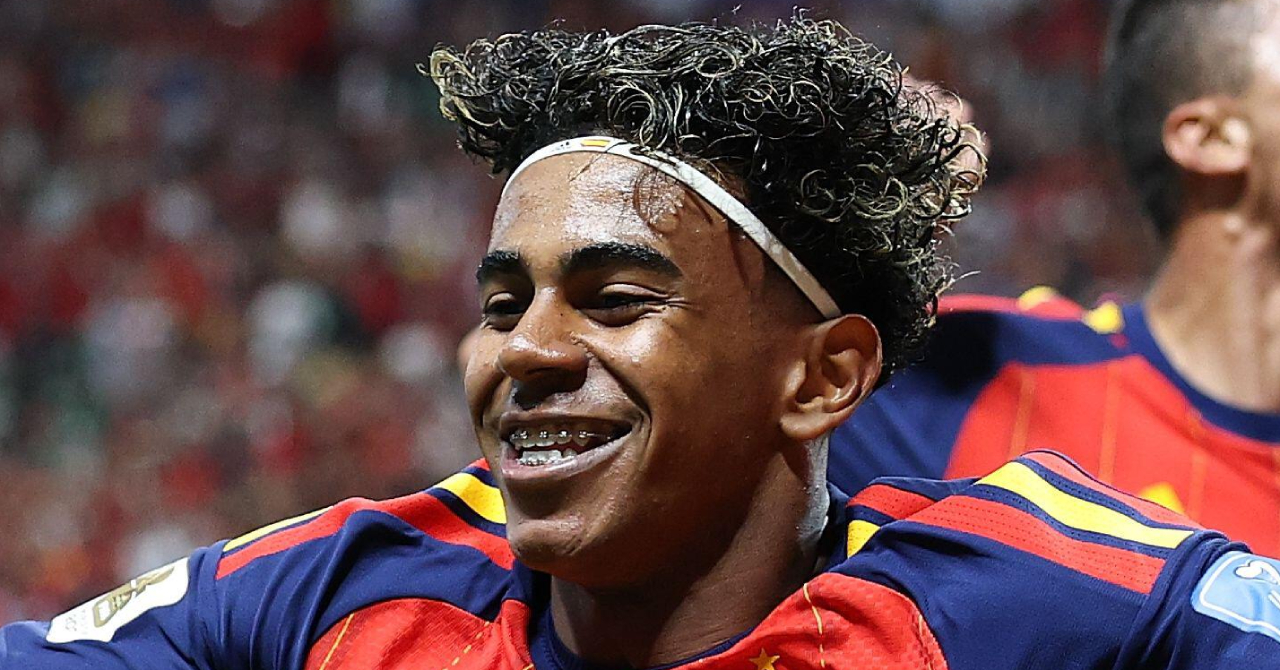
The roar was deafening, a tidal wave of crimson and gold engulfing Madrid. From atop their champions’ bus, Lamine Yamal, barely out of his teens, jabbed a playful, defiant finger at a sign that would send shivers down Argentinian spines: a mocking tribute to Leandro Paredes. The phrase “VELADA DEL AÑO VII, PAREDES VS GAVI” – “Event of the Year VII, Paredes vs. Gavi” – emblazoned on a makeshift banner, was a playful, yet pointed, reminder of the raw, unbridled drama that had unfolded just hours earlier on the global stage. Yamal and teammates, including the ever-grinning Fabian Ruiz, shared a knowing laugh, celebrating not just a World Cup triumph, but the fiery passion that had cemented Spain’s place at the pinnacle of international football.
The champions were in a suitably ecstatic mood as their made their way through the streets before the likes of head coach Luis de la Fuente and full-back Marc Cucurella sung on stage alongside musicians. This wasn’t merely a parade; it was a coronation, a vibrant outpouring of national pride after a tournament that had tested their mettle, their tactics, and ultimately, their collective spirit.
“VELADA DEL AÑO VII, PAREDES VS GAVI”.
Lamine Yamal, pidiendo UNA PELEA DE BOXEO entre ambos jugadores, tras el cruce post Final del Mundo. 😳🇦🇷🇪🇸pic.twitter.com/iBhbgBOYxwhttps://t.co/hW3Lz4d47A
— Ataque Futbolero (@AtaqueFutbolero) July 20, 2026
Barcelona’s electrifying talent, Lamine Yamal, has undeniably etched his name into the annals of football history. His extraordinary eight days began with his 19th birthday last Monday, followed by a masterful performance in Spain’s semi-final victory over France last Tuesday, culminating in a World Cup win in New Jersey that defied expectations and showcased a maturity far beyond his years. His youthful exuberance, combined with blistering pace and an audacious dribbling style, was a constant threat, symbolizing the dawn of a new, fearless era for La Roja.
Spain vs Argentina: The Boiling Point – Paredes and Gavi’s Confrontation
The World Cup final was never going to be a tea party. Pitched against the formidable reigning champions of 2022, Argentina, Spain entered the fray knowing they faced a battle of wills as much as skills. The match was a pulsating, frequently fractious affair, fueled in part by the relentless aggression of Argentina’s midfield general, Enzo Fernandez, whose late second booking for a rash challenge further stoked the already simmering tensions. The midfield became a warzone, tackles flying, words exchanged, and the atmosphere growing increasingly electric with every passing minute.
But it was after Spain’s dramatic extra-time victory, courtesy of Ferran Torres’ 106th-minute golden strike, that tempers finally flared in violent fashion. The final whistle, instead of bringing relief, ignited a powder keg. Boca Juniors midfielder Paredes, his frustration boiling over, confronted Spain counterpart Gavi. What began as an exchange quickly escalated, with Paredes shoving Gavi to the ground in the most noticeable altercation. Players from both sides rushed in, a chaotic melee erupting at the center circle, a truly unedifying but perhaps inevitable end to the most prestigious match in world football, a testament to the raw emotion and immense stakes involved.

Game Highlights: A Battle of Titans
The World Cup final in New Jersey was a masterclass in contrasting styles and sheer willpower. From the opening whistle, Spain, under Luis de la Fuente, sought to impose their signature possession-based game, meticulously probing Argentina’s robust defensive lines. La Albiceleste, meanwhile, reverted to their characteristic blend of tactical discipline and individual brilliance, launching swift, incisive counter-attacks that kept Spain’s backline on high alert. The first half was a tense chess match, with both goalkeepers – Spain’s Unai Simón and Argentina’s Emiliano Martínez – making crucial saves to deny early breakthroughs. Rodri, the Player of the Tournament, was a colossal presence in midfield, orchestrating Spain’s attacks and stifling Argentina’s creativity.
As the game wore on, the physicality intensified. Argentina’s Enzo Fernandez, a dynamo in midfield, was everywhere, but his aggressive approach led to a booking in the first half. The second half saw a more open affair, with both teams pushing for a winner. Close calls from Spain’s Yamal and Argentina’s Julián Álvarez kept fans on the edge of their seats. The pivotal moment of regulation time came when Fernandez, already on a yellow, received a second for a reckless challenge on Gavi, reducing Argentina to ten men in the dying minutes. This tactical shift altered the landscape, forcing Argentina into a more defensive shell and giving Spain the numerical advantage going into extra time.
Extra time was a brutal test of endurance and nerve. Spain, with their extra man, pressed relentlessly. Wave after wave of attacks crashed against Argentina’s heroic defense. Then, in the 106th minute, the moment arrived that would define the tournament: a surging run down the left flank by Marc Cucurella, who delivered a pinpoint cross into the box. There, lurking with predatory instinct, was Ferran Torres. He met the ball with a perfectly timed half-volley, sending it crashing past a despairing Martínez into the back of the net. The stadium erupted; Spain had found their breakthrough. The remaining minutes were a desperate scramble for Argentina and a resilient defensive stand for Spain, culminating in the chaotic post-match scenes that underscored the intensity of the rivalry.
World Cup final 2026: Rodri Hails Redemption Man, Ferran Torres
Player of the tournament Rodri, the orchestrator and defensive shield for Spain, confessed he was lost for words amidst the celebratory chaos, yet his actions spoke volumes. Leading supporter chants for full-back Marc Cucurella, who even showcased his drumming skills, Rodri exemplified the camaraderie within this victorious squad. But it was his heartfelt tribute to Ferran Torres that truly resonated.
“These lads here are amazing,” Rodri declared, his voice thick with emotion, via AS. “I’d like to remember someone very important to me – a player who has been unfairly criticised and who today is a part of Spanish football history: Ferran.” This powerful endorsement from the squad’s most influential player underlined Torres’s journey from a target of public scrutiny to the hero of the World Cup final, a narrative of resilience and ultimate triumph.
De la Fuente, the pragmatic visionary who also led his team to the EURO title two years ago, beamed with pride. He thanked the nation, acknowledging the immense effort behind the scenes. “We are fortunate to have 26 fantastic people who are fantastic footballers,” added the 65-year-old. “The best in the world. It is an honour to manage them and share this moment with my coaching staff. Together, we are stronger – don’t forget that. Long live Spain.” His words painted a picture of a united front, a team forged in the fires of competition and bound by shared ambition.
World Cup 2026: Ferran Torres’s Ecstasy, Pedro Sanchez’s Grand Vision
Barcelona’s Ferran Torres, still radiating the glow of his extra-time heroics, struggled to contain his joy. “I’m so happy to see children enjoying the occasion. We must always keep believing, because everything comes in time,” he told LA 1, reflecting on his arduous path to glory. “I’m literally flying, because we’re back from New York. The goal… everything comes with hard work, and this time it has been like that.” His words were a testament to the power of perseverance, a message that will undoubtedly inspire a generation of aspiring footballers across Spain.
Spain’s prime minister, Pedro Sanchez, clearly caught up in the euphoria, dared to dream even bigger. He suggested that La Roja could add to their two World Cup titles when they co-host the finals with Portugal and Morocco in 2030. “I want to thank the [Spanish Football] Federation. I know it’s a big effort for them to come and share this victory with everyone. A huge thank you to the coaching staff and the players for their performance, their effort and the win. We thoroughly enjoyed watching you play. Why not dream of a third in 2030? Especially with Spain as the host country.” Sanchez’s rallying cry wasn’t just political posturing; it was a reflection of a nation emboldened, ready to cement its place as a footballing superpower for years to come.
Prediction: A Dynasty in the Making?
This Spanish squad, a potent blend of seasoned winners like Rodri and electric youngsters like Lamine Yamal and Gavi, has not only claimed the World Cup but has also laid down a formidable marker for the future. With Luis de la Fuente’s tactical acumen and his ability to foster a cohesive, resilient unit, Spain has established a new era of dominance, mirroring their golden generation of the late 2000s and early 2010s. The core of this team is young, hungry, and technically brilliant. They’ve conquered Europe and now the world. When the World Cup returns to European soil in 2030, with Spain as a co-host, the home advantage and the psychological boost will be immense. The experience gained, the confidence earned, and the sheer talent at their disposal suggest that this is not a flash in the pan. Expect La Roja to be a perennial contender for major honors. My prediction? With the foundations firmly in place and a generation of talent hitting their prime,Spain will not only reach the World Cup final in 2030 on home soil but will lift the trophy once more, solidifying their status as the undisputed footballing dynasty of the 2020s and early 2030s.