
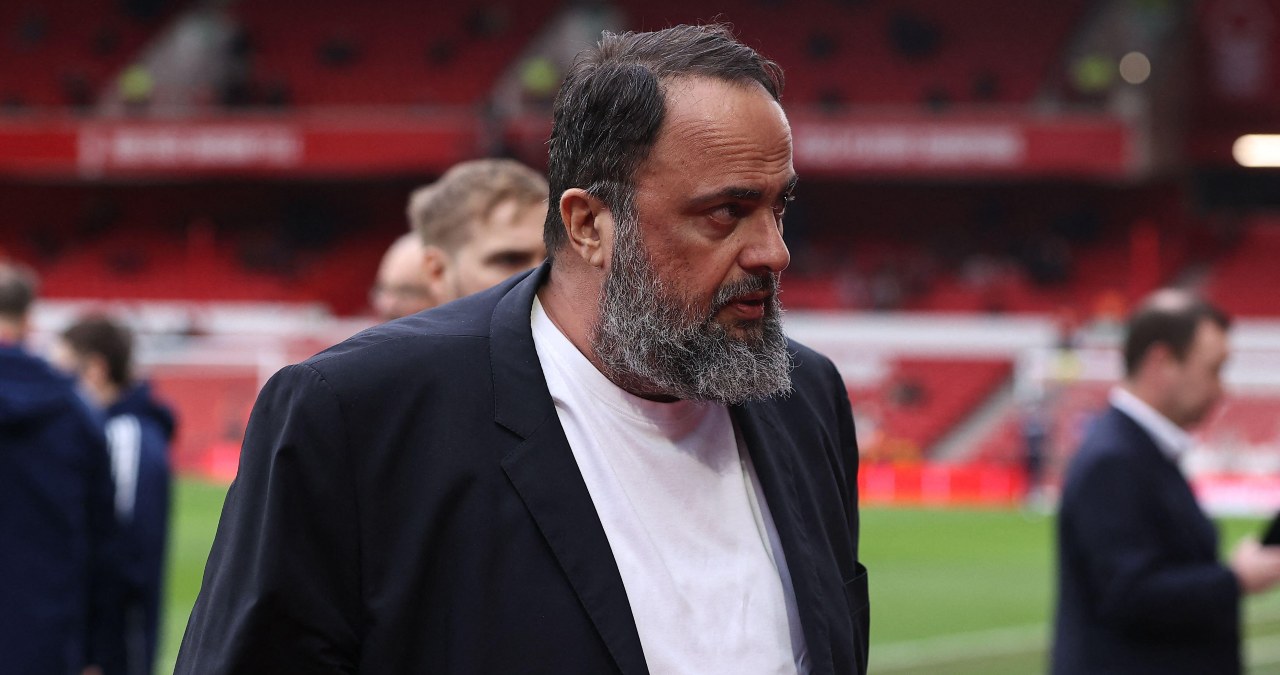
The beautiful game, often lauded for its passion and drama on the pitch, occasionally reveals an ugly underbelly, dragging boardroom battles and legal skirmishes into the spotlight. A seismic legal tremor has just rocked the Premier League, as Nottingham Forest owner Evangelos Marinakis fires a direct legal broadside at Crystal Palace, alleging defamation over a fan banner that has sparked outrage and ignited an already simmering rivalry.
Marinakis’ lawyers officially lodged a defamation claim in the High Court on Monday, with CPFC Limited – the corporate entity behind Crystal Palace Football Club – listed as one of two defendants. The bone of contention? A banner unfurled by Palace fans during a 1-1 Premier League draw at Selhurst Park last August, which starkly depicted Marinakis holding a gun to the head of Forest midfielder Morgan Gibbs-White. The accompanying text, dripping with sardonic irony, read: “Mr Marinakis is not involved in blackmail, match-fixing, drug trafficking or corruption.”
The banner’s message was a thinly veiled, yet potent, reference to historical allegations that have shadowed Marinakis, claims he has vehemently and consistently denied. For a club owner, whose reputation is intrinsically linked to his club’s standing, such imagery and insinuation are not merely provocative; they strike at the very core of his public persona and business integrity. This isn’t just about a football chant; it’s a high-stakes legal challenge questioning the boundaries of fan expression and club responsibility.
The Football Association, ever the arbiter of conduct, had already weighed in. In November 2025, the governing body charged Palace with failing to ensure that supporters did not behave in an improper, offensive, abusive or provocative way. This FA charge, while significant, now seems a precursor to a far more serious and public legal battle that could set precedents for how clubs are held accountable for their fans’ actions, and for the personal reputations of those at the helm of the sport.
Forest and Palace’s Boiling Rivalry: A Deeper Dive
To understand the explosive nature of this lawsuit, one must peel back the layers of a rivalry that has intensified dramatically over the past year. It’s a concoction of on-field clashes, off-field maneuvers, and a specific player saga that has cemented animosity between the two clubs. Morgan Gibbs-White, the talented 26-year-old England international, lies at the heart of one such flashpoint.
Last summer, Gibbs-White looked destined for a move to North London after Tottenham Hotspur reportedly triggered his colossal £60million release clause. It was a transfer that would have sent shockwaves through Forest’s ranks, but in a dramatic twist, Gibbs-White opted to sign a new deal at the City Ground. His decision, announced in a video alongside Marinakis himself, underscored the owner’s personal investment and persuasive power. It was a declaration of loyalty, orchestrated and celebrated, that likely rankled the Eagles, seeing a coveted talent commit his future elsewhere, potentially influenced by an owner known for his hands-on approach.
However, the roots of this burgeoning rivalry run far deeper than player transfers. A pivotal event that truly poisoned the well occurred last season, when Crystal Palace faced the ignominy of demotion from the Europa League to the less prestigious Conference League. The reason? A breach of UEFA’s stringent multi-club ownership rules, designed to maintain the integrity and competitive balance of European competitions. While the specifics of the breach remain complex, the fallout was clear: Palace’s European ambitions were curtailed.
Crucially, reports circulating at the time suggested this decision was made following a formal complaint lodged by none other than Evangelos Marinakis. For Forest, Palace’s misfortune was their gain, as the Reds, who had finished just outside the Europa League spots, were subsequently promoted to the competition as a direct result of Palace’s demotion. This wasn’t just a regulatory decision; it felt like a tactical maneuver, a ‘dagger twist’ delivered from a rival owner, directly impacting Palace’s prestige and financial standing.
The irony, perhaps, is that both clubs went on to enjoy remarkable European campaigns despite the controversy. The Eagles, fuelled by a sense of injustice and perhaps a point to prove, soared through the Conference League, ultimately clinching their first-ever European trophy – a testament to their resilience. Forest, meanwhile, embarked on a memorable Europa League journey, reaching the semi-finals before a valiant exit. These successes, rather than defusing the tension, only added another layer to their competitive fire, ensuring that every future encounter would be charged with a palpable sense of history and grievance.
Game Highlights: Crystal Palace 1-1 Nottingham Forest (August, Selhurst Park)
The match itself, played under the shadow of the burgeoning off-field animosity, was a fiery affair that perfectly encapsulated the brewing tension. Selhurst Park, a cauldron of noise, was particularly vociferous, the Palace faithful making their feelings known even before kick-off. The game exploded into life in the 18th minute when Palace’s electrifying winger, Eberechi Eze, danced past two defenders on the left flank before unleashing a powerful, curling shot that left Forest goalkeeper Dean Henderson with no chance, nestling expertly into the top corner. The eruption from the home crowd was deafening, a release of pent-up energy and an early statement of intent.
Forest, however, are not a side easily intimidated. They battled back with grit, their midfield pressing high and disrupting Palace’s rhythm. The equalizer arrived just after the hour mark, a testament to their tenacity. A well-worked corner routine saw Renan Lodi deliver a pinpoint cross to the towering presence of Willy Boly, who rose highest amidst a sea of bodies to power a header beyond a helpless Vicente Guaita. The away end erupted, a mix of relief and defiance.
The final half-hour was a frantic, end-to-end spectacle. Both sides pushed for a winner, with Palace hitting the post through Odsonne Édouard after a lightning counter-attack, and Gibbs-White himself forcing a spectacular save from Guaita with a venomous strike from distance. Tempers flared in the closing stages, with several robust challenges and a flurry of yellow cards, but ultimately, neither side could find the decisive touch. The 1-1 draw felt like a battle fought to a standstill, reflecting the deeper, unresolved conflict simmering beneath the surface.
The banner, unfurled during this very game, served as a stark visual reminder of the off-pitch drama that had already gripped the two clubs, ensuring the rivalry would only intensify. This wasn’t just a point gained or lost; it was another chapter in a rapidly developing saga of bad blood and bitter grievances.
Prediction: A Long, Thorny Path Ahead
The legal action initiated by Evangelos Marinakis against Crystal Palace is more than just a personal grievance; it’s a significant moment for the Premier League and the broader football landscape. This lawsuit will delve into the complex interplay of freedom of expression, reputation, and the responsibilities of football clubs for the conduct of their supporters. The High Court claim will likely be a protracted affair, potentially setting a precedent for how far clubs can be held liable for defamatory fan behavior and the specific nature of visual defamation.
On the pitch, this legal battle will undoubtedly fuel the fire between Forest and Palace. Future encounters will be imbued with an even greater sense of animosity, turning competitive matches into grudge matches. While legal outcomes are inherently unpredictable, I predict a settlement will eventually be reached out of court, rather than a full trial. The reputational damage and legal costs for both parties, regardless of the verdict, are substantial, and the Premier League will likely encourage a resolution to prevent this from becoming a long-term, public spectacle that overshadows the sport.
However, the emotional scars will remain. For Crystal Palace, this incident serves as a harsh reminder of the need for robust fan behavior policies and proactive engagement. For Nottingham Forest and Marinakis, it underscores the intensity with which club owners are scrutinised and the lengths they will go to protect their image. The rivalry between these two clubs, forged in the fires of European demotion and now cemented by legal action, is here to stay. Expect future fixtures to be must-watch events, where every tackle, every goal, and every fan display will be analysed under a microscope. The Beautiful Game, it seems, just got a whole lot uglier, and a whole lot more fascinating.