
The medal stage of the 2026 men’s Olympic hockey tournament has commenced, and what an event it has proven to be. It has been utterly captivating from start to finish in the initial phase, featuring unexpected discussion points and anticipated excellence from the foremost ice hockey athletes globally.
To put it plainly, the Olympic Games are enhanced by the involvement of NHL athletes. There is no other competition where the elite competitors can partake to represent their countries with such high stakes. Not all players can attend the IIHF world championships in the spring, and evidently, not every country took part in last year’s 4 Nations Face-Off.
Across time, numerous athletes have discovered a heightened level of performance while representing their country on the grandest platform. There are individuals accustomed to significant responsibilities on their NHL teams who assume more minor international duties, and their performance subsequently declines.
As the medal stage approaches, the rankings appear somewhat divergent from widespread predictions. Sweden and Finland encountered difficulties at different junctures, Slovakia and Switzerland exceeded their anticipated achievements, and there’s a sense that one or two surprising victories are developing as the competition reaches its peak.
Presented below are the notable performers and the letdowns from the pool stage, with the elimination phase next on the agenda.
The standouts
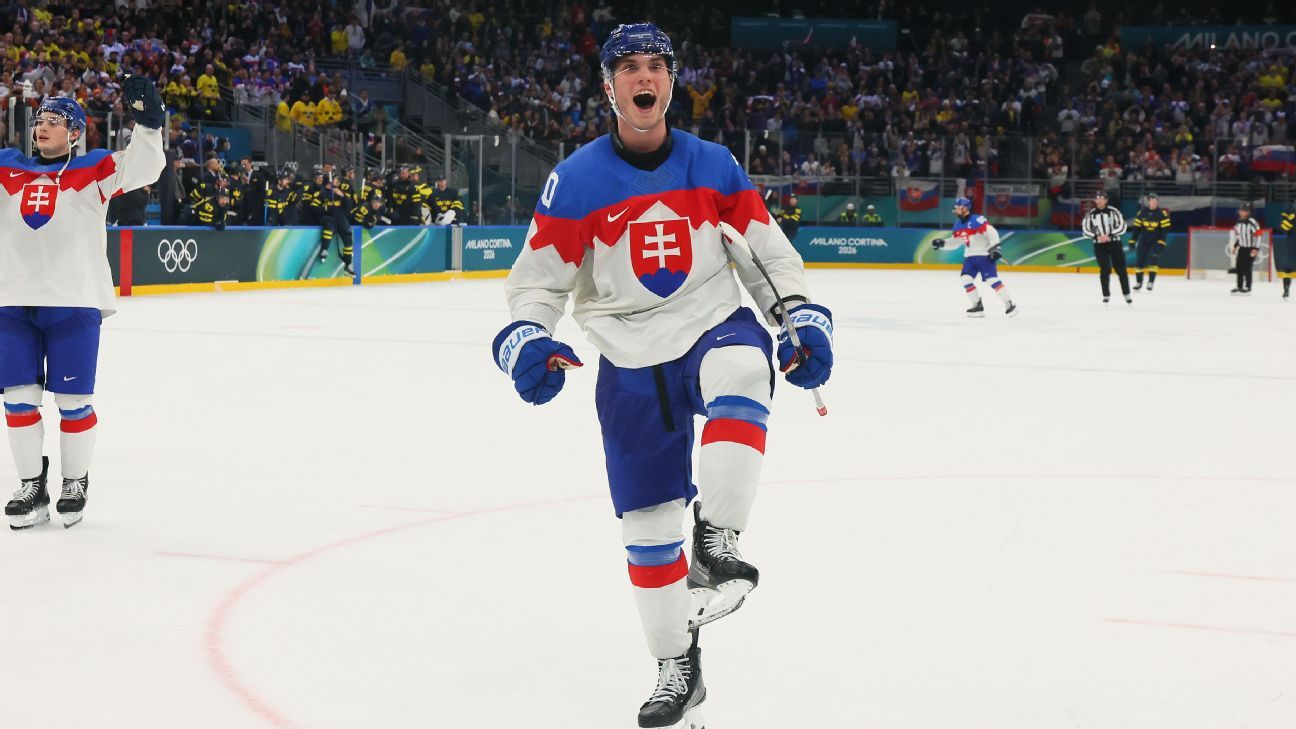
In the piece discussing the tournament’s pivotal elements, I mentioned that the upcoming generation of Slovakian ice hockey would need to spearhead the effort. Slafkovsky has emerged as among the competition’s premier athletes, exceedingly impressive for Slovakia. Joint second in the event’s scoring with six tallies, Slafkovsky has served as the driving force.
He has matured into an effective power forward over the past 18 months, and though he has consistently delivered strong performances in international contests, he has advanced his game further at the Olympic Games. He is at the forefront for Slovakia in terms of points, attempts on goal, close-range shots, and offensive opportunities. He has generated offense during crucial moments, netting the initial score and the securing goal against Finland, and engineering the vital third goal in the latter stages against Sweden. He’s not merely the prospect of Slovakian hockey, he is the contemporary reality.
Slovakia found itself in the most challenging bracket, along with Sweden and Finland, and triumphed, securing the No. 3 seed for the knockout stage. This proved surprising. It seems that apprehensions regarding the decline of Slovakian hockey have been significantly overstated.
Samuel Hlavaj has performed exceptionally well as goaltender for Slovakia, boasting a .934 save percentage, and he was especially outstanding against Finland. Hlavaj’s performance has resulted in a favorable placement that will see Slovakia play either Germany or France in the quarterfinal, with a strong likelihood of securing a spot in the semifinals.
Slovakia has surpassed anticipations during the initial stage and has a genuine opportunity to become the underdog success story of the Olympics. A semifinal appearance in a premier competition would be an immense achievement for Slovakian hockey — and a groundwork for future development with its youthful core of skilled players.
The first overall picks
Aside from Slafkovsky (2022), the top draft selections are excelling in the competition. The leading five point-getters in the event were previous first overall selections. Connor McDavid (2015) has been the premier athlete in the competition, tallying a point every frame. Macklin Celebrini (2024) and Sidney Crosby (2005) are level with Slafkovsky at six points. Auston Matthews (2016) and Nathan MacKinnon (2013) have five points across the initial phase.
McDavid is at the forefront of the competition for scoring and offensive opportunity generation. His velocity has been a pivotal factor, and his capacity to attract opposing players and execute maneuvers has fueled Canada’s scoring outburst. The pairing of MacKinnon’s and McDavid’s swiftness has demonstrated itself as a defender’s worst fear, and Celebrini’s intelligent off-puck movement has rendered him the ideal counterpart. If those three maintain their present standard of play, halting them will represent a monumental, possibly insurmountable, challenge.
Despite all the discussion concerning Matthews’ slump over the past few months, he paces the United States in goals, points, close-range attempts, and offensive opportunities. He’s generating offense from quick transitions and sustained pressure, he’s causing disruption in front of the net, and he has been a key target in defensive assignments. Matthews had been showing improved form for Toronto preceding the Olympic Games, and his performance has extended into the competition.
Considering the U.S. excluded potent offensive talents such as Jason Robertson and Cole Caufield from their lineup, his revitalization occurred at the most crucial juncture. If the United States is going to navigate the challenging medal stage, Matthews must persist in generating offense and scoring during pivotal moments.
1:16
USA men’s hockey faces challenging road ahead
Greg Wyshynski breaks down the U.S. men’s hockey team’s potential path to Olympic gold.
Leonardo Genoni turns back the clock
A considerable number might not have recognized Genoni before this event, but this marks not his initial instance of exceptional play for Switzerland in international contests. The 38-year-old has been outstanding for Switzerland and the primary factor behind the squad’s fifth-place conclusion in the initial stage. Boasting a save percentage of .949 and thwarting 2.5 additional goals beyond anticipation through three games, Genoni has served as the pillar of Switzerland’s accomplishments.
Genoni conceded three goals versus Czechia and posted a shutout against France, while being rested for the game against Canada. Genoni will be the primary netminder in the medal stage, and should the Swiss fulfill predictions and defeat Italy, Genoni will likely confront a substantial quantity of offensive opportunities from Finland in the quarterfinal.
If the Swiss were to then subsequently surprise Finland, a matchup against Canada or the United States probably lies ahead. Genoni would be under enormous pressure to maintain Switzerland in contention, a feat he is competent at achieving. He has already
been one of the preeminent netminders – and a compelling narrative of the tournament – in what could conceivably be his final Olympic appearance for Switzerland.
Disappointments
Sweden: From coaching to goalies
Should anyone have accurately foreseen Sweden’s third-place group finish, kindly forward your lottery numbers my way. With Finland missing the injured Aleksander Barkov and Slovakia lacking substantial depth, numerous observers had anticipated Sweden would earn a direct passage to the quarterfinals. Not only did this fail to materialize, but Sweden is also on a collision course for a quarterfinal face-off with the United States, assuming their expected triumph over Latvia.
The Tre Kroner have committed numerous missteps, beginning with their coaching staff.
Filip Forsberg, who stands fourth in seasonal scoring among Swedish forwards, unaccountably commenced the tournament as the 13th forward. Across the preliminary round, Forsberg leads in slot shots and offensive contributions per 60 minutes, and ranks second in inner slot shots per 60 among Swedish forwards. Nevertheless … his ice time places him 14th.
Sweden has found it challenging to generate scoring opportunities against lesser adversaries, and Forsberg’s offensive prowess might have proven beneficial. For Sweden to contend for a medal, he needs to be utilized far more strategically and with greater frequency. Sweden possesses sufficient depth to field three offensive lines, and while there is a valid case for Forsberg’s inclusion in the top six, assigning him anything less than a third-line position to foster supplementary offense would constitute a considerable oversight by the Swedish coaching personnel.
The goaltending has proven largely unsatisfactory, and it is astonishing that coach Sam Hallam chose Jacob Markstrom instead of Jesper Wallstedt, considering their individual season performances. Filip Gustavsson has been calamitous in net, with concerning errors against Italy and difficulties during the defeat to their primary rival, Finland. Hallam’s decision to start Markstrom for a pivotal third game, rather than his younger netminder, proved costly. That choice probably determined the outcome between securing a direct quarterfinal berth and confronting the United States.
With two unreliable netminders, Hallam confronts a dilemma: Anticipate one of them rediscovering their form — or rely on an NHL newcomer who has been inactive for over two weeks.
Switzerland commenced the competition with a remote possibility of securing a medal and still retains an opportunity to claim one. The squad’s NHL-caliber talent, spearheaded by Fiala, largely fueled these expectations.
Regrettably, his tournament — and NHL season — was abruptly cut short due to an unfortunate collision in the concluding moments against Canada. Fiala was removed from the ice on a stretcher after a tangle with Tom Wilson and necessitated surgical intervention for his lower leg.
This represents a considerable detriment to Switzerland, as Fiala was performing on the primary line alongside Timo Meier and Nico Hischier, shouldering the scoring burden.
Fiala’s injury highlighted the issue of NHL player involvement, with NHL club owners apprehensive about player participation precisely for such occurrences. Though there is optimism that Fiala’s injury will not provoke a strong reaction among owners, there is a tangible concern that it might influence future Olympic involvement beyond the collectively agreed-upon 2030 Games.
Our best wishes accompany Fiala in his recuperation, while devotees of hockey trust this will not imperil NHL involvement in subsequent Olympics. Such an outcome would prove to be the most disheartening of all.